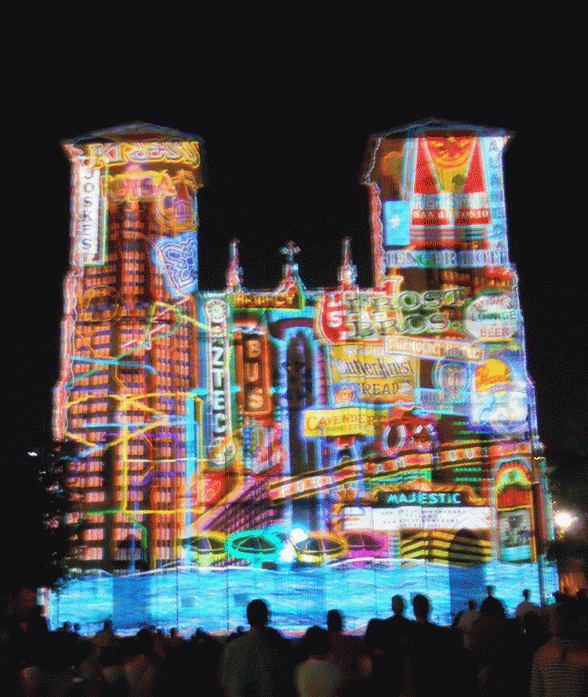
The Recipe for ‘Unchopping a Tree’


unchopping

But actually, without branches
or roots, it wouldn’t be a tree.
I mean, it would just be a log.

Wallace Shawn in My Dinner with Andre, 1981

Unchopping a Tree.

The title of the book published in 2014 by Trinity University Press immediately conveys the message inside.

Despite the promise of the title and your wish for it to be possible, you know it is not. W.S. Merwin almost could have stopped there – a perfect reduction of words to express concern for the environment.

But your desire to believe a toppled tree could be healed in a magical way that “all the king’s horses and all the king’s men” failed to achieve for Humpty Dumpty and the lyrical prose of the Pulitzer-Prize-winning writer entice you inward:

Start with the leaves, the small twigs, and the nest that have been shaken, ripped, or broken off by the fall….

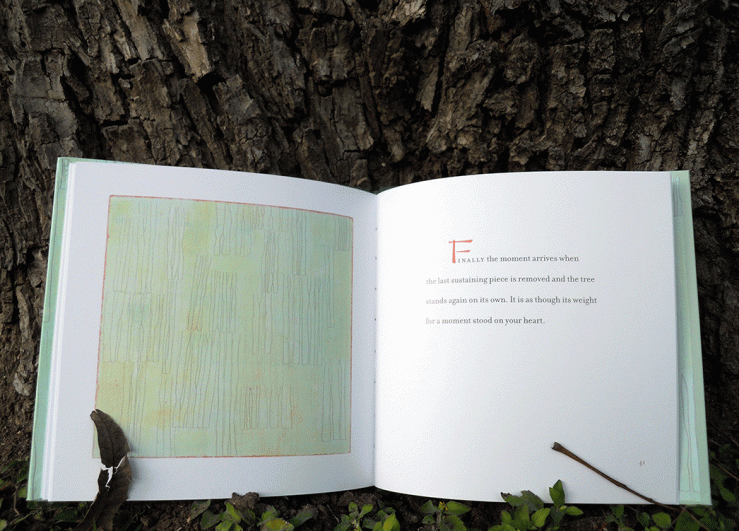
The soothing silverpoint drawings illuminating the inner cellular life of trees by Liz Ward, a professor of art at Trinity University, lessen the fear of approaching the immensity of the task of righting a tree.
inside

Finally the moment arrives when the last sustaining piece is removed and the tree stands again on its own. It is as though its weight for a moment stood on your heart.

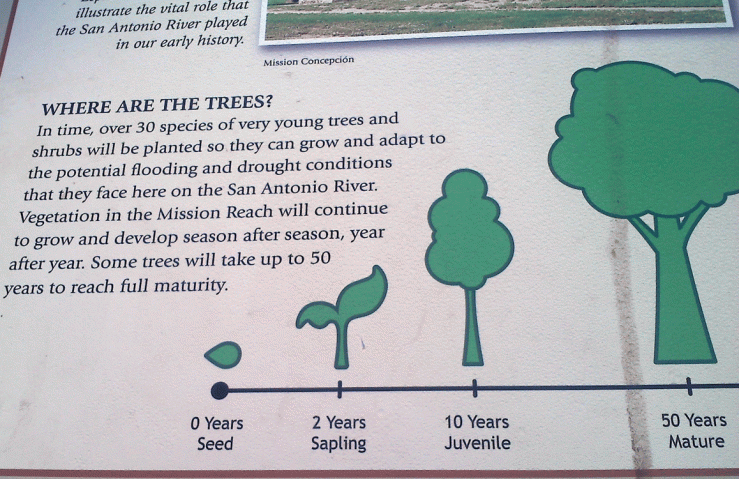
Walking the Mission Reach along the banks of the San Antonio River as it wends its way southward makes one wish all the towering trees that shaded the river for centuries before mid-20th-century bulldozers eradicated them for flood control could be “unchopped.”

Alas, the dictionary fails to include the word in its inventory of things that can be undone for obvious reasons.

So great patience is required as the San Antonio River Authority painstakingly strives to restore the natural habitat, sapling by sapling.
tree-sign

A Chinese proverb reminds us:

One generation plants the trees;

another gets the shade.

For, to heal our environment, as Merwin advises in Unchopping a Tree:

Everything is going to have to be put back.

March 16, 2019, Update:

Mr. Merwin’s ardor for the natural world took frequent root in his poetry….

Stylistically, Mr. Merwin’s mature work was known for metrical promiscuity; stark, sometimes epigrammatic language….

Lawrence Lieberman wrote…. “The poems must be read very slowly, since most of their uncanny power is hidden in overtones that must be listened for in silences between lines, and still stranger silences within lines.”

“W.S. Merwin, Poet of Life’s Evanescence, Dies at 91,” Margalit Fox, The New York TimesMarch 15, 2019
Biannual round-up of what postcards you read most

cathedral6Every six months it’s good for me to check back to see what type of post you have been reading during the past 12 months. As usual, you are all over the map, leaving me free to continue selecting topics arbitrarily.

It makes sense that blog-readers love libraries; the most read post expressed concerns affecting funding of the San Antonio Public Library. The mystery surrounding the murder of Helen Madarasz in Brackenridge Park rose to second in popularity, and there are those who pine to hear the San Antonio Song. A few new posts pushed aside several long-time favorites, and, for some reason, you dug deep in the archives to resurrect a couple that had not been read for quite a while.

The number in parentheses represents the rankings from six months ago:

  1. The danger of playing hardball with our Library: Bookworms tend to vote, 2014
  2. The Madarasz Murder Mystery: Might Helen Haunt Brackenridge Park?, 2012 (7)
  3. Please put this song on Tony’s pony and make it ride away, 2010 (5)
  4. The Tragic Rule of Maximilian and Carlota in Mexico, 2014 (10)
  5. Remembering everyday people: Our rural heritage merits attention, 2014
  6. Picturing the City’s Past Just Got Easier, 2014
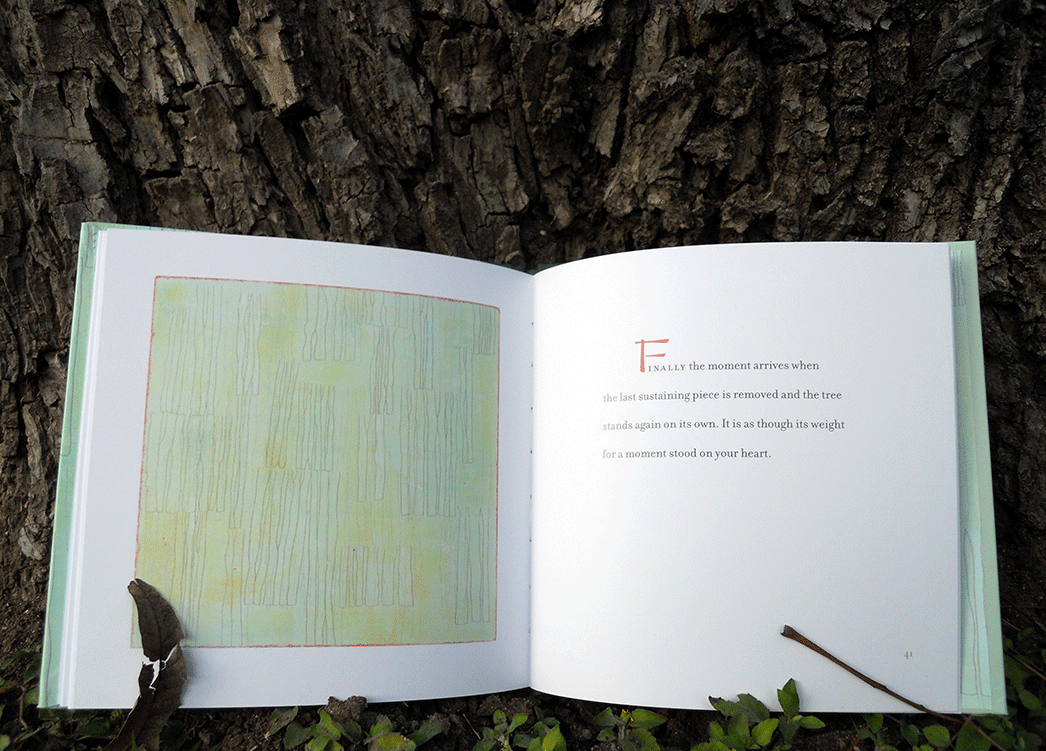
  7. Seeing San Fernando Cathedral in a new light…, 2014
  8. Postcard from San Miguel de Allende: Sun rises again at La Aurora, 2014 (9)
  9. “Nuit of the Living Dead” (8), 2010
  10. How would you feel about the Alamo with a crewcut?, 2011
  11. That Crabby Old Colonel Cribby Condemned the River to Years of Lowlife, 2013
  12. Postcards from San Miguel de Allende: Redirecting Graffiti Artists, Part Four, 2014

Thanks for dropping by every once in a while and for giving me permission to keep rambling on about whatever I’m currently pondering.

And best wishes throughout the coming year.

Quinze’s “Wind” to blow on the Mission Reach of the San Antonio River

A month in the searing desert sun building a huge wooden structure.

A mere four days to enjoy it. Then setting it ablaze.

“It is not that easy to burn your own installation down,” said artist Arne Quinze during a June 2013 lecture sponsored by the San Antonio River Foundation at the San Antonio Museum of Art. “I still have goosebumps from it.” While an estimated 50,000 people witnessed the conflagration at the 2006 Burning Man Festival in Nevada, “The day after, nothing was left over.”

The Belgian artist’s first public art took the form of graffiti, but his work evolved into large-scale three-dimensional structures, often installed in urban settings, including Nice, Shanghai, Rio de Janeiro, Brussels, Rouen and Beirut. Quinze views cities as “open-air museums,” with art teaching “you to look at the world in a different way.”

Many of his installations are temporal, although not as fleeting as the one in Nevada. His installations sometimes spark controversy, but, by the time they are removed, there are public protests. “When we take it down, the space is more empty than before,” he said. “It makes them realize the importance of art in their lives.”

wind
example of a “pillar” of wind

The artist is drawn to strong hues of red and orange because they are “full of contradictions – a fire burns or warms; blood means life or death.” His series of “Wind” sculptures seem to follow that predilection. On his website, he describes the elements he installs in the landscape as representing “the frozen movement of wind going through a grass field, a sculpture waving like leaves in the sun.”

berg's-mill
Berg’s Mill
san-juan-today-2
Mission San Juan Capistrano

Perhaps that is what makes “Wind” most fitting for the rural river setting chosen by the River Foundation for his installation. His monumental blades of wind will serve as a gateway transitioning and leading people up from the river to the area where the ruins of the historic Berg’s Mill community are perched on the left and Mission San Juan Capistrano lies ahead on the right.

“Wind,” according to Quinze’s website, is designed to: “evoke emotion, spark conversation and make people stop in their tracks. They will be attracted to explore this surreal experience of the shadow and sunlight shining through the fixed pillars….”

To contribute to public art projects along the Mission Reach and the development of Confluence Park, visit the website of the San Antonio River Foundation.

Looking forward to being stopped in my tracks in 2015.

April 20, 2015, Update: Noticed that Arne has more site-specific renderings for his “Wind” installation posted online now.

And this is from the April 2015 River Reach, published by the San Antonio River Authority:

arne-at-san-juan

October 20, 2015, Update:

Artist Lecture: Arne Quinze will talk about “Wind” installation, his first permanent public art piece in the United States, at Blue Star at 6:30 p.m. on Thursday, October 22.

Sculpture Unveiling: Mission San Juan Portal will be unveiled at 10 a.m. on Wednesday, October 28.