Weather Forecast: 11 Days of Confetti Showers Ahead

more-pics
Royalty from Fiesta San Jacinto, 1915

Thousands of eggshells from February’s Cowboy Breakfast are recycled annually by volunteers from the San Antonio Conservation Society who stuff them full of colored confetti, transforming them into cascarones to crack over the head of revelers at A Night in Old San Antonio. During NIOSA alone, 200,000 cascarones are cracked. Can’t imagine what the overall total is for the entire 11-day run of Fiesta San Antonio, April 16 through 26.

Although San Antonians continue to exuberantly embrace the more than 100 events packing the calendar, few pause to remember the origins of Fiesta. The festival was founded as a salute to the Texian victory at the Battle of San Jacinto on April 21, 1836.

Perhaps a reporter, though, writing a century ago in the San Antonio Light best summarized what the annual event means for natives: it transports San Antonians “from the prosaic, work-a-day world to a wonderful fairyland” – a ten-day escape from reality.

King Antonio I, 1915, San Antonio Light

The year 1915 was the first year the king assumed the name of King Antonio. Following his ceremonious arrival aboard a whistle-blowing Southern Pacific train, Dr. T.T. Jackson’s chariot drawn by six milk-white horses transported him to Alamo Plaza to kick off Fiesta San Jacinto.
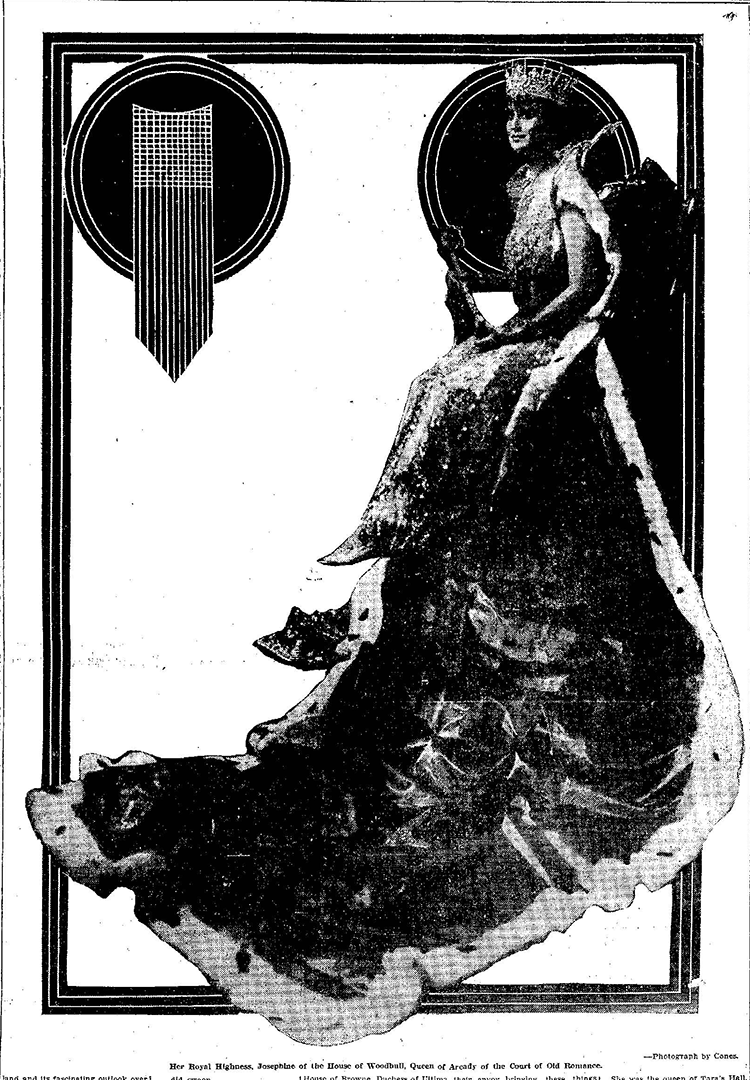
Queen of Arcady, 1915, San Antonio Light

Later in the week, Josephine Woodhull was crowned as “Her Majesty, the Queen of Arcady” at the Majestic Theater. She wielded her scepter over the “Court of Old Romance.” Edged in ermine, her peacock blue velvet train was embroidered heavily with gems, shimmering as a peacock’s feathers.

Numerous parades filled the week, including the “Pageant of Caliph,” a burlesque night parade staged by the Fiesta Association. The first float in 1915 bore the “Duchess of Frijoles,” satirizing the high society coronation of the prior evening. Politicians, local to international, received “a goodly share of ‘guying,’” including a “Floating Vote” float with politicians portrayed aboard as “pulling the strings.”

A century ago, the Battle of Flowers Parade represented the high point of the week, with floats and carriages laden with thousands of fresh flowers. During the mock battle circling Alamo Plaza, even visiting Governor “Pa” Ferguson was pelted with flowers.

battle-of-flowers-11

Somehow, the flower-pelting tradition was allowed to continue, despite its tumultuous first year. The following is pulled from a post from several years ago. Sarah Reveley transcribed the description of the 1891 melee from an April 25, 1891, edition of the San Antonio Daily Light:

…The procession contained over 100 carriages and other vehicles, all gaily decorated and many containing decorations of real artistic merit. Mr. Madarasz’s carriage, decked in pure white lilies and variegated grasses, with honeysuckle was plain, pretty and neat. Col. H. B. Andrews’ pony phaeton, with four Shetlands drawing it, was exquisite, and J. J. Stevens’ children in a four-in-hand Shetland surrey, representing a yacht, was also very pretty….

On arriving at the plaza the police divided the procession into two lines, each half going in opposite directions and passing around the park were brought, face to face with each other. The crowd on foot pressed the carriages closely and the fight began and waged furiously for nearly an hour. The occupants of the carriages had all the ammunition while those on foot had none. They began picking the fallen roses from the pavement, and even tore off the trimmings of the carriages, and soon had the best of the fight.  Heavy bunches of laurel thrown soon had their effect, and many ladies lost their temper and used their carriage whips indiscriminately on the crowd. One lady struck Mr. Doc Fitzgerald, a passive spectator, a severe blow on the face with her whip, but did not see fit to apologize for her mistake. Mr. H. P. Drought made an ugly cut with his whip into the crowd…. One young angel with white wings appealed to the crowd for protection from the missiles saying, “I wish you men would make them quit….”

The police were powerless to keep the people off the park beds, and prevent them from tearing off the flowers. One outright fight occurred. Mr. Phil Shook, one of the horseback party, lost his temper, and cutting a man in the face with his riding whip, was assaulted, and a fist fight on the pavement resulted. Both combatants were arrested by the police. Mr. Charley Baker used his umbrella for defense. While the crowd was very dense on the plaza, waiting for the procession to come along, Mr. Cristoph Pfeuffer’s splendid team and carriage took fright on South Alamo street, at an electric car. The carriage was decorated and contained several ladies, a child and the driver. Dashing into Alamo street, past and into the crowd of people and vehicles, it overturned a buggy and horse at the corner, and its driver jumped out and was dragged under the carriage by the lines. The lady on the front seat caught one of the lines and held it, but the horses made straight for the crowd of women and children in the park and struck a very deep mass of them, it being impossible for them to move out of the way. The ladies were thrown out and their clothing was badly torn. One little boy was knocked senseless, another was bruised, and one little girl had her apron torn off.  Other children were trampled by the frightened people. The plunging horses were secured and the carriage was taken to a side street….

Some irrepressible small boys arranged a dog fight in the midst of an interested crowd of spectators, during the battle, and a regular stampede ensued. Some of the combatants whose supply of ammunition had exhausted, resorted to buggy robes and quirts for aggressive warfare, and umbrellas and parasols for the defensive….

The battle was a success, but if it is given next year, more police will be needed, carriages must not be allowed on the plaza at all, and the participants must not lose their temper.

Let the chaotic merriment begin. Viva Fiesta!

Picturing the City’s Past Just Got Easier

sacs-libraryTucked away on the top floor of the Anton Wulff House, the headquarters of the San Antonio Conservation Society, is a library. This library is stuffed with all things San Antonio – 3,900 books, historic maps, oral histories, 13,000 photographs – tracing the city’s past.

Although the library is only open 24 hours a week, this valuable resource has thrown open its doors to researchers everywhere. Not only is the collection catalog online so researchers know what is available, but 475 of the library’s historical photographs have been scanned in for viewing. These are photos difficult to share even in person because they require white-glove treatment for preservation purposes.

The society’s entire Raba Collection has been digitalized. Taken or reproduced by Bohemian-born photographer Ernst W. Raba (1874-1951), these images document the physical attributes of the city, and some of its citizens, between the 1850s and 1930s. Additional rare images now available online focus on events, from everyday scenes to historic ones.

birdsellers

According to Librarian Beth Standiford in the Conservation Society’s newsletter, The Preservation Advocate, this first step toward making the library’s collection more accessible was made possible with Capital Club funds. These gifts are provided by “friends” and include recent large donations from H-E-B; GLI Distributing, Inc.; Valero Energy Foundation; Jabby Lowe; Ann Griffith Ash; Kathleen and Curtis Gunn, Jr.; The Steve and Marty Hixon Family Foundation; Karen and Tim Hixon; The Joan and Herb Kelleher Charitable Foundation; Patsy Pittman Light; and JoAnn Boone and Rio San Antonio Cruises.

The Capital Club allowed the society to hire intern Elizabeth Pople to scan these initial photographs, add them to the online catalog and improve descriptions of them. As additional funds are available, the library will enter these into the template for uploading to the University of North Texas’ Portal to Texas History to broaden access. Future plans also include using Virtual Exhibit software to create online photo exhibits and to begin digitizing the 1982 San Antonio Downtown Historic Resources Survey.

Part of the purpose of the San Antonio Conservation Society is:

…to keep the history of Texas legible and intact to educate the public, especially the youth of today and tomorrow with knowledge of our inherited regional values.

This project certainly fits the bill by making a giant leap in the number of people who can be made aware of the rich heritage of the city. Awareness of San Antonio’s historical assets leads to appreciation of them. If they are appreciated, they are preserved without question – no need to resort to expensive legal battles or to throw oneself in front of bulldozers Wanda-Ford-style.

As someone who spends much time digging through historical graveyards of all kinds, my hat’s off in gratitude to contributors to the Capital Club at all levels. Good friends can be hard to find, but here’s hoping the society finds additional generous ones to further these efforts.


The Alamo: I’ve never been much of a fan of crewcuts

In light of current discussions focusing on the fate of Alamo Plaza (read Express-News article), thought this Alamobsessive blogger would take a shortcut to an earlier “crewcut” post. Based on the article, sure am a fan of President Sue Ann’s stand on behalf of the San Antonio Conservation Society.

“How would you feel about the Alamo with a crewcut?’ was posted in August of 2011:

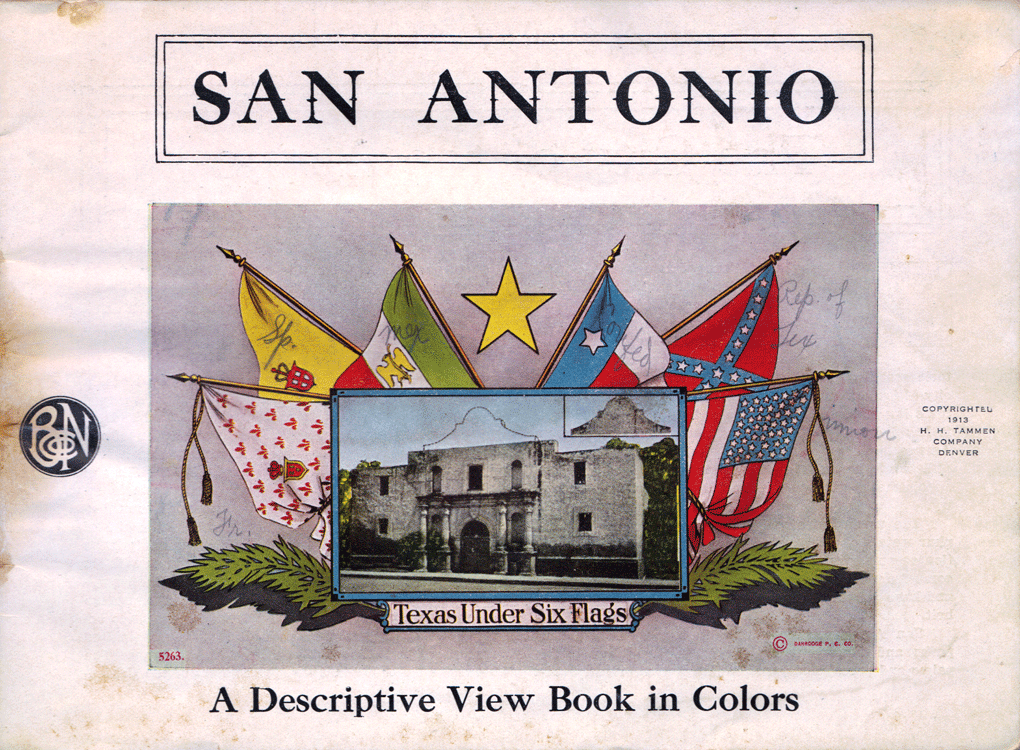
The treatment of the Alamo on the frontispiece of San Antonio, a 1913 “Descriptive View Book in Colors” – a birthday present from a friend – caught my eye with its unusually frank acknowledgement of the major alteration of the facade of the former Mission San Antonio de Valero.

The frontispiece of this booklet showed the Alamo with the added architectural frontispiece removed.

The distinguished curving outline of the facade has become a symbol not only of the battle that took place there in 1836, but of the city itself. The widely replicated outline, commercialized into many a business logo, is recognized worldwide.

But the distinctive parapet was not part of the original church built nearly 300 years ago; nor was it there during the famous battle in 1836.

According to the Handbook of Texas Online, the curvilinear addition is thought to have been the brainchild of an architect and builder by the name of John M. Friese, who designed the Menger Hotel next door to the Alamo a few years later. Friese’s client was the United States Army, which was renting the former mission from the Catholic Church. The project fell under the supervision of Major Edwin Burr Babbitt, assistant quartermaster for the post. According to the Handbook, Major Babbitt actually wanted to tear the Alamo down and erect a completely new building. General Thomas S. Jesup vetoed that idea, fortunately for today’s tourism industry, and the parapet was added in 1850 as part of the adaptation of the building for the Army’s needs.

Through the years, many changes have taken place on the plaza in front of the Alamo, the plaza that was enclosed by crumbling mission walls at the time of the battle.

A group has emerged with plans to recapture those grounds from the city that has encroached upon them. The Texas History Center at Alamo Plaza, Inc., has developed elaborate presentations for what it calls the Alamo Restoration Project.

The stated goal of this proposed project is:

to enhance the visitor’s pilgrimage to the “Cradle of Texas Liberty” by providing a historic atmosphere for personal reflection, inspiration, and learning. We encourage people to seek out their heritage, explore the rich and diverse history of the region, and immerse themselves with the texture of the past.

While this sounds noble on the surface, there are some who think the part of this site’s “heritage” and “diverse history” that is more important than a lost battle might be its much earlier role as a mission outpost.

Another major issue is the problem of a historic landmark built atop of the original western wall of the mission compound. The handsome Crockett Block, designed by architect Alfred Giles, was built only 30 years after the Army added the parapet to the Alamo. The project’s plan is to simply move the massive building, as The Fairmount was relocated in 1985.

What would be left would be a huge open footprint of the grounds at the time of the 1836 battle, but what I see is hot. There are just not many days of the year where people are going to want to stand in the middle of a treeless, shadeless plaza contemplating the battle. Five minutes in the middle of the plaza on a day like today would be more than enough to make one pray for the return of the raspa vendors.

To accomplish this restoration project would mean major battles with not just the Daughters of the Republic of Texas but also with the yellow-hatted ladies of the Battle of Flowers Association, whose parade has a strong historical connection to Alamo Plaza.

While there are pictures on the group’s website showing the Alamo without the added parapet, there is nothing written online that I see calling for its removal. But, to be true to the group’s goals, it obviously should be.

Calling attention to the need for better treatment and interpretation of our most famous tourist site is worthwhile, but stripping the area back to the battle era seems extreme.

And, would San Antonians ever be willing to let go of that distinctive frontispiece for an Alamo with a crewcut? If nothing else above were, those seem like fighting words to me.