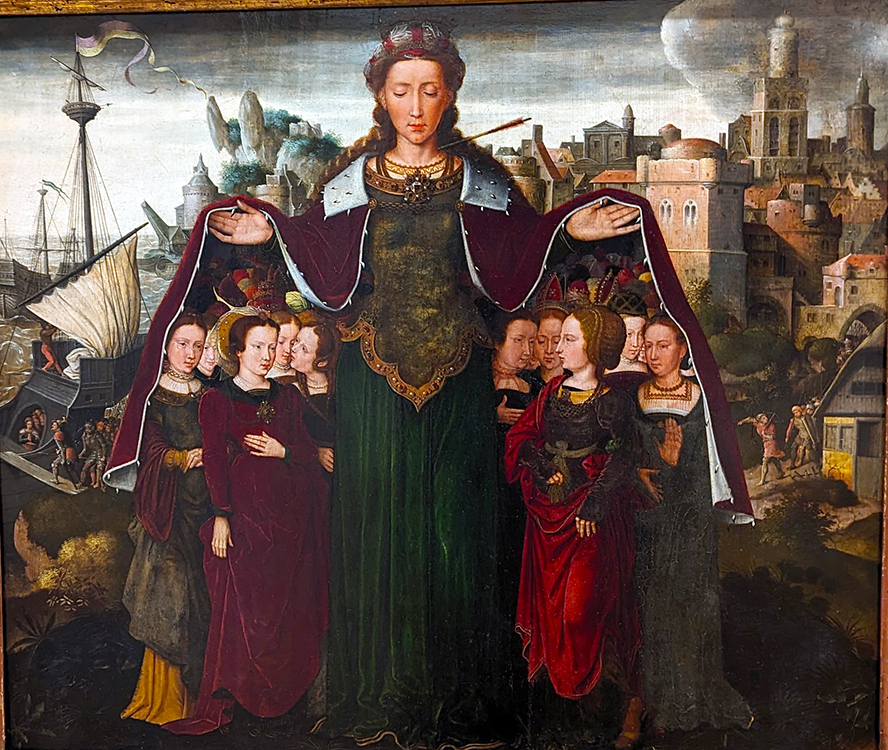
Above: “Saint Ursula and the 11,000 Virgins,” Pieter Claeissens, 1560
Pieter Claeissens’s painting hanging in Museo de Bellas Artes de Asturias attracted my attention because of my unfamiliarity with Saint Ursula. According to legend, 11,000 handmaidens of Princess Ursula set sail with her from southern England on a journey to marry the pagan to whom her father had betrothed her. The ship was blown off course, so Ursula and her entourage decided on an extended pilgrimage to Italy first. Huns had taken over Cologne by the time they finally arrived there, and, for some reason, the Huns failed to appreciate having all those virgins in their midst and slaughtered them.
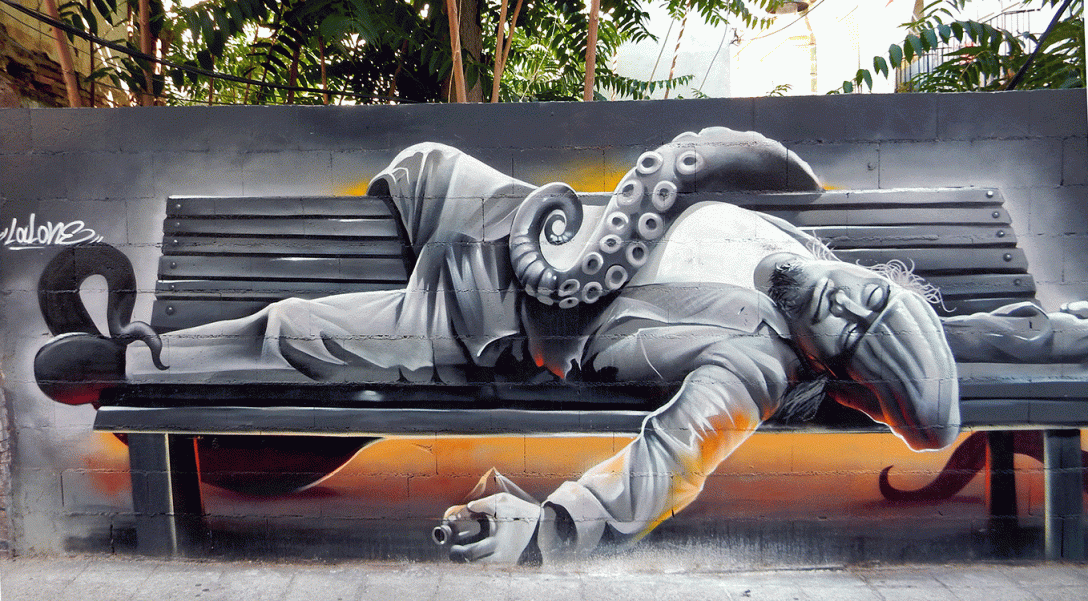
Pulpo and wine. Not an uncommon combination for us while in Malaga, but fortunately we had an apartment for recovery. And octopi never invaded dreams, as far as I know.
The historic center of Malaga is pretty pristine, with polished marble pavers on pedestrian streets gleaming as though in a palace.
A few steps outside, and artists displaying varying degree of talents begin to commandeer attention in several neighborhoods. Some work is obviously invitational or approved; others unauthorized. Some artists cannot resist reminders that this is the birthplace of Picasso.
This post represents one of a series of shots snapped during wanderings. For visitors, street art always seems a way to gain a deeper understanding of people inhabiting a city.
Cities are the spearhead of the most outstanding experiences and the most daring behavior, the places where the greatest development of the arts takes place. Consequently many artists choose life in the city as one of the central features of their work, with the city (often) being understood as a collage of a host of discontinuous, fragmented memories and experiences, a confused labyrinth in which the inhabitants cross paths with one another but remain immersed in their own thoughts.
Jose Miguel G. Cortes, director of IVAM
From the balcony of the apartment we are renting in Valencia, we have a personal portal into Valencia’s Institute of Modern Art, better known as IVAM. Unfortunately, all this portal permits us to see is one of the museum’s stairwells; we have to walk around to the main entrance and pay to enter.
But “Lost in the City,” an exhibition drawn from IVAM’s extensive permanent collections, was a worthwhile place to begin our stay in Spain’s third largest city. Organized around themes, the show portrays more than a century of artists’ positive and negative reactions to the growth of metropolitan areas. The snapshots below capture a few of the included works, but I was derelict in recording many of the artists’ names.
Helena Almeida
Robert Rauschenberg, 1981
“Untitled (Oasis),” Gregory Crewdson, 2004
“Wrap around window,” James Casebere, 2003
Julio Gonzalez
“Wanted,” Erro, 1999-2000
interior stairwell in IVAM
reflection out front of IVAM
“Stadt des Orion,” Hannsjörg Voth and Ingrid Amslinger, 2002 – 2003
IVAM also introduced us to the works, “Corpus,” of Helena Almeida, a Portuguese artist renowned for her performance and conceptual art.
The original core of the institute’s huge collection of sculptures are by a Spaniard, Julio Gonzalez (1876-1972). Born into a family of craftsmen working in metal in Barcelona, Gonzalez yearned for more artistic expressions than construction projects allowed. Traveling to Paris to immerse himself in the thriving art community, he collaborated with Pablo Picasso in the 1920s on a series of metal sculptures that involved a mutual exchange of their creative expertise.
The harsher depictions of metropolitan scenes captured in many works in “Lost in the City” and our stark view of the museum’s portal stand in contrast to our current experiences in Valencia. The heart of this city is pedestrian and bicycle oriented. Our neighborhood is crisscrossed by a rabbit-like warren of winding narrow streets constantly interrupted by intimate plazas filled with lively cafes.
Despite its population of 800,000 residents, even strangers feel welcome in the warmth of such a walkable environment. Becoming lost under the stimulating spell of Valencia is an urban journey beckoning us daily.
Fortunately, the 1927 version of Fritz Lang’s Metropolis is not what life has become…. at least not here.
Between the mind that plans and the hands that build there must be a Mediator, and this must be the heart.



 Postcards from Barton Springs