Elderly and disabled priests needed a suitable place to live out their lives, so the Brotherhood of Silence undertook construction of an elegant residence to accommodate them in 1675 – Hospital de los Venerables Sacerdotes, or the Hospital of Venerable Priests. No expense appears spared during the Baroque palace, with altars and murals by some of Spain’s most famous artists. The project was completed under the direction of architect Leonardo de Figueroa (1650-1730), who designed San Luis de los Franceses. The former residence of aging priests was restored by the Focus Foundation in the late 1980s and now serves as the foundation’s headquarters and as an elegant exhibition space for the impressive artwork of the collection of its Velazquez Centre as well as contemporary acquisitions.
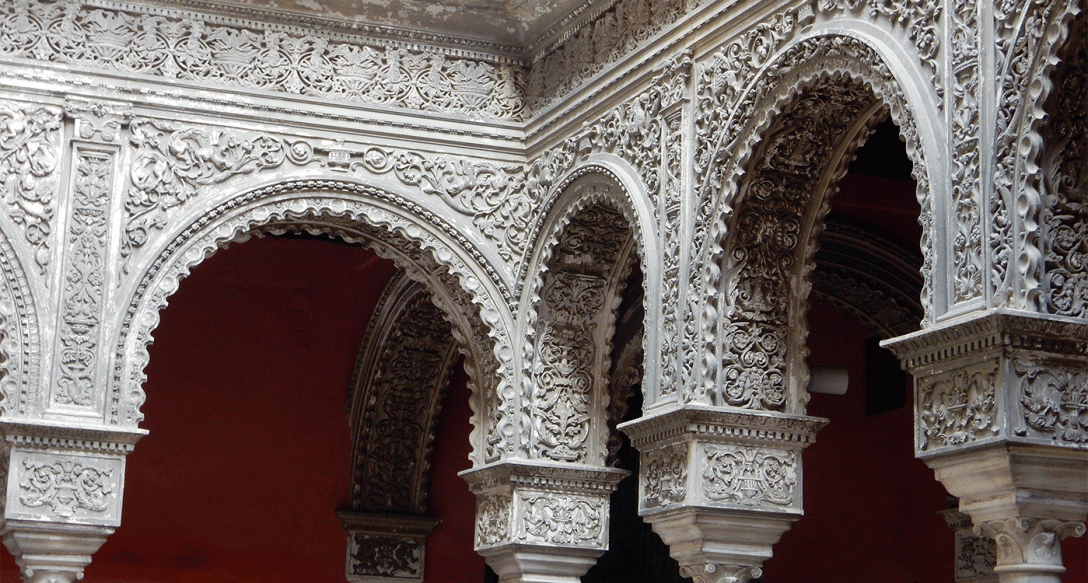
Among the numerous private palaces open to the public by its owners is Casa de Salinas. The 16th-century Mudejar-Renaissance style palace was purchased and restored by the Salinas family in the 20th-century. As in Casa Lebrija, Roman mosaic flooring found its way from an ancient site into a private home.

Hospital de los Venerables

“Santa Rufina,” Diego Velasquez, Hospital de los Venerables

Casa de Salinas

Casa de las Duenas

Hospital de los Venerables

Hospital de los Venerables

Hospital de los Venerables

Casa de Salinas

Hospital de los Venerables

Casa de Salinas ceiling

Casa de las Duenas

Casa de las Duenas

Hospital de los Venerables ceiling

Casa de las Duenas

Casa de las Duenas

Casa de las Duenas

Hospital de los Venerables

Casa de las Duenas

Casa de Salinas

Casa de Salinas

Casa de las Duenas

Casa de Salinas

Casa de las Duenas

“Picador en la Plaza,” Fernando Botero, Hospital de los Venerables

Hospital de los Venerables

Casa de Salinas

Casa de las Duenas

Casa de las Duenas

Santas Justa and Rufina, Casa de las Duenas

Casa de Salinas

Casa de las Duenas

reliquary in Hospital de los Venerables

Casa de las Duenas

Casa de Salinas

Casa de Salinas

Casa de las Duenas

Casa de Salinas

Casa de Alba coat of arms, Casa de las Duenas

Casa de Salinas

Casa de Salinas

reliquary in Hospital de los Venerables
Another palace with origins in the 15th century is the Casa de las Duenas. In 1496, the house was sold to a member of the de Ribera family, and its rich combination of mudejar and Renaissance architectural details resembles the family’s Casa de Pilatos. Later, a Ribera descendant married a Duke of Alba, transferring the palace to the House of Alba.
The architectural interest of the house is perhaps overshadowed by the flamboyance of one of its owners, the 18th Duchess of Alba, who died in 2014 at the age of 88. The long-named María del Rosario Cayetana Paloma Alfonsa Victoria Eugenia Fernanda Teresa Francisca de Paula Lourdes Antonia Josefa Fausta Rita Castor Dorotea Santa Esperanza Fitz-James Stuart y de Silva Falco y Gurtubay also was multi-titled. According to Cayetana’s obituary in The Telegraph:
According to the Guinness Book of Records, she had more titles than any other person on the planet, being a duchess seven times over, a countess 22 times and a marquesa 24 times. Yet the Duchess always insisted she was not rich: “I have a lot of artworks, but I can’t eat them, can I?” she once said. Apart from thousands of paintings by Goya, Velazquez, Titian and others lining the walls of her numerous palaces, her collection included a first edition of Don Quixote, Columbus’s first map of America and the last will and testament of Ferdinand the Catholic, the father of Catherine of Aragon.
Her first wedding in 1947 to a son of the Duke of Sotomayor was held in the Cathedral of Seville, according to The Telegraph, the opulent ceremony:
…cost an estimated £2 million in today’s terms and was described at the time as “the most expensive wedding in the world.” The ceremony was so grand that there was concern it would overshadow the nuptials of Britain’s future Queen, held a month later in austerity Britain. The bride wore a white satin gown (view here) modelled on the dress worn by Napoleon III’s bride Empress Eugenie (1826-1920).
The couple had six children, with only one rumored to be fathered not by her husband but by a flamenco dancer. After her husband’s death in 1972, she next wed a former Jesuit priest 11 years younger than she. Outliving him as well, she shocked society, and her children, by marrying a civil servant 24 years younger in 2011. By then, much plastic surgery had transformed her former natural beauty into an almost cartoonish mask. The obituary includes photos of her with her final husband.
Most of her vast fortune, running into the billions, was divided amongst her children. One of her sons opened the first floor of the family residence to the public in 2016.


 Postcards from Barton Springs