Saints and sinners in Tricentennial exhibition at San Antonio Museum of Art

Given my history of promoting the elevation of the June 13 feast day of San Antonio’s patron saint to a major celebration (for example, here), I feel it a betrayal of Saint Anthony of Padua, originally of Lisbon, that I am not featuring his image at the top of this post. After all, there is a splendid statue of him cradling baby Jesus prominently displayed in the entrance hall of the San Antonio Museum of Art as part of its tricentennial exhibition, “San Antonio 1718: Art from Viceregal Mexico.” 

But I gravitated instead to a detail of “The Mystical City of God,” painted by Cristobal de Villalpando in 1706 and on loan from the Museo de Guadalupe in Mexico City. Depicted in front of the “The Mystical City of God,” envisioned in her 1668 multi-tome work chronicling the life of the Virgin Mary, is Sister Maria de Jesus de Agreda (1602-1665), one of my favorite saints capable of bilocation.

Yes, I realize Saint Anthony had mastered that art centuries earlier. He was known for his capability of preaching a sermon at the altar at the same time he was up in the loft singing with the choir. And then there was the rather remarkable occasion he was in Italy while simultaneously appearing in Lisbon to testify on behalf of his father, who was falsely accused of murder.

It is believed this painting was commissioned by Fray Antonio Margil de Jesus (1657-1726), the Franciscan priest who walked barefoot from Zacatecas to San Antonio to found Mission San Jose y San Miguel de Aguayo in 1720. The art of bilocation certainly would have come in handy for the Franciscan, as he made that more than a thousand mile roundtrip hike across mountains and the desert twice.

But Sister Maria de Jesus de Agreda is particularly significant to the Americas because she bilocated across the ocean to the New World. A favorite advisor to King Philip IV (1605-1665) of Spain, Sister Maria de Jesus de Agreda is said to have been transported by angels to parts of what is now West Texas and New Mexico to teach Native Americans about Christianity as many as 500 times between 1620 and 1631. All the while remaining ensconced in the Monastery of the Immaculate Conception in Spain.

A Franciscan friar arriving in  New Mexico in 1629 found members of the Jumano tribes waiting, eager to be baptized. The Native Americans told him and other friars repeatedly they had been visited by a lady in blue who advised them too seek out the friars to complete their conversion to Christianity. The tales of the mysterious visitations of the lady in blue to the Jumanos were reciprocated by the descriptions of the outward appearance of the Native Americans to whom she had visions of teaching provided by the lady in blue whilst in Spain.

Aside from the statue of Saint Anthony, the other images above are plucked somewhat arbitrarily from the more than 100 works in SAMA’s exhibition.

Monumental in size, “The Martyrdom of Franciscans at Mission San Saba” was painted in 1765 by Jose de Paez, recording an event that occurred only seven years earlier. Founded near present-day Menard in 1757, Mission Santa Cruz de San Saba was attacked by 2,000 warriors – an alliance of Comanche, Apache and other tribes who obviously had not benefited from any of the visitations of the Lady in Blue – on March 16, 1758. Eight people were massacred, and the mission was burned to the ground.

Love the white rabbit peeking out the sleeve in the 1789 portrait of “Friar Joseph Arriaga” by Manuel Montes. Saint Francis often is depicted surrounded by fluttering brown sparrows, and, in that tradition, this Franciscan has a sparrow or two peeking out from under his robe as well.

In sharp contrast to that gentle side of the church’s teachings, I offer a horrifying detail of “Allegory of the Confession of the Soul.” Makes one awfully happy for the opportunity the church extends to say three “Hail Marys” and two “Our Fathers” to have all your confessed sins forgiven. And then there are the cherubs in great need of watching their step balancing atop monstrous creatures from hell in a detail of “The Hernandezes Honoring Their Devotion to Saint Michael the Archangel,” 1818.

The lives of everyday people are featured in some of the assembled paintings as well. The body language of the Gutierrez family in their 1814 portrait conveys much about their roles. The daughter is learning the art of lacemaking from her mother, while the captain instructs his son in geometry. The father is posed in a way to block the access of the womenfolk to the mathematical problems. The future roles of the daughter and son are dictated by the lessons they are offered.

“San Antonio 1718: Art from Viceregal Mexico” remains on exhibit until May 13.
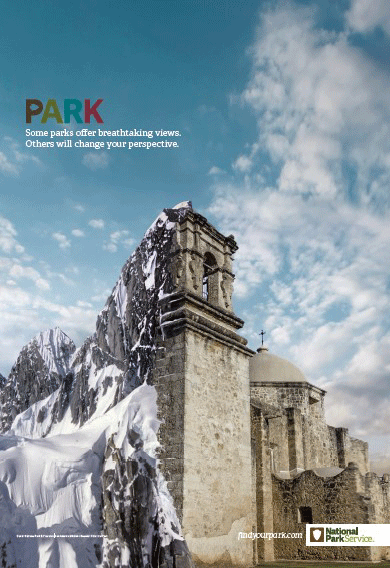
A shimmering mirage on a simmering summer day….

parkThe National Park Service turns 99 on August 25 and among the mash-ups created for the occasion is this mélange of Denali National Park and the San Antonio Missions National Historical Park.

As appealing as morphing Mission San Jose into a giant raspa or a baked Alaska in the middle of the summer, “Lincoln Logs,” combining the towering trees of Sequoia National Park with the solemn columns of the Lincoln Memorial, is a stunning image.

lincoln-logs


Processing Art through Public Filters, Part One

UTSA Libraries Special Collections

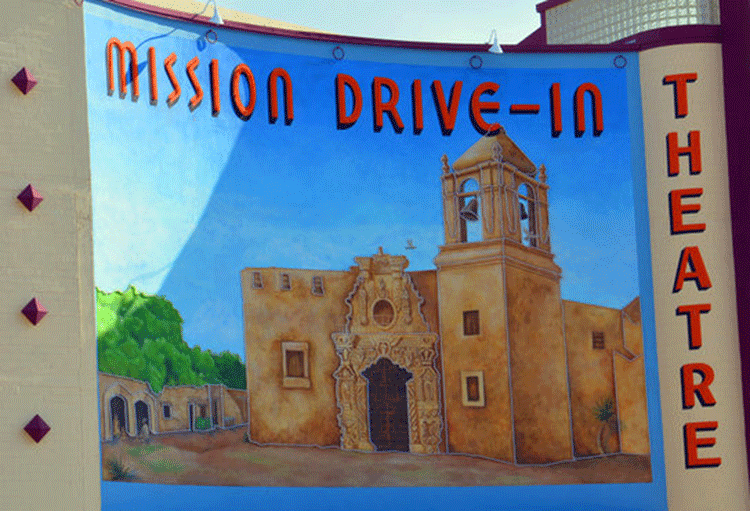
When completed the Mission Drive‐in Theatre will serve as an icon for preservation and neighborhood re‐development….

The project goal is to complete the approved mural components of the Historic Mission Drive‐In Marquee in a way that follows recommendations of the Secretary of the Interior’s Standards for the Treatment of Historic Buildings, and stays consistent with the historic period….

…all viable methods of re‐creating the mural, sign lettering and lighting feature will be considered, provided that the completed work re‐creates the style, color and graphic quality of the original mural and components as closely as possible.

Public Art San Antonio, 2012 RFP

Historic Mission Drive-In Marquee Re-Creation

The resulting illumination of the marquee mural instantly makes the old Mission Drive-In Theatre a striking night-time landmark on the south side.

Public Art San Antonio

But there is something missing.

KENS-5 TV
KENS-5 TV

The new mural is soul-less, devoid of the human presence that characterized the original.

Instead of a re-creation, the design was sanitized following public protests in several contentious meetings.

A sombrero-porting Latino leading a donkey, a beast of burden sparing many a worker from debilitating back injuries, and one napping under a sombrero are both regarded as racial stereotyping.

I concede there was a time when many Anglos viewed such images and uttered the racial slur “lazy Mexicans.” Call me naïve, but I like to think we have moved beyond that point.

Sombrerería in Mexico City, Late 1800s, Underwood & Underwood stereoview card: "The ordinary sombreros are made of palm-leaves and straw, but those of the wealthier classes are of expensive felt, and may be white, gray, or maroon in color. They are often very ornate, being embroidered with the wearer's monogram, or designs of flowers, and faced with gold or silver lace. In Mexico, only the men wear hats, and they are a very valued  possession. Sometimes a man will invest his entire fortune of thirty or forty dollars in his sombrero. They are frequently of vast dimensions. The larger the sombrero, in fact, the greater its aesthetic value in the eye of the average Mexican. The flourish with which he doffs it in salute is something never to be forgotten by the unaccustomed foreigner."
Sombrerería in Mexico City, late 1800s, Underwood & Underwood stereoview card: “The ordinary sombreros are made of palm-leaves and straw, but those of the wealthier classes are of expensive felt, and may be white, gray, or maroon in color. They are often very ornate, being embroidered with the wearer’s monogram, or designs of flowers, and faced with gold or silver lace. In Mexico, only the men wear hats, and they are a very valued possession. Sometimes a man will invest his entire fortune of thirty or forty dollars in his sombrero. They are frequently of vast dimensions. The larger the sombrero, in fact, the greater its aesthetic value in the eye of the average Mexican. The flourish with which he doffs it in salute is something never to be forgotten by the unaccustomed foreigner.”

My hope is, rather than erase the existence of sombreros from our collective memory, we honorably embrace them as part of our heritage in San Antonio.

Here is why:

  • San Antonio was part of Mexico for longer than it has been part of the United States.
  • Mexicans who worked outside in the hot sun wore sombreros. They were smart.
  • The crown of a sombrero can be angled to follow the sun like a sunflower, shading both the face and the neck.
  • Hardworking people who rose long before the sun and worked until after it went down could use their sombreros for shelter while taking well-deserved naps.
  • People who sport gimme caps get red necks. No additional comment necessary.
mi sombrero guapo
mi sombrero guapo

I’m all for a sombrero resurgence. I’m doing my part.

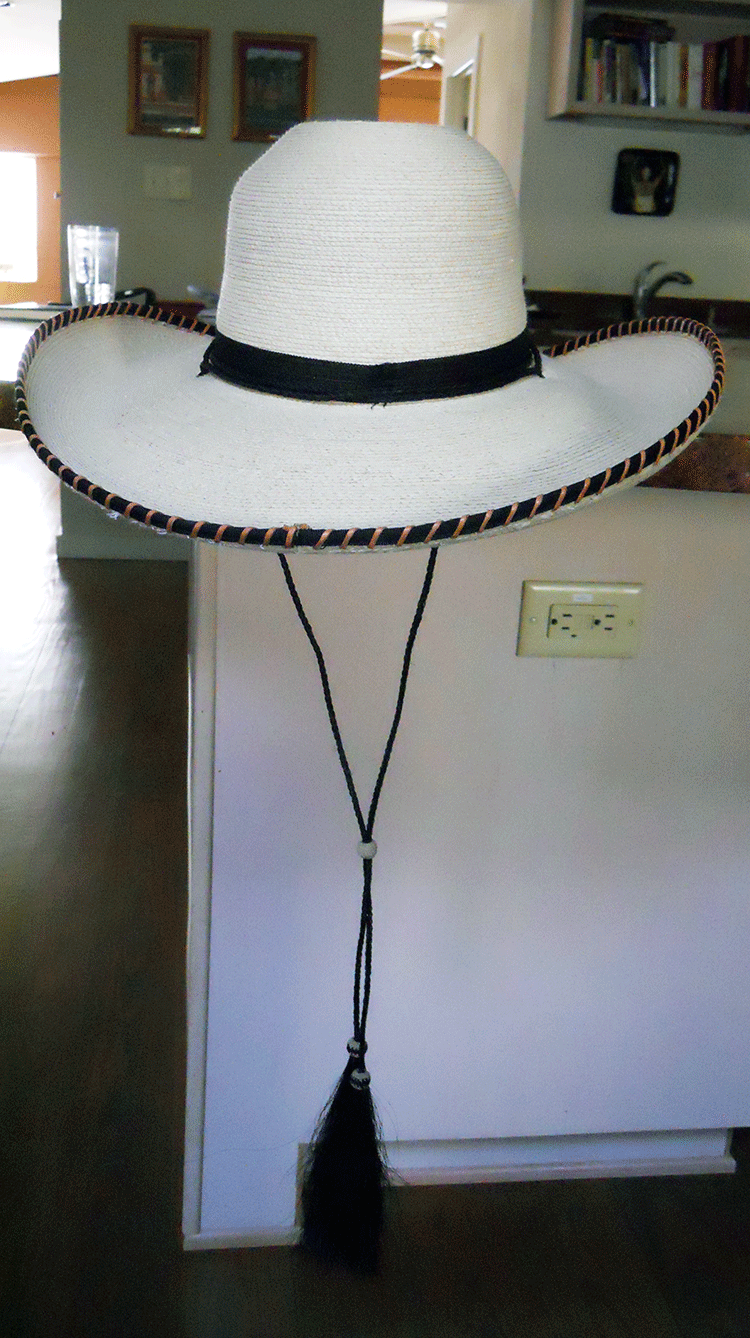
Yes, I know this aging gringa looks foolish wearing her broad-brimmed caballera hat, complete with a horsetail-hair stampede string to hold it in place when the wind threatens to send it swirling.

But time has taught me a few things. I grew up on a beach trying to keep up with tan people. I merely burned and freckled. A slow learner, I repeated the process over and over, summer after summer.

I’m part of a freckled race that old Dr. Pipkin said had no business south of Ireland. But I hate cold and love hot sauce.

Because I was not wise enough to learn from experience, I had, what I told the Mister was in his honor, an upside-down, backwards “L” carved in my chest. But that “L” actually represents the third letter of melanoma.

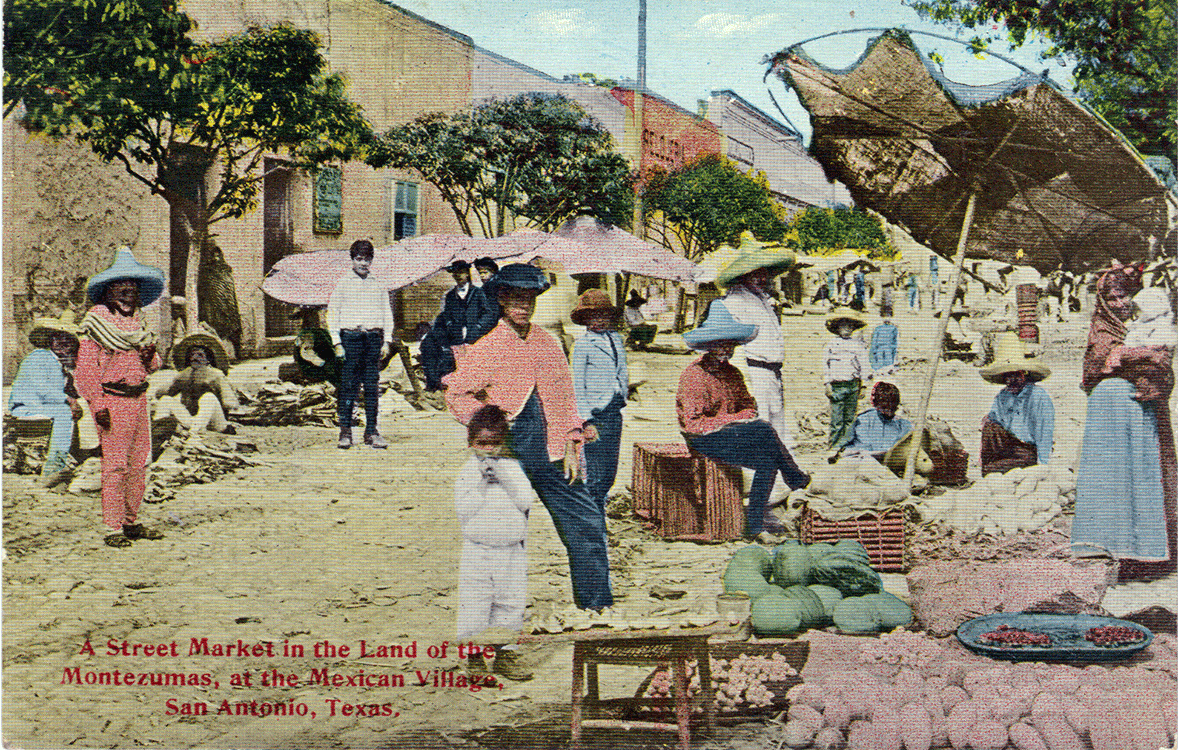
I’m only telling you this so, when you see me wearing my caballera hat walking along the Mission Reach, you won’t make fun of me in front of me. My sombrero represents a self-preservation technique I learned from old postcards, from photos of men like those who used to grace the Mission Drive-In marquee.

san-antonio-market

And, yes, some of the postcards were condescending in tone. But the photos were of real people, real people living in San Antonio who wore sensible hats when going about their daily business.

At this latitude, the sombrero-toting figure appears the smart one. Having a red neck is no sign of intelligence; it’s just asking to be branded with one of those “L’s.”

If only I had one of those back-saving burros to port that case of two-buck Chuck up to the kitchen….