
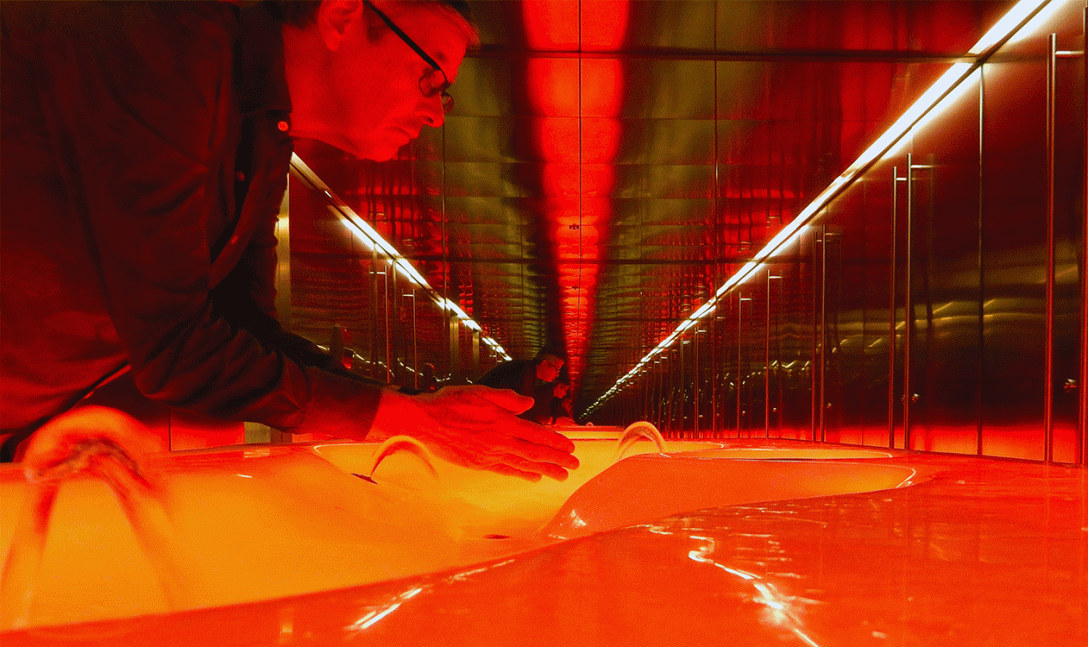
Three months ago this blog took you to MACRO, Museo d’Arte Contemporanea Roma, to view the “mortal remains” of Pink Floyd, but totally neglected to invite you into the men’s room. The long bank of illuminated wash basins offering multiple reflections of your cleanliness habits in both the men’s and women’s bagni are must-stop spots in the museum housed in a former Peroni Brewery.
Apologies. The strange introductory photo is offered as a distraction because this grouping of museums makes no sense, aside from their location outside of the main tourist grid.
As this begins with the contemporary art scene, we might as well hop over to MAXXI, the National Museum of 21st Century Arts. Even were the museum devoid of art, people would make the pilgrimage to MAXXI to view the striking design of the late Iraqi-born British architect, Zaha Hadid.
Following Hadid’s 2016 death, Michael Kimmelman of The New York Times wrote:
She was not just a rock star and a designer of spectacles. She also liberated architectural geometry, giving it a whole new expressive identity. Geometry became, in her hands, a vehicle for unprecedented and eye-popping new spaces but also for emotional ambiguity. Her buildings elevated uncertainty to an art, conveyed in the odd ways one entered and moved through those buildings and in the questions her structures raised about how they were supported.


The other trio of museums belong together, as they are all located within the 33-acre park of Villa Torlonia. The property originally was a farm and vineyards owned by the Pamphilj family, whose palace we visited earlier.
At the end of the 18th century, a banker to the Vatican, Giovanni Torlonia (1755-1825), transformed the former farm into a luxurious garden-like setting for his newly acquired mansion. The elegant Casino Nobile was renowned for lavish parties thrown by the Torlonia family. The palatial residence attracted the attention of Benito Mussolini (1883-1945), who purportedly paid the princely sum of $1 per year to acquire it for his residence from 1925 to 1943.
With parties often occupying the main villa, princes in the Torlonia family needed a villa to escape the throngs. An underground passageway connected the Casino Nobile to the smaller Casino dei Principi, or House of the Princes, guarded by a stately pair of sphinxes.
The third of the Villa Torlonia Museums is the Casina delle Civette, or House of the Owls, possibly because of the owls depicted in the stained glass above the entrance. Originally designed to resemble a rustic Swiss chalet, later architectural alterations added an assemblage of small balconies and turrets, more of a petite medieval hamlet look.
The entire Villa Torlonia compound was purchased by the city of Rome in 1978, which subsequently restored numerous of its buildings and opened the grounds as a public park.


 Postcards from Barton Springs