This Deadly Scenario Should Not Have Been Written

7 deadly scenariosAndrew Krepinevish has done what I would have sworn impossible.  He has almost managed to evoke a sentimental attachment to all of the horrible signage violations invading the Alamo Plaza Historic District, even Shamu disrespectfully flipping his tail toward the shrine of Texas liberty.

The West Point and Harvard graduate struck a little too close to home – only about six or seven blocks away – in one of his 7 Deadly Scenarios: A Military Futurist Explores War in the 21st Century.  His book, not light end-of-the-summer beach-reading material, was published in January 2009 by Random House, and I’m probably the last person to hear about it.  But the “future” he described is nearly here, and he is picking on the 175th anniversary of the Battle of the Alamo:

At precisely 8:28 a.m. on the morning of March 6, 2011, just as the city’s morning rush hour is at its peak…

Sorry to interrupt his story, but have the reenactors cleared out before 8:30, or are they in big trouble?  Am I on the plaza at the tail end of my morning walk?

…a blinding flash of light rips through the downtown area.  Nearby buildings are immediately vaporized.  Buildings farther off buckle and collapse….  A local television station’s traffic helicopter captures the blast at a distance of nearly nine miles away.  As the telltale mushroom cloud begins to rise from the city, the traffic reporter remarks, “My God, it’s an atomic bomb!…”

“Remarks?”  My loft and I were just vaporized.  That reverse commute my husband makes five days a week sounds pretty appealing at this point in the narrative.  I sure hope this is Krepinevich’s worst-case scenario.

The lead shot on the evening news, not only in America but around the world that night, centers on two images: the footage from the traffic helicopter with the reporter’s horrified voice-over; and on-the-scene reporters standing at locations where the severely damaged Alamo mission – the shrine to Texas’s independence – can be seen in the distant background.

The Daughters of the Republic of Texas must have gotten the roof repaired in order for it to withstand such a powerful attack, but I’m not reading another word.  This book gives me the creeps.  Ban this book. 

I certainly prefer a symphonic concert for the 175th anniversary.  But tell the reenactors to be on alert, and please, Tony, maybe don’t hang the banner.  Let’s not give the nefarious characters invented by Krepinevich that kind of directional signage. 

Rather selfish of me (an understatement much like “remarks”), but could we instead install a banner steering them toward the “reel” Alamo, John Wayne’s Alamo, the one in Brackettville? 

Update on August 31:  The “reel” Alamo is closing to the public. 

Wayfinding and New Accessibility Enhance River Walk Experience

Always hated to have to break the news to lost joggers asking for help, the ones who looked really ready to be back in their hotel rooms, that they had veered off about a mile in the wrong direction.  But lately, few are in need of assistance.  The $250,000 wayfinding system funded by the Convention and Visitors Bureau and designed by Marek-Hill of Houston seems to actually work.  For the first time since I have lived in San Antonio, there is an informative, logical and cohesive look to River Walk signage.

Ben Olivo of the San Antonio Express-News writes that Juliana Marek is a product of Alamo Heights High School who:

likens a good system to a bread crumb trail, that it’s impossible, or rather impracticable, to cram mounds of information into a single sign.

“What a good sign system does is break down the information in understandable amounts, because people can’t digest as much as they’re moving around,” Marek said. “You really, really have to try and simplify the information as much as possible.”

The signage also helps those wandering Paseo del Rio locate accessible routes, which, finally, most of the downtown River Walk is.  For years, many preservationists balked at altering Robert H.H. Hugman’s original designs to make accessible pathways, and the city shied away from the expense.  I must confess I, too, was skeptical architects could incorporate the necessary changes without damaging the aesthetic appeal. 

But Judy Babbitt, the city’s Access Compliance Manager, never quit in spite of strong opposition.  Judy always has been reminded on a daily basis where virtually every violation of the Americans with Disabilities Act is located downtown because she wheels it continually.  She literally has devoted decades to the campaign to eradicate unnecessary obstacles. 

According to the Public Works Department website, which includes accessibility maps: 

Since the early 1980’s, the City of San Antonio has been active in eliminating architectural barriers and in creating wheelchair accessibility to and along the River Walk. The City has improved more than 50 locations during these two decades, generating new ramps, pathways and, with the help of private businesses, new elevators.

As a frequent critic of the city’s tendency to “value-engineer” the character out of projects, I am totally bowled over by the sensitivity and quality of materials used in the new system of ramps.  They are handsome additions to the River Walk.  Sensitive areas, such as the stepping-stones by the fountain by Omni La Mansion del Rio, were not ruined.  The craftsmanship of the inserts eliminating the dangerous openings is exquisite. 

Like many pedestrians presented with the choice, I find myself often opting for the ramps over steps.  It feels good to stretch out one’s calves on the slight incline and reminds me what strength would be required to propel oneself up them using only arm-power.  Judy should have just challenged all the nay-sayers years ago to arm-wrestle her for the right to make Paseo del Rio accessible.  The paths would have been completed more than a decade earlier.   

Note Added on September 18, 2010More improvements ahead….

Update on January 27, 2012: The City’s efforts to make the downtown River Walk more accessible are receiving recognition:

The Governor’s Committee on People with Disabilities, in partnership with the Accessibility Professionals Association (APA), has announced the winners of the 2011 Accessibility Awards, which recognize businesses and organizations that go above and beyond the legal requirements to provide both physical and service accessibility to people with disabilities.

City of San Antonio Historic River Walk Downtown (San Antonio)
Owner: City of San Antonio
Design Professional: Beaty Palmer Architects, Inc – Michael Beaty AIA, Principal

Slip-Sliding Backwards on Alamo Plaza Signage

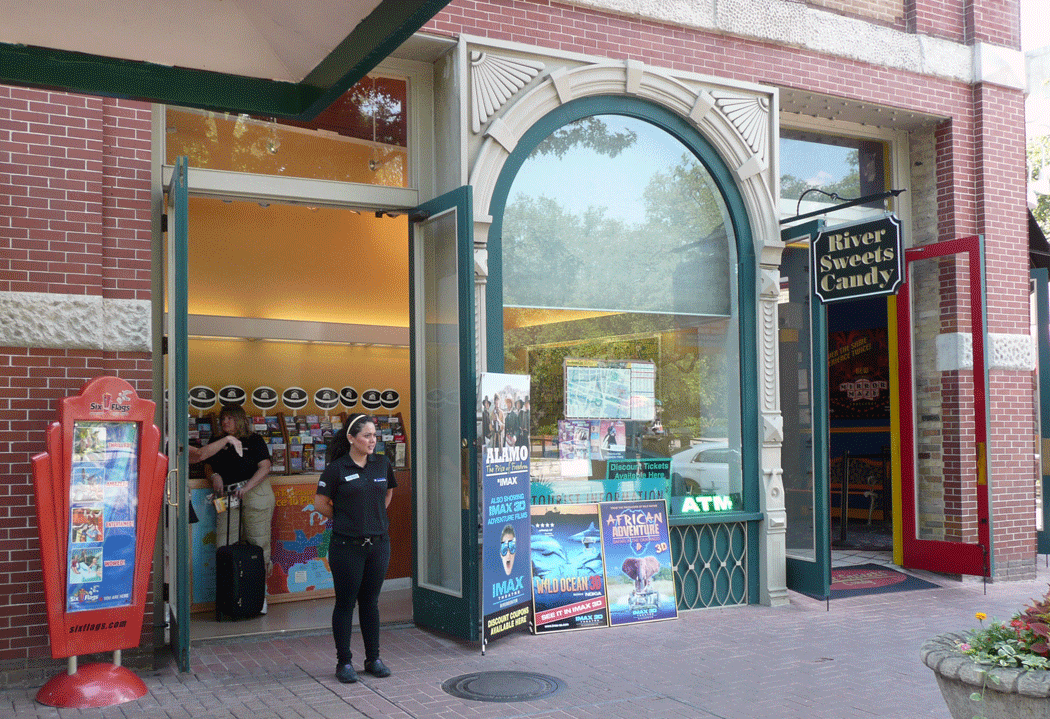
Such a sad birthday greeting this morning on my way to workout.  The 1891 Reuter Building is one of the most handsome landmarks on Alamo Plaza.  Yet there he is – a huge Shamu brazenly filling the building’s beautiful arched window.  I was too saddened to even stop and take a photograph.     

This violates the City’s Unified Development Code in so many ways, particularly as I am sure Sea World is not behind those doors.  Will no one put a stop to the runaway commercialization of the Alamo Plaza Historic District?     

Reuter Building
This photograph shows the commercialization of the facade of the Reuter Building prior to the installation of Shamu in the middle window.


I hope the San Antonio Conservation Society will decide to spring into action to defend this affront to the Society’s property.  This is the Conservation Society’s facade according to its website:     

The facade was given to the San Antonio Conservation Society Foundation by the building’s owner, Mr. Thomas Wright, in May, 1978, and was the first such gift accepted by the Foundation. It was restored with funds from the Foundation, the owner, and a matching grant from the U.S. Department of the Interior administered by the Texas Historical Commission.     

The Society helped shrink the banner; surely they can shrivel up this Shamu beached on Alamo Plaza.     

Update on August 14:   Pictures do say it better; so I went back to Alamo Plaza on my morning walk.   Tried to restrict photos to the topic at hand, but portable signboards are creeping back out some of the businesses’ doors and the Alfred Giles-designed Crockett Block has the same window issues as the Reuter Building.     

Update on August 31:  The Historic Design and Review Commission has some tightening of signage regulations on its agenda tomorrow, which is great.  But only if it is enforced.  Hopefully, the tightening and clarification of who’s in charge means enforcement ahead….  We’ll know when we get to wave goodbye to Shamu, ads for the Buckhorn and all the other clutter.