Around Alamo Plaza: Been a long time, but the signs are still there.

There have been many posts in this blog ranting about haphazard appearance of the front door for many a visitor to San Antonio – the Alamo Plaza Historic District.

Most businesses evidently believe duplicate signs are critical; even the city’s newly remodeled Visitor Information Center has two extra, twin signs flanking its doorways. I thought the Hotel Indigo was going for cool, but apparently not. And, although it’s not in the district, the city’s recently redone plaza with its strangely homuncular statue of Henry B. gets graced with an illegal sandwich board advertising a garage a block away.

There is no need for many words this time; the photos of illegal signs speak for themselves.

This slideshow requires JavaScript.

If you have the stomach for more ugly signage greeting our millions of visitors annually, here is a small sampling from older posts:

Please complain about the lack of enforcement of signage regulations in the Alamo Plaza Historic District to your city council representative and consider dialing 311 to report violations you see.

More cheese, please… with a wee bit of honey

Rabbit: “And help yourself, Pooh. Would you like condensed milk, or honey on your bread?”
Pooh: “Both. But, never mind the bread, please. Just a small helping, if you please?”
Rabbit: “There you are. Is uh… something wrong?”
Pooh: “Well, I did mean a little larger small helping.”

 The Many Adventures of Winnie the Pooh

Twice a year it would happen. I could not breathe, and hives would gradually creep up from my calves. When they finally began to stretch up for my neck, where they would show, I would finally give in to the discomfort and go see my allergist for a steroid shot.

Now he is a well-respected allergist, and he ran all those stick-you tests. Cedar elm was one of the largest culprits, and they completely surrounded our home in Olmos Park. Red wine (Inner Pooh voice repeatedly interrupting the doctor’s words: I’m not listening.). And dairy products (Inner Pooh voice: I can’t hear you.). You mean as in milk, right? No, you can’t mean cheese?

So what’s a girl to do but give up drinking milk and live with periodic outbreaks of hives?

I had never been much of a fan of honey. But that was because I had never had a dab of it dribbled on the ideal vehicle for it – cheese. And we had to travel to Sevilla, Andalusia, Spain, last year to make that discovery.

The cheese plate at this beautiful restaurant we loved came with a nutty, orange-flavored honeycomb in the middle. Hold the bread; no need for it. Just pure cheese and honey. I feel guilty about not remembering the name of the restaurant in Sevilla, so am trying to atone by including photos of it as well.

This slideshow requires JavaScript.

A year later, only a month ago, we were wandering the streets of Perugia, Umbria, Italy, in search of a bite for lunch. I was feeling virtuous for not being seduced by the stunning chocolate confections in the window of Sandri Patisserie on Corso Vannucci.

We settled instead at Ristorante Gus, pleasantly shaded in the middle of the pedestrian-only Via Mazzini. According to a New York Times article that came out while we were in Italy, Gus is new. The locals seemed to love it and were all ordering sushi, but we were too recently de-planed to want that.

Good intentions still intact, I ordered a smoked trout salad, and Lamar had a vegetarian panino and chickpea soup. Everything was great, but that pesky little inner Pooh voice started singing about the bees once I spied the cheese plate. This bountiful cheese board came with a palette of eight different honeys to dabble on the cheese.

Now I am hooked. A comb full of honey leapt into my cart at Mustafa Asian and Middle Eastern Grocery Store. And from there, the blame’s all on Central Market with those banners tempting me with “For the Love of Cheese” every time I drove by.

Since vacations are not around every day, I’m resigned to letting Central Market shop around the world for me. Although I wish CM’s blog did not mention the word “dairy” and then this:

While cheese is a good source of protein, calcium and vitamin D, let’s face it: Fat is what gives cheese its beguiling texture and depth of flavor.

(Inner Pooh voice: I can’t hear you.)

To go with the honeycomb, I selected some rosemary Asiago, blue Stilton, Bucheron and some other powerful blue-veined, ancient-looking cheese. Sorry, doctor, but such behavior would be great for your business… if I had not moved away from all those cedar elms.

And sure wish I had a bottle of Umbria’s Montefalco Sagrantino to go with that cheese and honey.

So Pooh ate, and ate, and ate, and ate, and ate, and ate, and ate, and ate… and ATE! Until at last he said to Rabbit in a rather sticky voice: “I must be going now. Good-bye, Rabbit.”
Rabbit: “Well, good-bye, if you’re sure you won’t have any more.”
Pooh: “Is there any more?”

The Many Adventures of Winnie the Pooh

Saplings to Shade the Next Generation

Reports from Spanish missionaries exploring what was then northern Mexico almost 300 years ago described a river with lush, tree-lined banks. Native Americans, who called the land Yanaguana, valued these trees for much more than shade from the brutal summer sun. Trees provided wood for fuel and tools and bark for medicinal purposes. Brasils, Mexican plums and persimmons all provided fruit, and pecans and walnuts provided food that could be stored for months. 

The much maligned, homely honey mesquite tree was among the most useful. The hard wood could be hewn into tools or musical instruments; the gum and bark served as an antiseptic. While the tough seeds were discarded, the blossoms and pods were eaten. But don’t expect mesquite pods to be the next gastropub trend in the locavore movement. According to Texas Beyond History:

The Cahuilla utilized mesquite in three different forms – blossoms, green pods, and dried pods. Blossoms were collected and either boiled or roasted on heated stones, squeezed into balls, and consumed. Green pods were pounded into a juice using a mortar and pestle. Most of the harvest probably was pounded into meal using a mortar and pestle. The meal was moistened with water, then allowed to harden into flatcakes a few inches thick. It was stored in this form, but often bruchid beetle eggs would hatch and the cakes would become infested with larvae (Bean and Saubel 1972). The Pima, at least, are on record as saying that the larvae simply added some zest to the meal. Informants said that the pods could be consumed without any preparation by breaking them into small pieces and chewing them (Russell 1908).

While the area off Avenue A adjacent to the River Road neighborhood provides a glimpse of what the river might have looked like in its natural state, the recently opened stretches of the Mission Reach of the San Antonio River Improvements Project are virtually treeless. 

Flood-control projects of years ago were single-minded; trees impeded flood waters so were removed leaving a barren flood channel. Native grasses and wildflowers planted the past several years as part of the San Antonio River Improvements Project have improved that landscape dramatically, but 100-degree summer days cry out for shade.

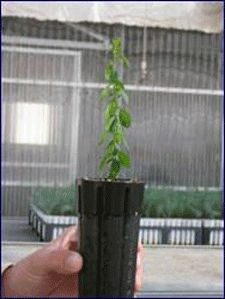
My grandmother always said, “Little acorns grow into tall trees;” although she was reassuring a young girl she would one day blossom bosoms. And in greenhouses and fields outside of Lubbock, the Texas Forest Service is nursing acorns and those pesky Anaqua seeds that embed themselves in the ridged valleys of my walking shoes into a huge crop of saplings to shade the next generation hiking along the banks of the San Antonio River. 

In November, crews from the San Antonio River Authority will begin planting 3,000 saplings ranging in height from a few inches to a few feet in the first phase of the Mission Reach. Depending on the species – including cedars, willows, cypresses, cottonwoods, elms, Mexican sycamores, possumhaws and redbuds – the trees will take from 10 to fifty years to reach full maturity.

To provide a preview of some of the native trees soon to grace the banks, the San Antonio River Foundation worked with the Parks and Recreation Department of the City of San Antonio to plant 15 trees at Roosevelt Park by Mission Road. The trees were planted in honor of the hard work of the volunteers on the San Antonio River Oversight Committee who have shepherded the project along through the years. This anaqua sporting a Treegator skirt, slowly releasing water to nourish the roots through the drought, is among them.

The River Foundation will be sharing saplings for you to take home and plant from 4:30 to 6 p.m. on Thursday, October 20, at Confluence Park, 310 West Mitchell. In addition a free tree, you will be able to view the Master Plan for this neighborhood park reestablishing the historical connection from the river to Mission Concepcion.

And, the best news: By the close of 2015, the River Authority will have planted another 20,000 trees along the Mission Reach. The next generation might not even need to wear sunscreen on morning walks.

January 24, 2012, Update: Want to add this link to another blogger’s recent post about plantings along the Mission Reach.