‘So Doth a Little Polly,’ sayeth this Lamar

mockingalamo

In June of 1920 I received the degree of Bachelor of Arts with Honors in Mathematics and Economics, a title which, coupled to the name of Lucius Mirabeau Lamar the Third, was of such resounding grandiloquence as to bring from the assembled students faculty and families (who else would be there in the boiling muggy Texas sun?) a burst of applause embracing, I knew well enough, a component of irony. It did sound good, as some of the movie false fronts look good, but there was mostly air behind it.

From Shards by Lucius M. Lamar, 1968

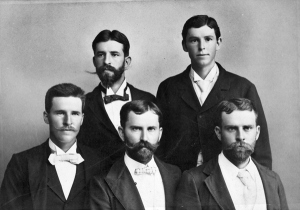
And this before Lucius M. Lamar, III, (1898-1978) added a law degree.

It is not surprising someone so willing to self-mock would choose a conscientiously pretentious name for the protagonist in a pride-before-the-fall, the-grass-is-always-greener, be-careful-what-you-wish-for fable, So Doth a Little Polly, woven for his five-year-old-niece and seven-year-old nephew.

Jesus Francisco de Assisi Sensontle.

This tale of a San Antonio mockingbird did not bow to monosyllabic rhyming words first-graders could read. No, it was a vocabulary-stretching story rippling with multiple layers of bicultural meaning and accompanying music ranging from “Hinky Dinky Parlez Vous” to Handel.

Sensontle, or Don Sensontle as he preferred to be called, wintered on Alamo Plaza, convinced he reigned over all other feathered creatures. He believed his singing so awe-inspiriting he was “astonished at his own virtuosity” (Notes in the margin recommend the accompaniment of a toy flute here.).

One day a sparrow, Cecil, asked if Sensontle had read the recent news from Austin in the paper:

“A gentleman never reads,” replied Sensontle with dignity, being innocent of that clerical accomplishment.

“Perhaps not,” went on Cecil, ignoring the implication….

The news Cecil the sparrow was trumpeting was that the mockingbird had been proclaimed the State Bird of Texas.

Pompous pride over this tribute soon led to a downturn in Sensontle’s popularity among the birds of the plaza (pompous chords followed by a fast march).

Frustrated, Sensontle flew to a home on Zarzamora Street to visit his caged cousin, Maria Ysabel Dolores Soledad Sensontle, “a handsome and engaging young fellow, whose somewhat effeminate name had been bestowed by his captors under a misapprehension as to his sex.”

Yearning for an easy life, Sensontle negotiated to change places with his cousin for a year.

youtube video posted by zxtkain

A year later Maria returns and perches on the branch of a fig tree near his former cage. Sensontle desperately pleads:

“Kindly release me.”

“Come,” said Maria, “your morals have improved at the expense of your manners. You should ask no labor of me until I have got my wind.”

“I ask nothing save the fulfillment of your promise, which is a sacred duty you should perform at once, tired or not. Be quick, let me out!”

“Patience, cousin, patience,” soothed Maria.

And then.

And that’s the problem.

Twelve dried, yellowed, longer-than-legal-sized typewritten pages.

The end of the story is missing, scattered somewhere amongst the shards left in the wake of closing the Mister’s parents’ household. Lost. Along with copies of other “children’s” works produced by Lucius, including “Hardboiled Harry.”

We are hoping the Mister’s great-uncle passed the stories down orally to his own children and are mailing “So Doth a Little Polly” to his daughter tomorrow.

Please. Let us know if Sensontle lived to fly freely lording over the Alamo once again….

Writing Nonfiction: Dig a little. Peck a little. Dig, dig, dig….

It seems every time I type a few sentences for the book I’m writing about the Coker community, I come across something that makes me want to dig deeper. Most of the time, the research is like doggedly following a trail of bread crumbs through dense underbrush for hours only to look up and realize a flock of crows just swept down and gobbled up the path ahead.

Sometimes though, as in two days ago, I am rewarded. When I wrote Last Farm Standing on Buttermilk Hill, I was not comfortable in the identity of the man Joseph Coker shot by water hole. Seeking someone named John Jones in a community full of Joneses can be tricky. But at last, I found him, and it was not the one I had assumed.

My point is, that discovery now serves to justify my endless, stubborn wanderings after trivia to round out the story. Cutting off research is the hardest thing about writing nonfiction.

The following update from the Coker Cemetery Association Newsletter, illustrates the stumbling-lost-in-the-woods style of research distracting me daily:

In the 1860 Census, Ella and J.K.P. Campbell were listed between the Robert Smith family and Joseph Coker. A 35-year-old stock raiser from Tennessee with a 21-year-old wife from Vermont made an interesting pairing, particularly on the eve of the Civil War.

James Knox Polk Campbell with daughter Mattie from the family files of Chuck and Honor

With no intermarrying ties in the community, the couple slipped out of my mind until I was working on the Civil War chapter for the book you have commissioned about the Coker Settlement. Unlike many men in the community who enlisted as privates, James Knox Polk Campbell immediately was appointed assistant commissary for the Sixth Regiment of Texas Infantry at Camp Holmes, Arkansas.

So many families stayed for so long on the land around the Coker Settlement, the families moving away always mystify me. Why would anyone abandon a home in this rattlesnake-infested, drought-prone land where one had to constantly watch out for marauding Indians poised to snatch up your children while you were hoeing or bent over laundry?

Digging to find out more about Campbell, I stumbled across an online post dating from the 1990s. Charles _____ had letters, letters referencing Campbell’s “ranching venture” outside of San Antonio and his Civil War imprisonment. All I had to do was find Charles _____.

I prefer looking for dead people; surely they are happy to know someone cares enough to want to know their stories after they have left the earth. Nosing around the internet for the living makes you feel you are prying, spying, trying to identify someone by prowling on LinkedIn, Facebook, Google, white page look-ups.

And then making that phone call, to perhaps the totally wrong stranger, and not sound crazy? I lucked out and got an answering machine. And lucked out even more. I hit the right person in the right state the first time and got a return call.

And from someone sympathetic to such a call emerging from nowhere about some post made more than a decade earlier. Chuck, himself, had stumbled across the letters on the internet years earlier.

Billee W. Hoombeek brought them to the surface. Chuck retained her email from years ago and forwarded it to me. She was an archaeologist working on the Green Mountain National Forest project in Vermont between 1979 and 1988. As part of her project, she concentrated on “interpreting the deserted farmsteads that dotted the woods.” Hmm, a kindred spirit perhaps?

One of her resources in the Brandon, Vermont, library was a collection of materials assembled by a “Mr. Chamberlin” for a novel he had intended to write comparing life in two small towns – Brandon, Vermont, and Brandon, Virginia. Here, Hoombeek encountered the letters from Campbell to his father-in-law, Colonel Frank Farrington, of Vermont. Finding them fascinating, she went out of her way to share them through a Campbell descendant organization and online.

When Chuck found her, she responded: “I would be in seventh heaven if an ancestor of mine had left such a rich treasure. He does indeed have feet of clay, but she (Chuck’s wife Honor, who is the actual descendant) will know him very well when she finishes.”

And Chuck and Honor are again sharing with us….

A blog post by the Special Collections of the UTSA Libraries reminded me how I long to get back to the comfort and flow of writing historic fiction – based on thorough research but woven together by my imagination instead of hundreds of footnotes.

The facial hair photo on the UTSA blog happened to be of some real people featured in a chapter of An Ostrich Plume Hat, the completion of which is now interrupted by the writing of two other books. At any rate the photo is of the Goeth brothers – my favorite two going by the confusing initials, C.A. and A.C.

Edward Wilhelm Goeth, a rancher; Conrad A. Goeth, a lawyer; Adolph Carl Goeth, a merchant; Max A. Goeth, a rancher; and Richard A. Goeth, a doctor
Edward Wilhelm Goeth, a rancher; Conrad A. Goeth, a lawyer; Adolph Carl Goeth, a merchant; Max A. Goeth, a rancher; and Richard A. Goeth, a doctor, from the UTSA Libraries Special Collections

Read about the Goeths’ involvement with Texas politics – part fact, part invention – here.

When immersed in fiction, I can close my eyes in the tub and hear my characters talking to one another. While writing nonfiction, bath time means my mind is submerged in thoughts of those innumerable trails of crumbs beckoning me to follow in wildly divergent directions.

Several chapters somehow have managed to emerge from my keyboard, so perhaps an end is in sight.

For now, I know I need to just keep awkwardly dog-paddling, trying not to drown in the details. This book is not supposed to be like digging my own grave.

Singing high praise for the trees Max and Minnie spared: ‘Last Farm in Town’

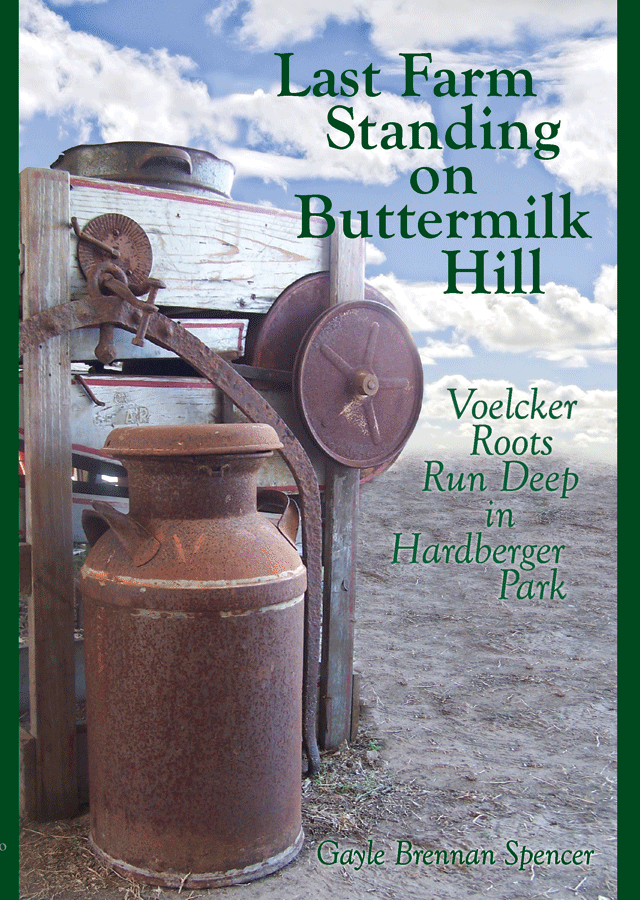
last-farm-coverOkay, we’re behind the times. Last Farm Standing on Buttermilk Hill has no promotional video.

But, is this cool or not?

It has a song. A song recorded on August 30, 2013.

Well, okay. The book doesn’t own it.

But the song surely will become the official one of Phil Hardberger Park Conservancy, supportive caretaker of the former farmland on which Max and Minnie Voelcker spared the trees shading walkers and runners in Phil Hardberger Park.

This is what the vocalist, Michele McMurry, wrote about “Last Farm in Town” on August 31:

Doug (McMurry) and I recorded this song, which he wrote as a tribute to Phil Hardberger Park and the rich roots of the Voelcker dairy farm. Doug was inspired by a book titled “Last Farm Standing on Buttermilk Hill,” written by friend and colleague, Gayle Brennan Spencer.

As you may know, Doug is very involved with parks as a director of the Phil Hardberger Park Conservancy and former chairman of the City of San Antonio Parks and Recreation Board.

The neat part was Doug playing my dad’s 1964 Martin (D28) guitar.

Enjoy …

“The Last Farm in Town” by Doug and Michele McMurry…

Oh, and the photo in the video is the interior of Max and Minnie’s milking barn.