The Tragic Rule of Maximilian and Carlota in Mexico

Empress Carlota and Emperor Maximilian of Mexico, circa 1864, from the Lusher Collection and included in exhibit at the Witte Museum February 1 through March 30

City of Mexico, Thursday, Jan. 10, 3 p.m., 1867 – Yesterday morning Col. Paulino Gomez Lanadrid, commanding 700 reinforcements of Imperial troops sent to succor the besieged garrison at Cuernavaca, was killed near that place during an attack by a body of Liberals, who were lying in ambuscade….

More than 500 families, mostly Mochos and French, will leave here on the 20th with 4,000 French troops….

Maximilian is waiting for the last French soldier to leave. The shadow of the last of the expeditionary corps will not be lost sight of by the Archduke, who is now residing in a humble house between here and the Castle of Chapultepec.

The New York Times

And so, Maximilian, the falling emperor of Mexico, awaited his fate.

"Execution of Emperor Maximilian of Mexico" by Edouard Manet, 1868
“Execution of Emperor Maximilian of Mexico” by Edouard Manet, 1868 (not part of exhibit at the Witte)

The French installation of the Archduke Maximilian and his Belgian-born wife Charlotte to reign over the politically unstable Mexico of 1864 was bound not to end well. But the story is a rich one of international intrigue on both sides of the Atlantic.
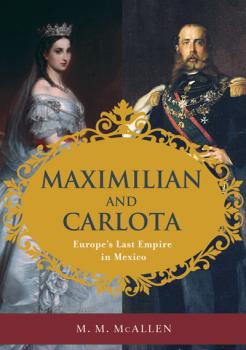
m-and-c-galley-coverAs Trinity University Press prepares to release Maximilian and Carlota: Europe’s Last Empire in Mexico by Mary Margaret McAllen, the Witte Museum is opening a companion exhibit, “Maximilian and Carlota: Last Empire in Mexico,” focusing on the fascinating lives of the ill-fated royal couple. The exhibit of portraits, photographs and artifacts opens on February 1, while the author will read from her book and be available to sign copies during a reception from 4 to 6 p.m. on Saturday, February 8, at The Twig Book Shop.

Fell in love a few year’s ago with C.M. Mayo’s masterful novel, The Last Prince of the Mexico Empire, focusing on a child caught up in the political turmoil – Principe Agustin de Iturbide y Green. A Library Journal review in 2009 perhaps summarizes the complexities involved most succinctly:

Once upon a time, there was a little half-American boy who briefly became heir to the Mexican throne—until his distraught parents sued the doomed Emperor Maximilian for his return.

I highly recommend Mayo’s book, and am looking forward to reading McAllen’s. And if these and the exhibit leave you thirsting for even more glimpses into the lives of Maximilian and Carlota, Mayo maintains an ongoing blog Maximilian ~ Carlota, described as “resources for researchers of the tumultuous period of Mexican history known as the Second Empire, or ‘French Intervention.'”

I’m hoping one of the two authors will suddenly contact me with a sliver of information (a very unlikely record to stumble upon, so am certainly not holding my breath) about a San Antonio connection to the royal rulers. Among the Austro-Hungarians enlisted to serve in support of their reign in Mexico was Baron George Ritter von Tomasini (1818-1912). As the Second Empire of Mexico collapsed, Tomasini and his wife made their way to New Orleans and to San Antonio by 1872. Here, they joined the community of dairy farmers at the Coker Settlement, about which I am writing a book for the Coker Cemetery Association. Geographically, the heart of the Tomasini farm was located where the cluster of shops and restaurants known as The Alley on Bitters are found today.

Eva and George Tomasini, photo from www.thealleyonbitters.com
Eva and George Tomasini, photo from http://www.thealleyonbitters.com

February 3, 2014, Update: Read Steve Bennett’s review of McAllen’s book in the San Antonio Express-News

March 19, 2014, Update: David Martin Davies will moderate a discussion with McAllen from 10 to 10:45 a.m. in the Story Room on the 3rd floor of the Central Library during the San Antonio Book Festival on Saturday, April 5.

January 5, 2016, Update: C.M. Mayo has posted a podcast of a conversation with McAllen recorded in The Twig in October 2015.

Biannual survey of what you are reading on my blog

You, one of the few who actually reads this blog, have failed me. As usual, the subject matter of the most-read posts is all over the map, providing me no guidance of where to head.

gun-posterExcept guns at the Alamo. And I really prefer not to write about guns. The popularity of those posts rose because they were circulated widely among those who want to brandish arms publicly, so much that I felt compelled to move away from the window while typing so not to serve as an easy target.

Drummer Phil Collins’ promotion of Two Roads to the Alamo* and the Conservation Society Book Awards on his facebook page kept it hovering near the top. People from all over the world clicked on his link, disappointed to find out it was mainly about me.

The number in parentheses represents the rankings from six months ago:

  1. Please come and take them away from San Antonio, 2013
  2. Two Roads to the Alamo* and the Conservation Society Book Awards (1), 2013
  3. George Hutchings Spencer, 1923-2013 (4), 2013
  4. The State surrenders the Alamo; Run for Cover, 2013
  5. Library Foundation flapping red cape for the bullish on books (6), 2013
  6. The Memorable Mary Denman (5), 2010
  7. Processing Art through Public Filters, Part Two (7), 2013
  8. Richard Nitschke: Seeing Agave in a Different Light, 2013
  9. “Nuit of the Living Dead” (8), 2010
  10. Please put this song on Tony’s pony, and make it ride away (11), 2010
  11. Sarah’s faces more than a thousand times better, 2013
  12. Cheez Doodles as Art (2), 2011

Don’t blame me if you don’t like where I head next. You have left me totally perplexed. But thanks for trying to hang in there.

‘So Doth a Little Polly,’ sayeth this Lamar

mockingalamo

In June of 1920 I received the degree of Bachelor of Arts with Honors in Mathematics and Economics, a title which, coupled to the name of Lucius Mirabeau Lamar the Third, was of such resounding grandiloquence as to bring from the assembled students faculty and families (who else would be there in the boiling muggy Texas sun?) a burst of applause embracing, I knew well enough, a component of irony. It did sound good, as some of the movie false fronts look good, but there was mostly air behind it.

From Shards by Lucius M. Lamar, 1968

And this before Lucius M. Lamar, III, (1898-1978) added a law degree.

It is not surprising someone so willing to self-mock would choose a conscientiously pretentious name for the protagonist in a pride-before-the-fall, the-grass-is-always-greener, be-careful-what-you-wish-for fable, So Doth a Little Polly, woven for his five-year-old-niece and seven-year-old nephew.

Jesus Francisco de Assisi Sensontle.

This tale of a San Antonio mockingbird did not bow to monosyllabic rhyming words first-graders could read. No, it was a vocabulary-stretching story rippling with multiple layers of bicultural meaning and accompanying music ranging from “Hinky Dinky Parlez Vous” to Handel.

Sensontle, or Don Sensontle as he preferred to be called, wintered on Alamo Plaza, convinced he reigned over all other feathered creatures. He believed his singing so awe-inspiriting he was “astonished at his own virtuosity” (Notes in the margin recommend the accompaniment of a toy flute here.).

One day a sparrow, Cecil, asked if Sensontle had read the recent news from Austin in the paper:

“A gentleman never reads,” replied Sensontle with dignity, being innocent of that clerical accomplishment.

“Perhaps not,” went on Cecil, ignoring the implication….

The news Cecil the sparrow was trumpeting was that the mockingbird had been proclaimed the State Bird of Texas.

Pompous pride over this tribute soon led to a downturn in Sensontle’s popularity among the birds of the plaza (pompous chords followed by a fast march).

Frustrated, Sensontle flew to a home on Zarzamora Street to visit his caged cousin, Maria Ysabel Dolores Soledad Sensontle, “a handsome and engaging young fellow, whose somewhat effeminate name had been bestowed by his captors under a misapprehension as to his sex.”

Yearning for an easy life, Sensontle negotiated to change places with his cousin for a year.

youtube video posted by zxtkain

A year later Maria returns and perches on the branch of a fig tree near his former cage. Sensontle desperately pleads:

“Kindly release me.”

“Come,” said Maria, “your morals have improved at the expense of your manners. You should ask no labor of me until I have got my wind.”

“I ask nothing save the fulfillment of your promise, which is a sacred duty you should perform at once, tired or not. Be quick, let me out!”

“Patience, cousin, patience,” soothed Maria.

And then.

And that’s the problem.

Twelve dried, yellowed, longer-than-legal-sized typewritten pages.

The end of the story is missing, scattered somewhere amongst the shards left in the wake of closing the Mister’s parents’ household. Lost. Along with copies of other “children’s” works produced by Lucius, including “Hardboiled Harry.”

We are hoping the Mister’s great-uncle passed the stories down orally to his own children and are mailing “So Doth a Little Polly” to his daughter tomorrow.

Please. Let us know if Sensontle lived to fly freely lording over the Alamo once again….