Postcard from Madrid, Spain: Parting shots from ‘los jubilados’

To be away from home and yet to feel oneself everywhere at home; to see the world, to be at the centre of the world, and yet to remain hidden from the world—impartial natures which the tongue can but clumsily define. The spectator is a prince who everywhere rejoices in his incognito.

Charles Baudelaire in The Painter of Modern Life and Other Essays

Saw a tweet the other day and wish I’d saved it. Asked to define her career goals in a job interview, a woman responded: “I want to use ‘summer’ and ‘winter’ as verbs.”

Not sure that proved a job-scoring answer, but I loved it. Because one of the best aspects of getting older is the freedom to wander. No one holds you to two or three weeks a year any longer. Slow travel.

We used to ponder whether our goal should be to become boulevardiers or flaneurs when we “grew up.”

Okay, time for a confession. We have failed.

Both words seem more than a tad decadent for our traveling lifestyle. We don’t stay in hoity-toity hotels. We stay in small apartments. Breakfast is not spent in cafes, but in our home-away-from-home.

As the Mister says, we are not really vacationing as much as temporarily switching zipcodes. According to the Mister’s Fitbit, instead of occupying seats in trendy spots, we traversed about 50 miles of sidewalks a week in Madrid. We only ordered a cocktail seated at a bar once. Instead of late-night barhopping and tapa-feasting with the Madrilenos, we settled in for a light salad or homemade vegetable soup en casa.

Hardly deserving of the title boulevardiers or flaneurs, we admit.

On the other hand, the word “retirees” does not have a nice ring to it. The English word sounds so exhausted and past tense.

After all, the Mister is still a bluesman, and I’m still writing. The tools of our chosen avocations – guitar and computer – accompany us everywhere. But we use those on our own schedules and because they are our passions. In Madrid, sundown generally found us at home, nestled in our basement quarters contentedly plucking on guitar strings and pecking on computer keys.

A month spent wandering in Madrid, and we are leaning toward a more optimistic-sounding Spanish term for those who no longer are hemmed in by or defined by work.

So here are some random, parting shots from los jubilados.

Hope you don’t mind switching continents, but the next slightly postdated postcards will be “mailed” from a zipcode in Puebla, Mexico.

Postcard from Madrid, Spain: Paradise found in parks

Better to reign in Hell,

Than to serve in Heaven

Lucifer in John Milton’s Paradise Lost

There he is, the fallen angel himself, painfully ensnared atop a beautiful fountain, guarded by gargoyles, in the heart of Madrid’s Retiro Park. John Milton’s Paradise Lost inspired sculptor Ricardo Bellver to create a monumental depiction of the devil in 1877. Both widely acclaimed and highly controversial, the statue is regarded as the only piece of major public art dedicated to the devil.

Anyone bedeviled by the artwork can easily avoid it, as Retiro Park is huge and is only one of many found in the capital city. Madrid has more parkland in its center than any other major European city, and Madrilenos take full advantage of them any time they are free.

These photos are from Retiro Park and the Jardin Botanico next to the Prado.

Totally swooned for the handsome tuxedoed birds. Exotic in my mind, but considered nuisances by many – common magpies. As with the storks earlier in our trip, never recalled setting eyes on them before, which might be lucky as a multitude of legends portray magpies as harbingers – or at least a single magpie – of ill will.

With his theft of glittering objects, the magpie envisioned by Gioachino Rossini in the plot of an 1815 opera almost caused an innocent maid to swing from the gallows. And the magpie’s reputation surely was not enhanced by the inclusion of the overture to signify impending over-the-top violence by Stanley Kubrick in his 1971 film, A Clockwork Orange.

Struggling and longing to be ‘fictionalized’

deer


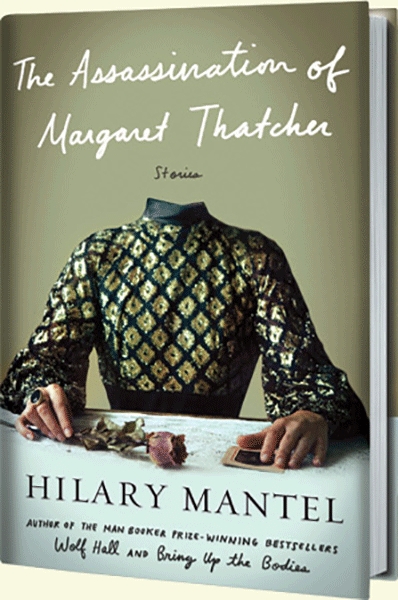
So can identify with the whining of the main character in “How Shall I Know You,” a short story in Hilary Mantel‘s The Assassination of Margaret Thatcher.

The woman is an author who has been “struggling with a biography” for several years.

As a biographer I was more than usually inefficient in untangling my subject’s accursed genealogy. I mixed up Aunt Virginie with the one who married the Mexican, and spent a whole hour with a churning stomach, thinking that all my dates were wrong and believing that my whole Chapter Two would have to be reworked.

Why, I can out-whine her any day. I have a whole cemetery I’m trying to untangle, and I’m sure I’m at least three years into it. And it is filled with a multitude of Smiths and Joneses and Cokers, many of whom inconsiderately passed down the same first names over and over. The Joneses prove particularly difficult, as they originate from two completely unrelated lines, or unrelated for quite a while before the Texas Revolution and not again until some time later.

And she only spent “a whole hour” thinking everything was awry? That’s nothing.

The author in the short story finds writing the truth, when it has to be uncovered, difficult.

I seemed to be pining for those three short early novels, and their brittle personnel. I felt a wish to be fictionalized.

Making up things does seem much easier than digging up facts long-buried. Often I want to just linger in the tub imagining different lives among all of those Coker descendants. The writer in “How Shall I Know You” does just that. She starts typing up exciting invented versions of the lives of Aunt Virginie and the Mexican, completely avoiding the facts associated with the original subject of the biography.

But, unfortunately, you just can’t make this stuff up.

And, I know I don’t need to.

The Coker Cemetery is fertile with true tales that should be passed on to the descendants of the residents resting there.

I’ve made it through the Texas Revolution, the arrival of German and Hungarian settlers and the Civil War. I’m getting there. Slowly.

Each nugget I discover is rewarding. In addition to the everyday stories of hardworking dairy farmers, there is a surprising bit of murder and mayhem to entertain me.

All I need is patience. And an extremely large dose of it.

the-assassination-of-margaret-thatcherWait a minute. Wolf Hall. Bring Up the Bodies.

The author of the author in the short story is the ultimate award-winning, best-selling researcher.

All whining privileges on my part are hereby revoked.