
When I first formed my theories concerning the nonfiction novel, many people with whom I discussed the matter were unsympathetic. They felt that what I proposed, a narrative form that employed all the techniques of fictional art but was nevertheless immaculately factual, was little more than a literary solution for fatigued novelists suffering from “failure of imagination.” Personally, I felt that this attitude represented a “failure of imagination” on their part.
Truman Capote in an interview conducted by George Plimpton
January 16, 1966, The New York Times
Whether accurate or not, Truman Capote claimed that in writing In Cold Blood he invented a new category of writing. A panel at Gemini Ink’s Writers Conference this weekend grappled with their own difficulties in fitting into traditional nonfiction labels and wrestling with how publishers promote them.
 Jan Jarboe, author of The Train to Crystal City, is meticulous about her facts, so much so she even hired a fact-checker out of her own pocket to ensure certain details were correct before her recent New York Times Bestseller (on the nonfiction list) was published. Although the book is true, she feels it blurs the traditional lines for nonfiction because she was determined not to break the flow of the narrative or drive herself crazy by “annotating every damn detail.”
Jarboe’s strict adherence to facts is part of her D.N.A. as a writer, having spent years contributing to Texas Monthly, which is noted for its team of fact-checkers. The panel moderator, John Phillip Santos, referenced John McPhee’s 2009 New Yorker article on that magazine’s fact-checkers, “Checkpoints,” chronicling the tenacity required both to perform the task and to work with the taskmasters.
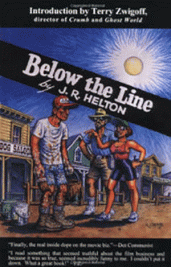 Author J.R. Helton plays more loosely, valuing the format of a nonfiction novel for “not worrying about whether you jump back and forth in time.” His works are subjective, a telling of events as he recalls them. He says he was brutally honest about some of the film industry people featured in Below the Line; so much so that Sarah Hepola writes in The Austin Chronicle that “the tell-all book might more accurately be called Below the Belt.” But, in Drugs, Helton says he purposefully changed names and places to prevent himself from getting killed by some of the dangerous characters he encountered during his past drug days. While he feels The Jugheads accurately related his side of the story of his family life when he was growing up in East Texas, his publisher categorized it as “fictionalized memoir.”
 Tim Z. Hernandez categorized himself as a poet when he was assigned the huge San Joaquin Valley as his territory for mining oral histories for California Stories. While he first considered the assignment “work,” the one-on-one interviews altered his writing and made him realize “you don’t have to leave to look for good stories.”
His interest in oral history led Hernandez to knock on the door of Bea Franco, the real-life never-before-interviewed “Mexican girl” Jack Kerouac wrote about in On the Road. Convincing her to entrust him to tell the story of her life, Hernandez translated his oral history interviews with her in Manana Means Heaven.
Writing for the Los Angeles Times, Hector Tobar observed:
Hernandez combines his skills as a poet and some dogged research to imagine and re-create the couple’s brief relationship with intimate and engrossing detail. The book begins and ends with a description of Hernandez’s real-life interview with Franco, and it’s clear the novel has benefited from Franco’s own account of her life as a farmworker and young mother.
Hernandez says he based his narrative on his recordings of Franco’s story but found some pieces missing. In order to ensure his efforts at filling in the gaps rang true, he read them aloud to his elderly subject. He knew he was on target when she would nod her approval saying, “That’s not how I lived it, but that’s how I remembered it.” The publisher marketed the book as “historical fiction.” Hernandez’s upcoming book that includes dialogue is being labeled a “documentary novel.”
And did The New Yorker’s famous fact-checking survive the test of time for Capote’s In Cold Blood? In Slate, Ben Yagoda wrote of finding the original notes made by the fact-checker assigned the laborious chore:
Almost from the start, skeptics challenged the accuracy of In Cold Blood. One early revelation (acknowledged by Capote before his death in 1984) was that the last scene in the book, a graveyard conversation between a detective and the murdered girl’s best friend, was pure invention. I myself made a small contribution to the counter-narrative. While doing research for my 2000 book, About Town: The New Yorker and the World It Made, I found “In Cold Blood” galley proofs in the magazine’s archives. Next to a passage describing the actions of someone who was alone, and who was later killed in the “multiple murder,” New Yorker editor William Shawn had scrawled, in pencil, “How know?” There was in fact no way to know, but the passage stayed.
So who knows? In a later session of the Writers Conference led by Claiborne Smith, editor-in-chief of Kirkus Reviews and literary director of the San Antonio Book Festival, Jarboe observed, “Nonfiction is often more unbelievable than fiction.”
signed: a writer drowning in a swamp of footnotes


 Postcards from Barton Springs