Street art entices venturing under the overpass

Quincy and St. Mary’s Street under I-35. Not a destination that ever crossed our minds for a walk from King William. That is until this weekend.

More than a dozen San Antonio artists,* organized by the private artist-driven San Antonio Street Art Initiative, tackled the unsightly interstate underpinnings and redefined the homely parking lot leased by the Wyndham Super 8 Hotel into an admission-free outdoor museum.

Composed of leaders of the city’s vibrant street arts scene, SASAI’s mission is to introduce and educate the local community about street and mural art and make our city a destination for street art lovers….

We seek to build and strengthen a street art community here that extends across all areas, activities and people. Street art makes neighborhoods vibrant. Street art extends the arts community outside the walls of museums, brings people to see new places to live and play, provides fresh perspectives for the young and old.

We are focusing initially on developing a visit friendly area in the city featuring a concentrated number of murals that will draw daily foot traffic, cyclists and visitors looking for an alternative beyond traditional tourist routes and attractions.

San Antonio Street Art Initiative

This is an amazingly ambitious and highly successful project.

So looking forward to seeing more.

Financial support for continued artistic efforts is welcomed on the website.

*Identifying who designed each mural was somewhat of an internet scavenger hunt for me…. Corrections are not just welcomed but encouraged.

Viewing San Antonio through a Spaniard’s eyes

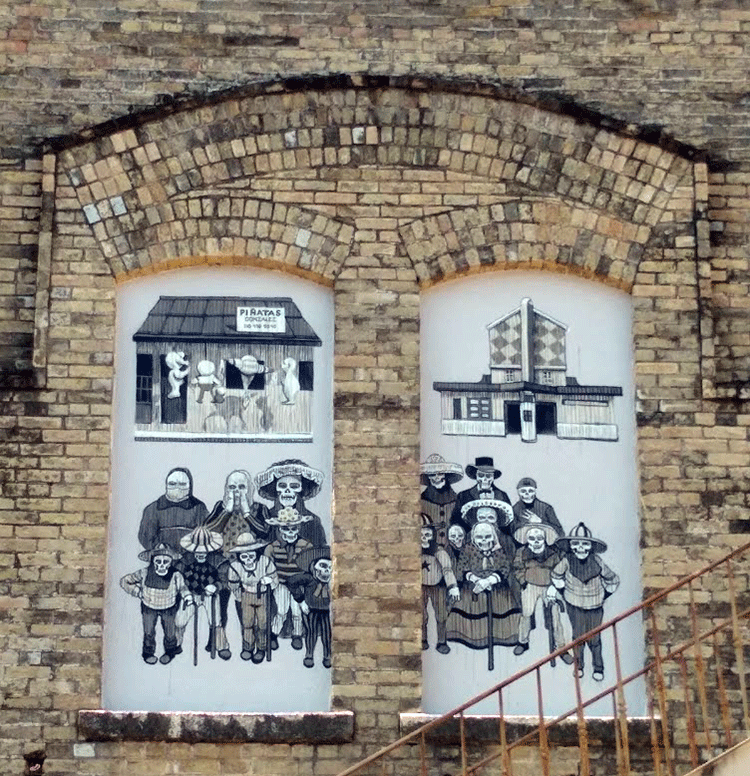
Murals by Spanish artist Daniel Munoz, or SAN, transform window frames bricked in long ago on the back of the former home of the Beethoven Maennerchor in Hemisfair into points of interest. SAN peered into the city’s past and how it contributes to the city of today in recognition of the San Antonio’s Tricentennial. The mural on the back of what is now Magik Theatre was commissioned by the city’s Public Art Department and Luminaria working in conjunction with Ink and Movement in Madrid.

These cellphone snaps represent a small sampling of SAN’s images. Love the way he captured the man peering into the dime store to represent the impending desegregation of the lunch counter in San Antonio; four Blacks broke a major color barrier when they were served there on March 16, 1960. Wonder if the muralist knew the 97-year-old former Woolworth’s, regarded as a landmark in the history of the Civil Rights Movement, is endangered by the current version of the Alamo Comprehensive Interpretive Plan. The building’s significance for the community is obvious even to someone from another country.


Postcard from Rome, Italy: Few clues for archaeologists of future times

The war against graffiti within the historic center in Rome is constant, but it is amazingly successful. “Divieto d’Avissione.”

The penalties must be high, because most of what is of any interest at all obviously is executed rapidly by stencil or pasted on a wall by someone on the run. The center is pretty much devoid of any authorized street art as well.

That was not the case in ancient Rome:

But, unlike today, Roman graffiti was not forbidden—and it was practically everywhere, from the private dining rooms of wealthy homes (domi, where friends sometimes left messages for the hosts) to the public forum. In fact, according to Kristina Milnor, more 11,000 graffiti images have been found in Pompeii—which is just about the size of the population at the height of the town….

Without this threat of punishment, it seems that graffiti was readily practiced by people at all strata of society, making it perhaps the most valuable text we have from the ancient world. Man, woman, child, slave, poor, rich, illiterate—it did not matter, so long as there was an empty spot on a wall. Which means that, through graffiti, we are able to hear the voices of those who have been traditionally voiceless, granting us the possibility of astounding insights into lives and minds we’ve never been able to access….

Naturally, all of these works have slowly changed ideas on what Roman life was like at the time.

“Why ancient Roman graffiti is so important to archaeologists,” Susanna Pilney, Red Orbit

The majority of these images are fleeting, soon to be eradicated by graffiti police. Surely not Super Papa Francis?

How will archaeologists of the future ever understand what Romans of today think about politics, sex, love, religion?

If the #qwerty from the featured image were all that remained, the keyboard reference would only confuse them. Who could figure out any Latin-based alphabet based on that?