‘Tree of Life’ bears bountiful crop of tales from the past

If history were taught in the form of stories, it would never be forgotten.

Rudyard Kipling

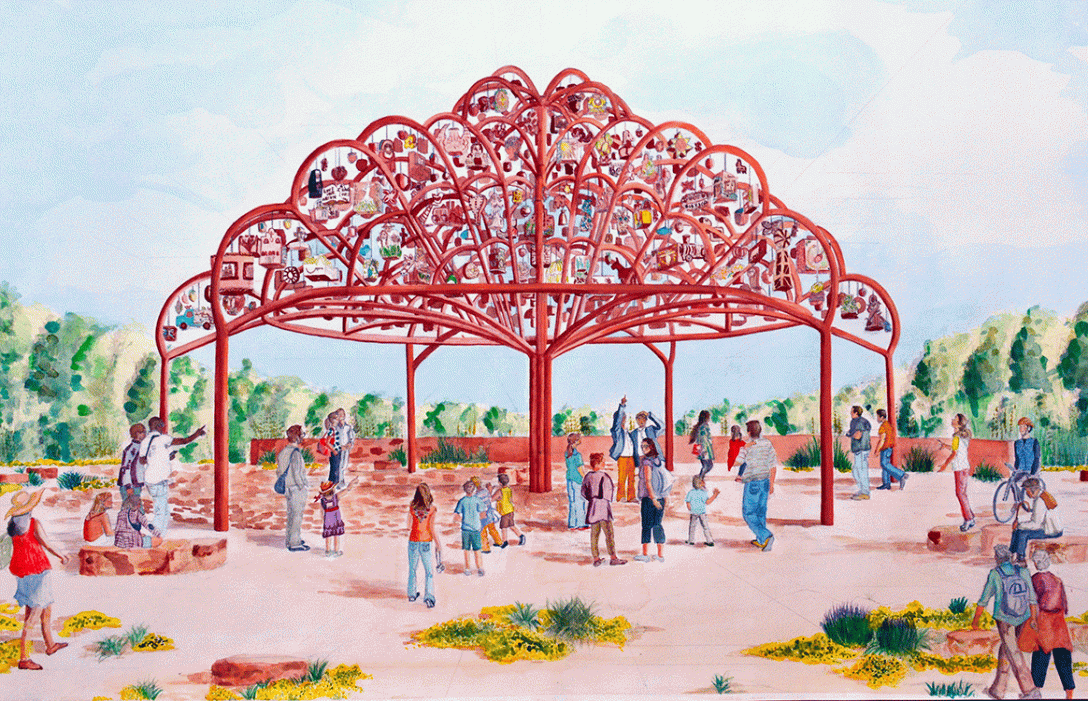
Assigned by the San Antonio River Foundation with the creation of a major work of public art to celebrate the community surrounding Mission San Francisco de la Espada and its strong connections to San Antonio’s ranching heritage, Margarita Cabrera envisioned a tree of life. A tree of life overflowing with fruit. “Arbol de la Vida: Voces de Tierra.”

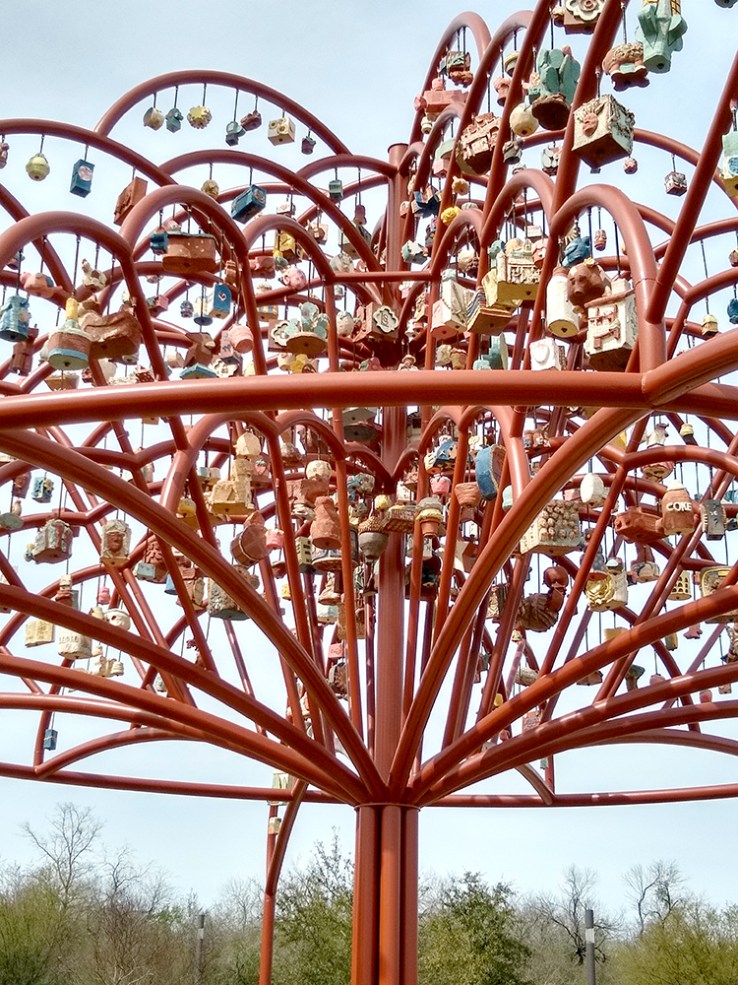
The origin of colorful trees of life is rooted in Colonial Mexico. Missionaries worked with craftsmen in the Puebla region of Mexico to create clay sculptures to relay biblical stories, often branching upward and outward from Adam and Eve at the base.

Building on that tradition of rendering stories in clay, Cabrera has collaborated with more than 600 members of the community since May to capture their narrative memories. Workshops were held to help even novices record these chapters of San Antonio’s shared history in slab and coil based clay sculptures. The finishing touches on the final fruits of this labor of love involving so many are being completed in a studio at Mercury Project.

While many of the 700 pieces already have been fired, these photos are of works in progress. After firing, Cabrera says, each piece will be filled with epoxy so that, even if a piece is damaged, the sculpture will remain intact. The average weight of each of the suspended “fruits” will be in the neighborhood of 200 pounds. Serving as a portal linking the Mission Reach of the San Antonio River to Mission Espada, this tree will be immense.

An ostrich-plumed hat perched atop the head of “la patrona” made Rosa Maria Hinojosa de Balli (1752-1803) easy to spot on early Texas cattle drives, according to Merri Gutierrez, one of her descendants. Gutierrez chose to depict the signature hat to represent the story of the daughter of two Spanish aristocrats who was born in Tamaulipas, Mexico. Known as the first cattle queen of Texas, Hinojosa de Balli amassed more than one-million acres of land stretching across five Texas counties. She built chapels at all of her ranches for the ranchhands and served as godmother to more than 300 of their children.

Thelma Ortiz Muraida is crafting a truck to signify the lifestyle of her father, a migrant worker born in Floresville. An artist who has illustrated numerous children’s books, Muraida is enjoying working with the clay. Her father loved to create folk art from found objects, and her great-aunt worked with her husband alongside Dionicio Rodriguez, known for his landmark faux bois cement sculptures. The truck pays tribute to those who work with their hands and their appreciation of and respect for the land. She is filling her truck with family members and the things they would pack up to create a sense of home as they roamed to harvest crops in other parts of the country –  birds, chickens, the pet dog and the guitar her grandmother played.

The meaningful ornaments for Cabrera’s tree are taking shape within the walls of Mercury Project, a network of artists’ studios founded in 2012 by artists and designers Antonia Richardson and Warren Borror in a renovated factory on Roosevelt Avenue. When Borror’s mother first saw the structure, she said, “I know this building.” From 1945 to 1955, the building was the San Antonio home of Clicquot Club Beverages, distinguished by its Eskimo Boy logo. The owner was popular for giving neighborhood kids free ginger ales and root beers, and church socials often were held upstairs. Borror chose that part of Mercury Project’s past to highlight for his contribution to the tree, a Clicquot bottle cap.

But the scallops of the edge of the bottle cap reminded the fifth-generation San Antonian of another part of both the city’s and his family’s past. The flip side of the cap will represent the cranks for a bicycle chain. His family has a photo of his great-grandfather in San Antonio’s first bicycle parade in 1893, and one of his great grandfather’s sons operated Ullrich’s bicycle shop where La Frite is today. While relating some of the city’s early bicycle history, Borror also is celebrating San Antonio’s increasing transition into a bike-friendly city.

So, staring up at 700 individual clay sculptures, how will anyone glean the stories behind them? There will be an app for that, says Cabrera. After firing, each piece will be photographed on all sides and will be accompanied by narrative from the community storytellers.

While shading people below, this tree will be an incredible place to play “I Spy.” The bountiful tree of life will stimulate viewers’ memories, encouraging multi-generational sharing, reviving San Antonio’s rich oral tradition often drowned out by contemporary media.

Harvesting the tales hanging above will take multiple visits to the story-telling tree. I sure hope this magical tree comes with a couple of rocking chairs below for grandparents to hold their grandchildren in their laps while telling them about life when they were young.

February 23, 2019, Update: Tales told through clay are bursting into bloom as the “Arbol” nears completion.

Morning walk turns into thematic parade through San Antonio’s heritage

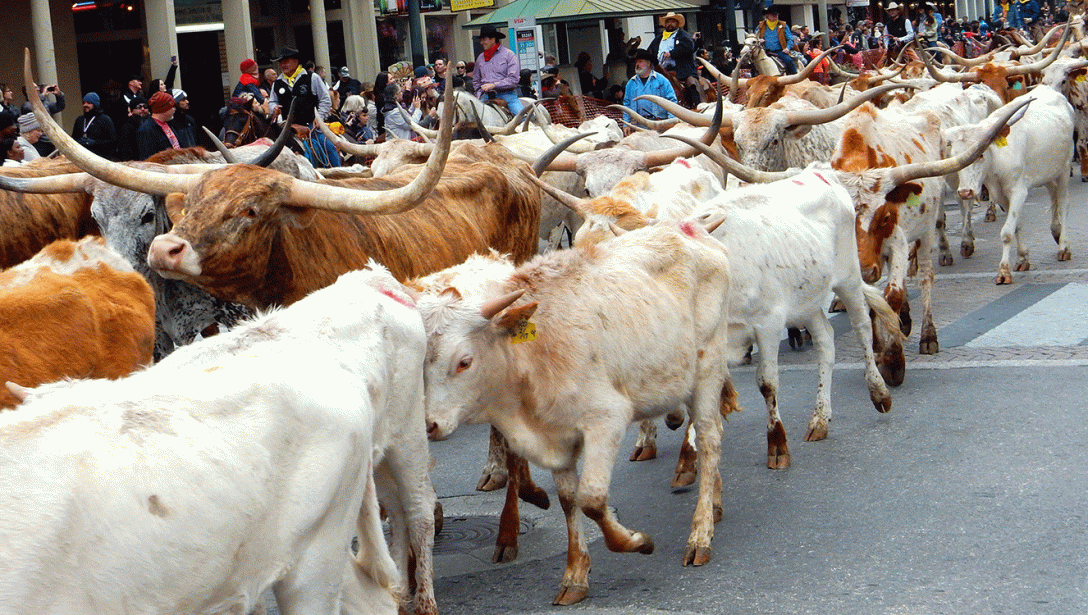
The sky spat a fine mist on us when we set out for a morning walk. We probably would not have headed out at all were I not obsessed by the prospect of seeing longhorns herded through downtown in the San Antonio Livestock Show & Rodeo’s Western Heritage Parade and Cattle Drive, enlarged this year as part of San Antonio’s celebration of its 300th birthday.

The tricentennial meaning of the “300” on the banner was lost on some of the spectators standing next to us. Child: “Wow. There are going to be 300 cows.” Dad: “No, it means this is the 300th year of the cattle drive.”

While this was not the 300th annual parade of longhorns, cattle have been part of San Antonio’s history since Native Americans tending livestock for San Antonio’s string of missions became America’s first cowboys. Many of the Spanish terms the charros used to describe their work and equipment became embedded in the English language, as in the word “rodeo” itself.

Longhorns are not foreign to downtown, with a strong connection to Alamo Street and its plaza:

In 1876 salesman Pete McManus with his partner John Warne (Bet-a-Million) Gates conducted a famous demonstration on Alamo Plaza in San Antonio in which a fence of Glidden’s “Winner” wire restrained a herd of longhorn cattle. Gates reportedly touted the product as “light as air, stronger than whiskey, and cheap as dirt.” Sales grew quickly thereafter, and barbed wire permanently changed land uses and land values in Texas.

“Barbed Wire,” Texas Handbook Online

Sheep, goats, hogs, cows and horses often clogged the streets as farmers and ranchers brought them in from the countryside to sell to city dwellers. City folks began to tire of the inconvenience of this practice as the 21st century dawned.

Driving wild stock through our streets should be prohibited at once. Yesterday afternoon a drove of about thirty horses went up Houston street, and came near killing a child, while general travel was greatly obstructed.

San Antonio Daily Express, March 12, 1891

Hoping this herd of longhorns will not be the last to parade past the Alamo.

Much like barbed wire transformed the days of the open range, a wall some propose to enclose San Antonio’s Alamo Plaza would bring an era to an end. For many San Antonians, the Alamo and its plaza represent more than a battle site frozen and time. Their evolution before and after 1836 is an integral part of our heritage. The plaza historically and currently lies at the heart of many of San Antonio’s annual celebrations.

Texans in other parts of the state often fail to realize how tightly this plaza is woven into our urban fabric. The revised Master Plan for the Alamo now appears to recognize that concern:

An early concept of structural glass walls was shared at a public meeting, however, the final Master Plan includes no walls. The plan does propose archaeology that would reveal the original Alamo wall footings so that visitors may see what remains of the original Alamo walls.

Although this assurance is followed by:

These and other design concepts will be fully explored in future phases of the plan.

Stay vigilant.

This year’s San Antonio Stock Show & Rodeo runs February 8 through 25.

Kicking off the year with biannual list of your favorite posts

The topics of posts you have been reading most over the last six months are wide-ranging. Concerns about the Alamo and Alamo Plaza tend to be remain your high priority, and the primary battle between Jerry Patterson and George P. Bush for Land Commissioner will keep these issues on the front page. I love it that you continue to help me promote Helen Madarasz as a ghost actively haunting Brackenridge Park.

The interest in our favorite restaurant in Budapest might arise not as much from regular followers as from Fricska’s loyal fans on facebook. San Antonio’s current Tricentennial Celebration seemed to send more people in search of “The San Antonio Song” written in 1907 by Williams and Alstyne. Thanks for your interest in my quest for a mini-Kate, and it makes me happy some of you heading to Guanajuato were aided by our restaurant suggestions.

So here’s your top 12, with the numbers in parentheses representing the rankings from six months ago:

  1. Dear Mayor and City Council: Please don’t surrender Alamo Plaza, 2017 (1)
  2. The Madarasz Murder Mystery: Might Helen Haunt Brackenridge Park?, 2012 (2)
  3. Postcard from Budapest, Hungary: Currently suffering from case of miss-you-Fricska blues, 2017

    Fricska Gastropub in Budapest
  4. Please put this song on Tony’s pony and make it ride away, 2010 (11)

    Chorus of “The San Antonio Song” written by the Tin Pan Alley pioneer team of Harry Williams and Egbert Van Alstyne in 1907: “San An-to ni An-to-ni-o. She hopped up on a pony and ran away with Tony.”
  5. Brackenridge Park: ‘Is it still a postcard place?,’ 2017 (4)
  6. What’s up top counts, 2017 (3)
  7. Thanks to the Mister on his day for persistence in obtaining my Mother’s Day present, 2017 (8)

    3-D representations of Kate
  8. Postcard from Guanajuato, Mexico: Wishing these dining spots were not 600 miles away, 2016 (6)
  9. Postcards from San Antonio a Century Ago, 2016 (5)

    San Antonio’s love affair with fresh corn tortillas is nothing new.
  10. How would you feel about the Alamo with a crewcut?, 2011 (7)
  11. Postcard from Campeche, Mexico: Sittin’ on Campeche Bay, 2017 (12)
  12. Postcard from Bergamo, Italy: Bidding Italy ciao, for now, 2017

    Bergamo, Italy

And the best part of number 12 on your list is that our bidding ciao to Italy “for now” appears accurate. Will be taking you there through pictures later in 2018. For now, though, delivery of postcards from the fall trip to Mexico City was delayed by the holidays. They will be dribbled out over the next month.

Thanks for dropping by periodically. Always welcome your feedback.