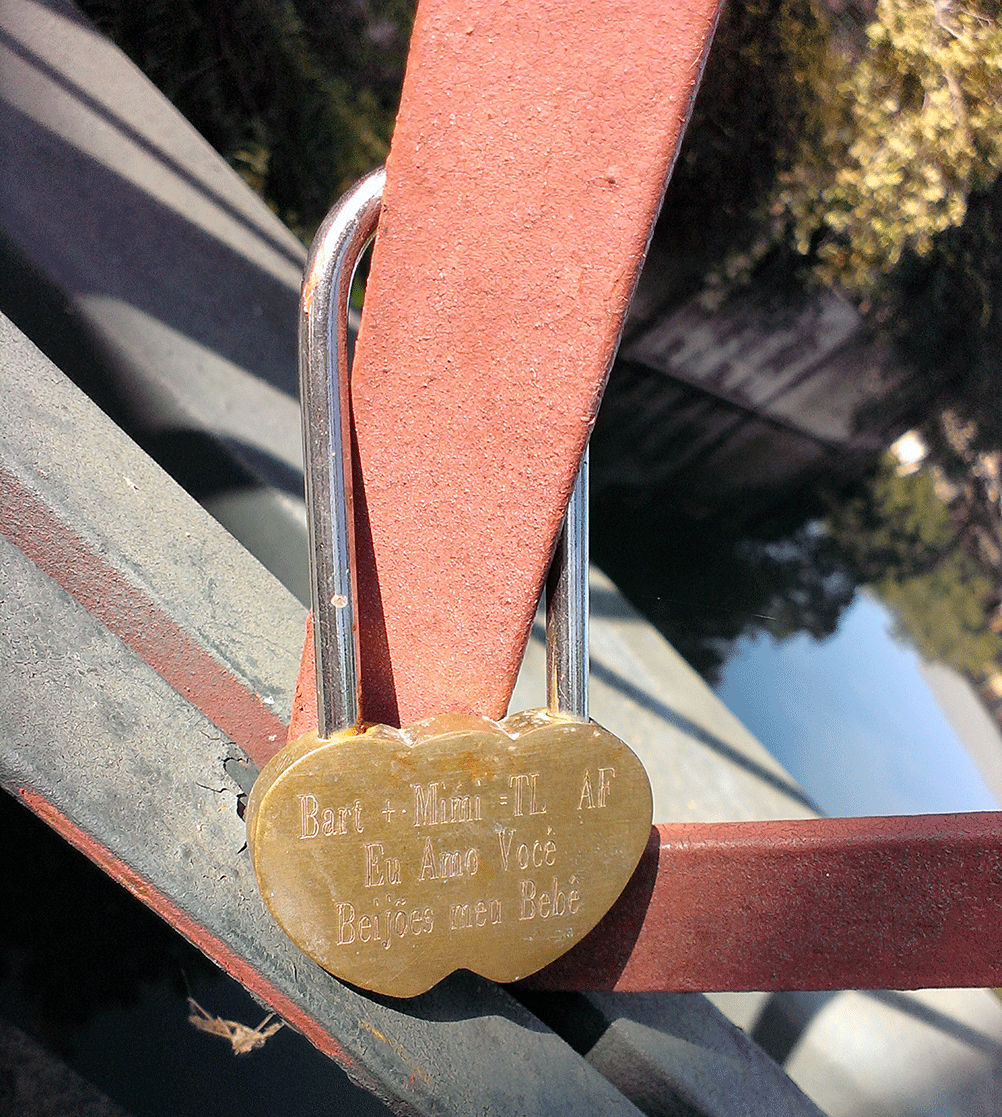
Bart + Mimi: Locked in love on ‘O. Henry’s Bridge’

Been watching “Bart + Mimi” for a while on morning walks, waiting to see if their public proclamation of love in Portuguese would multiply as love locks on bridges have around the world.

Multiplication is not desirable. A solitary lock is much more romantic, and cities where historic bridges are targeted struggle to cope with the weight of the demonstrations of love.

At first, I thought writing this blog would take much research into these cases, but fortunately “Mr. and Mrs. Adventure” spared me a lot of googling. They recently posted a blog on padlocked proclamations, including such sites as Via dell’ Amore in the Cinque Terre and the narrow 1828 Pont de l’Archevêché in Paris.

A few years ago according to The Independent, Parisian officials took action, only to be quickly reconquered by determined lovers:

A year after their mysterious disappearance, the “love-locks” of Paris are back on the city’s bridges, more plentiful and vibrant than ever despite lingering suspicions that unromantic officials from City Hall may again swoop with their wire cutters and remove the tokens of couples’ love….

In May 2010, Paris Town Hall expressed concern over the growing number of love-locks, saying: “they raise problems for the preservation of our architectural heritage”. It’s not only the Town Hall that expressed doubts; from time to time a dejected ex-lover has been seen desperately hacking at a padlock with a pair of pliers.

Shortly after this announcement, the bridge was found all but bare following a nocturnal clean-up.

Since the disappearance, lovers have shown their indignation by building-up collections once more….

The narrow pedestrian bridge in the King William Historic District on the south side of downtown Bart and Mimi selected to share their beijoes certainly looks the part. Some call the Johnson Street Bridge the O. Henry Bridge. Built in 1983, it replicates an earlier one removed from this spot during inartistic flood-control work completed in the 1960s. The 1880 bridge had been moved to Johnson Street from its original location on Commerce Street, where it served as an inspirational setting for writer Sidney Porter, or O. Henry.

This slideshow requires JavaScript.

While the moniker O. Henry might sound romantic, his morbid short story of suicidal consumptives set on the former Commerce Street Bridge was not. The following is from his Fog in Santone:

The drug clerk looks sharply at the white face half concealed by the high-turned overcoat collar.

“I would rather not supply you,” he said doubtfully. “I sold you a dozen  morphine tablets less than an hour ago.”

The customer smiles wanly. “The fault is in your crooked streets. I  didn’t intend to call upon you twice, but I guess I got tangled up. Excuse me.”

The purchaser of the morphia wanders into the fog, and at length, finds himself upon a little iron bridge, one of the score or more in the heart of the city, under which the small tortuous river flows.

But Bart and Mimi’s lock has triumphed over the inherited gloom, assuming its role as one of San Antonio’s quills:

If peculiarities were quills, San Antonio de Bexar would be a rare porcupine. Over all the round of aspects in which a thoughtful mind may view a city, it bristles with striking idiosyncrasies and bizarre contrasts.

Retrospects and Prospects by William Sydney Porter (O. Henry)

Hopefully, their en amo voce will remain a single quill and not inspire a wave of others to turn the little footbridge into an obese bristling porcupine.
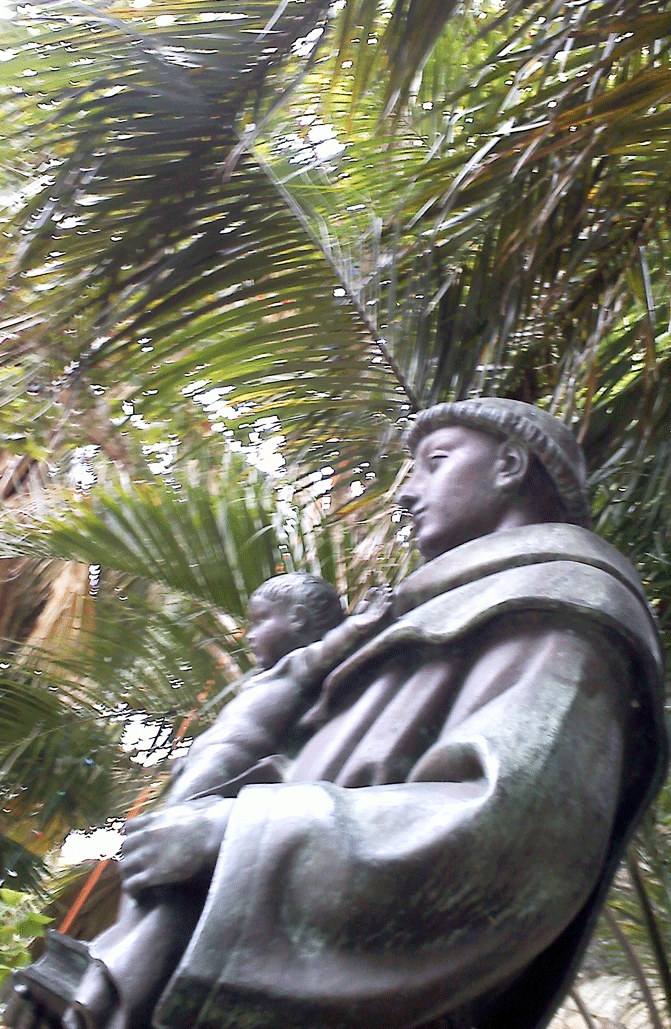
Sporting a San Anto medal just in case

Blessed be the eternal God; for the fishes of the sea honour him more than men without faith, and animals without reason listen to his word with greater attention than sinful heretics.

St. Anthony on the river

It is said that on that day, June 13, 2013, the fish gathered around him.

With great expectations, they gazed upward.

So many fish bobbed in the waters of the San Antonio River, barge traffic was halted.

The fish waited and waited to hear words of tribute. They waited for sounds of great celebration.

You probably think I am referring to the honkers, the ones who exuberantly circle the streets of downtown just above St. Anthony’s head whenever the Spurs are victorious.

Which they were not doing on June 13, the Feast Day of San Antonio de Padua, the patron saint of San Antonio.

Yes, the Spurs seemed lost. And, he, the patron saint of lost things, was all but ignored. Save by the fish.

St. Anthony, St. Anthony
Turn around.
I’ve lost something
That can’t be found.

Not everyone ignores St. Anthony.

What’s wrong with this video? It’s from Boston.

"Mission San Antonio de Valero Missing," digital collage by Gayle Brennan Spencer
“Mission San Antonio de Valero Missing,” digital collage by Gayle Brennan Spencer. Visit http://postscardssanantonio.com.

This festival does not take place here. In this city. In front of his mission.

St. Anthony is not vengeful. Surely the Spurs’ loss was mere coincidence. If saints interceded in sports, would St. Anthony have looked down more kindly on the team of his namesake city or the Celtics?

After all, here, in the heart of his city, we are in danger of losing even his mission. Mission San Antonio de Valero. But it’s rarely called by its proper name. You probably know it as the Alamo.

For a while, there was a spark of hope for an emerging celebration of our patron saint. An artist, Rolando Briseno, sought attention for the overlooked day on the calendar.

Flippin' San Antonio Fiesta 2011
Flippin’ San Antonio Fiesta 2011

He brought us a Flippin’ San Alamo Fiesta and a Flippin’ San Antonio Fiesta on June 13 a while back. An emerging grand Fiesta Patronal seemed on the horizon for future years.

But, alas, this year on the Feast Day of St. Anthony, the artist instead submitted a commentary to the San Antonio Express-News.

In this published piece, Briseno explains the rationale behind his earlier fiestas:

Tejanos, the first European/mestizo settlers of Texas and builders of the Alamo, and Latinos in general do not feel welcome at the Alamo today because the narrative has been spun into one of Anglo hegemony….

Little by little, over time, the Tejano role has been written out of the history books. Now that the Daughters of the Republic of Texas are no longer in control of the narrative at the Alamo, I’m among many who hope the Tejano contributions will be given just representation.

But Briseno has faith in the great state of Texas to rectify this, so there was no grand Fiesta Patronal:

I am not performing “Spinning San Antonio Fiesta” this year because Texas Land Commissioner Jerry Patterson, the new caretaker, has stated that he would like to change the Alamo’s narrative to be more inclusive.

This could make the Alamo a place where all people can go to leave behind discord and contemplate the convergence of cultures, and this, in turn, will make for a more harmonious future. That’s an ideal worth making a shrine for.

He’s right about the ideal. But I fear he is overly optimistic in his expectations of the commissioner.

There is much pressure building among the Alamobsessive to make Alamo Plaza a shrine to one day in history. And that day is not June 13.

Unlike Briseno, I fear that moment in 1836 will conquer the layers upon layers of history of great importance to our city that the plaza represents, both before and after the battle.

I’m not debating the historical importance of March 6, 1836, the Battle of the Alamo.

I’m not demeaning the sacrifices of those who perished in the battle, whether Mexicans or Texians. My dreams of Davy Crockett go way back.

And I do think millions who head to the plaza annually would benefit from better interpretation of that event on site.

But, I wonder whether the heroes of the day would want that moment in time frozen, the moment they were shot or impaled upon a bayonet.

If you were killed in a war, would you want those left behind to focus on the exact second the last drop of blood gushed from your body? Would you want them to visit that spot over and over and over, reliving your dramatic departure?

Or would you want them to remember what went on before, while you were alive?

And would you want to feel your sacrifice was worthwhile? Instead of being a static war memorial, would you want the plaza where you died returned to a place of life in the heart of a city filled with exuberant celebrations?

Briseno might be breathing easier, but I think it’s premature.

san-antoAs there is yet a Fiesta Patronal, I think some of us better don a St. Anthony medal if we want the story of Mission San Antonio de Valero to be found.

And, maybe, just maybe, it’s a good idea to go buy one before the play-off game tonight.

That way, at least the fish will hear honkers celebrating above St. Anthony’s head.

Go Spurs, Go!candle

Post-Game Update on June 19, 2013:

Maybe medals alone are not potent enough.

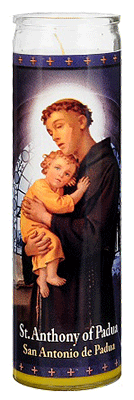
Time to ignite the power of a St. Anthony candle for Thursday night.

And, if we are not going to have a festival in his honor in San Antonio, I sure wish I could spend his feast day in his birthplace, Lisbon.

Pre-Game Update on June 20, 2013:

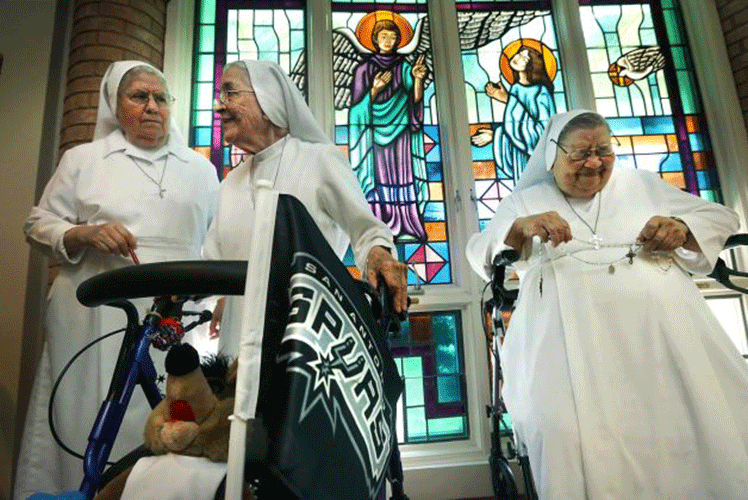
From “Nuns calling on the fan upstairs: For the naysayers who think Spurs don’t have a prayers” by Abe Levy in this morning’s San Antonio Express-News:

Would you deny the prayer of Sister Rosalba Garcia, 85?

A Spurs flag flutters from her walker next to a Spurs Coyote doll. On her closet door are team photos and a poster of her all-time favorite player, Manu Ginobili, next to a portrait of Sister Mary Mazzarello, the Salesians’ cofounder.

The photos accompanying this story are priceless.

Bob Owen photograph in San Antonio Express-News, June 20, 2013

Maggie Cousins: Urban Trailblazer

I wasn’t looking for Maggie this afternoon. But her name called out to me in the middle of a UTSA Libraries list of recorded interviews you can listen to online. I wanted to hear her voice, resurrected from the past.

At first, I was disappointed to find hers was only a transcript from an interview on KLRN. But, as I started reading, I realized it didn’t matter. I could hear her.

maggie-cousinsSusan Margaret Cousins (1905-1996) had one of the most distinctive voices I’ve ever heard. Maggie lived in New York City during much of her illustrious career including time as editor of Good Housekeeping and McCall’s and at Doubleday Publishing; yet years in the Big Apple failed to tame her Texas accent. In the March 24, 1974, edition of the San Antonio Express-News Mildred Whiteaker wrote, “Authoress Edna Ferber used to visit Maggie to get the flavor of the dialogue for Giant.”

Maggie’s pitch was incredibly low, and the words drawled out gruffly from somewhere deep in her chest. Most sentences ended with her wonderful chuckle rippling through her entire body.

Of course, most of the time I was listening to her it was happy hour. You never wanted to miss it when Maggie was holding court in the huge wooden corner booth where the “River Rats” gathered five days a week shortly after 5 p.m. as diligently as if punching a job-required time clock.

Maggie Cousins, 1986 Induction into Texas Women's Hall of Fame, http://www.twu.edu/twhf/
Maggie Cousins, 1986 Induction into Texas Women’s Hall of Fame, http://www.twu.edu/twhf

Maggie was a regular as long as she and her cane could propel her slowly huffing and puffing down the River Walk to the Kangaroo Court from her double-apartment in the Clifford Building. As a professional woman, Maggie broke the glass ceiling, inspired others to follow and never stopped writing, but the undated interview on UTSA’s website deals with Maggie in her role as a true urban trailblazer in downtown San Antonio in the 1970s:

I’ve been unusually happy in the city because when I first came I used to just walk up and down the River Walk. Sat down at Kangaroo Court one day and had a drink. Bob (Buchanan), the owner, came out and talked to me and from then on it became my place. I met all the young people that work downtown and the people that have the dreams and hopes and ideas and I was able to be in and listen to all their plans and most of them have come through with a lot of them. The wonderful young people who are downtown.

The booth in the Kangaroo Court was a great incubator and percolator for ways to improve downtown. But Maggie was one of the few “rats” who actually lived right downtown.

Here are a few of the Maggie-isms about dwelling downtown from the interview transcript:

  • There isn’t any atmosphere in the suburbs. You know, people live in large houses, have great manicured gardens, and they never go outdoors. I never see them using their lawns for any purpose.
  • I intended to have a car when I first came , and I couldn’t find a place to park. Living alone, you need a place to park and you can’t leave it in front of the building. So, I waited until they built a garage and then I was too old to drive.
  • Since the big boom in building has come and many of the old buildings have gone; when the new ones are built the rents are too expensive for small-time businesses like typewriter repair. When I moved here that was very important to me. There were three repair shops within walking distance of a block.
  • Mr. Butt, who lives in King William, has not built a grocery store for us poor people. But I presume when all these big condo projects are inhabited there will have to be a grocery store. I’ll be 95 years old. I’ve faced that.
  • I’d rather put up with the inconvenience and enjoy the things I enjoy down here. This place is within walking distance of the public library, which is important to me.
  • I have women friends who haven’t been downtown in ten years, they say proudly. I say, you gotta be crazy.
  • …I thought if I show people that they can live downtown they’ll get interested in it, but Texas people are very hard to change. But sooner or later, this generation will be interested in it.
  • If I ever get bored, all I have to do is look out the window….
  • Your lives are always made up of the past, present and future and without the past you just don’t have very much to look back on. And I think that San Antonio, that’s one of its great charms, the fact that it has some extremely fine 18th century architecture and lots and lots of 19th century architecture which I think gives it a quality that no other city in Texas has.
  • Imprint of human life on a place makes it more interesting and more attractive.

And Maggie’s imprint was rich and lasting.

I can hear her even now.

Update on June 13, 2013: Maggie’s obituary from the New York Times

Update on June 14, 2013: For more Maggie, visit these pages from When I was Just Your Age by Robert Flynn and Susan Russell:

I didn’t have any children to play with, but I had Grandpa and Grandma and aunts and people who had time to talk to me. They told me stories. That’s one reason why I became a writer.