Postcard from Bergamo, Italy: Final meals in Italy

The porcini man. We never learned his name. He slices fresh porcini throughout the day, places them in boxes at the door of the store and lets the distinctive woodsy scent announce to the locals the arrival of their supply.

The seductive ploy worked on us. We would sautee what for us was a luxurious mushroom with some of his rich dried tomatoes for a light supper. We visited him almost everyday.

Okay, not everyday for his porcini. His wine beckoned us to cross his threshold. He had the best prices and selection in the high, walled section of Bergamo. We could have bought wine down below, but it would have been a long haul back up the hill. And he was less than a block away from us on the narrow main street of the Alta Citta. A truffle store was a block away the other direction, but we limited our intake to shavings applied in restaurants.

There was a dangerous shop nearby that I tried to avoid. A storefront with two full windows of licorice candies. That business model would never fly in the United States.

Although there is nothing in my blood, I must have been born with Italian taste buds. The Italians seem to love the flavor of anise, and their licorice is the real thing. I crave the intense flavor but worry about the impact on my blood pressure. The memory of staying up half the night in a wide-awake state after a waiter in Ferrara left a full bottle of licorice liqueur on the table for me to self-serve reminds me to temper my intake. I asked the Mister – who absolutely has no hankering for licorice – to restrict me to a pastille or two a day.

While we continued to enjoy the traditional pumpkin-filled pasta, risotto, grilled vegetables and pizza we became accustomed to during our sojourn in Italy, our favorite restaurant in Bergamo was outside the walls in the city below. Monna Lisa successfully and subtly marries the flavors of fresh products and traditions of Lombardy tinged with accents from its owners’ native turfs – she hailed from Sicily and he from India. Results might include sea bass and ginger ravioli in a delicate mint and pea cream sauce; lentils dhal with smoked herring and coriander; or purple potato flan with gorgonzola and hazelnuts. So worth the hike down and the climb back up to the Alta Citta.

And, am embarrassed to admit, during our eighth week in Italy, a brand, new hamburger spot – Goss Grill – opened up almost across the street from us. We were among the first customers, ordering one to go to split hidden away in our apartment. It truly was as good as any American hamburger, yet tinged with an Italian accent of grilled eggplant and sun-dried tomato on top.

The subversive hamburger diversion should not be misconstrued to mean we do not continue to bow at the altar of alta cucina. Everywhere we go, we seek out Italian food after a week or so of immersion in any other cuisine.

It’s embedded in our taste buds.
Postcard from Campeche, Mexico: With abundant seafood, an ideal place to spend a meatless Lent

For anyone giving up meat for Lent, Campeche City would be an ideal place to spend the 40 days. Seafood is inexpensive and abundant. Finding fresh ceviche is no problem, and the huge shrimp are wonderful. A local favorite preparation is coconut shrimp, but menus offered many other options. Likewise, pulpo was prepared in vastly varying recipes.

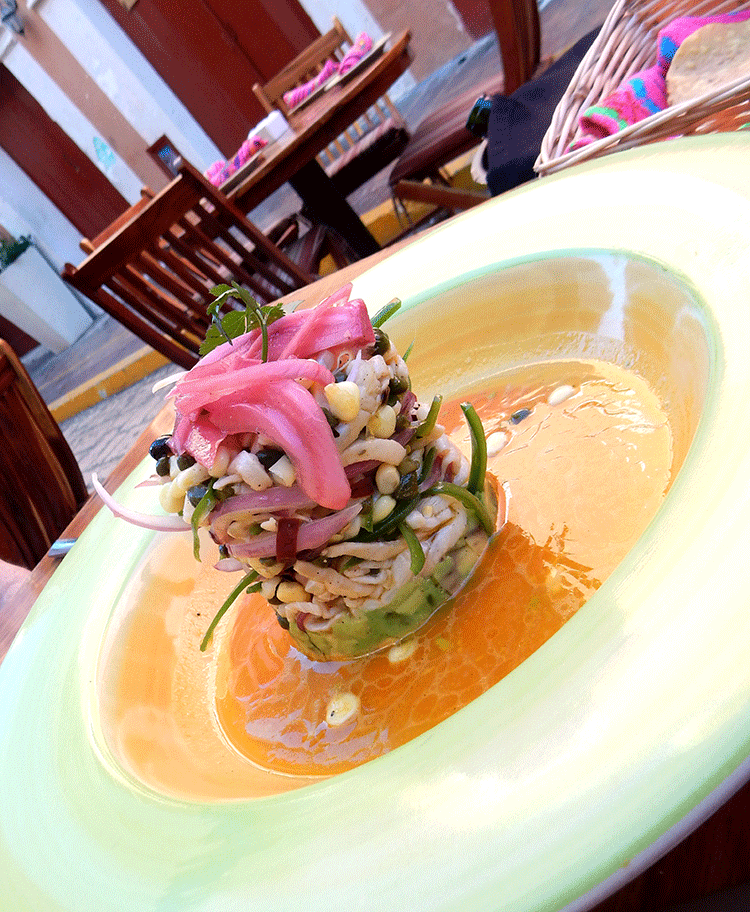
My absolute favorite seafood dish was the stacked salpicon de mero (a fish confusingly translated sometimes as grouper and sometimes as Chilean sea bass) offered at La Parrilla Colonial. Our top vote-getter for shrimp was a grilled wheel of shrimp topped with a cheese and spinach sauce served at Bavit 59. Other standouts included the cubes of ahi tuna topped with avocado at Bavit 59; camarones de coco and tostadas topped with pulpo al achiote at Restaurante Don Gustavo; and the achiote tuna tacos at La Parrilla Colonial.

And then there is dogfish. Americans have been slow on the uptake to eat dogfish, even though the small shark is commonplace from Maine to Florida. Fishermen harvesting them on the East Coast ship them off to England. The English apparently do not possess the same degree of seafood snobbery and gobble them up in pubs frying them for fish and chips. This lack of a market in the United States probably is a good thing because it takes a long time for these spiny dogfish to make babies; their gestation period is 18 to 24 months.

In Campeche, however, dogfish or cazon, is celebrated and used in numerous traditional dishes. Pan de cazon resembles stacked enchiladas. Black refried beans are spread on multiple layers of corn tortillas, topped with stewed, shredded dogfish and then covered with a tomato sauce prior to baking. Another centuries-old recipe features chiles xcatic, a regional yellow pepper, filled with stewed cazon. Although flavorful, we were not bowled over by either of these complex preparations. But this was not because of the flavor of dogfish. The cazon dish most to our liking was the simplest one – fresh dogfish tacos. We enjoyed these as an appetizer at Los Delfines, one of a strip of casual seafood palapa restaurants clustered together on one end of the malecon, a concrete boardwalk stretching miles along the bayfront.

We did eat meat several times. The Mister was smitten by the chicken with chaya, Mayan tree spinach, at La Parrilla Colonial. In addition to an elevated preparation of cochinita pibil, the kitchen turns out a flavorful taco al pastor for less than $1. Luan Restaurante Café offers a remarkably good milanesa telera, similar to a bolillo, but the cafe’s hours varied wildly. We broke away from regional specialties several times to enjoy Italian food at Scattola 59.

Both Luan and Scattola 59 endeared themselves to us because they carried multiple bottles of reasonably priced red wine. Some of the best restaurants in town made us feel as though they were conning tourists, as in us. They regularly claimed to be out of wines we ordered, with the only ones available as substitutes priced $5 or even $10 more. This touristy treatment made it hard to feel at home in the place we were staying for three weeks. A waiter at a boutique hotel should not be expected to beg customers to post positive reviews on TripAdvisor. And, in addition to upselling wine at another restaurant, the Mister had to endure a 15-minute parade of expensive Tequila offerings before finally being served the one he originally requested, strangely presented perched in a Johnnie Walker glass.

Aside from warning you to beware of or prepare to endure those peeves, we’d recommend any of the mentioned restaurants. The food in Campeche is distinctively different – in a good way – from any other place we have been in Mexico. Sure wish I’d encounter salpicon de mero in San Antonio.

Postcard from Bologna, Italy: We did eat at more than one restaurant

Rightfully, Bologna is renowned for its food. And, although this postcard is a bit belated, I’d hate to leave one with the impression our only recommendation for those traveling there is E’ Cucina Leopardi. We truly did venture away from our favorite spot… sometimes.

The lack of pretension accompanied by a comfortable, casual hospitality made the small farm-to-table Osteria Marsalino a favorite. Bruschetta and daily pastas were ever-changing based on what was fresh and the chef’s mood. Our food always was perfect, and the complimentary aperitif at the end of the meal contributed to our loyalty.

Fresh organic products are stressed at the always bustling Alce Nero Berbere. One lunchtime option is to order the daily vegetable assortment, consisting of five or six separate small plates of varying salads, greens, beans and/or roasted seasonal fare. There is a movement afoot among chefs in Italy, which we first encountered at Borgo 20 in Parma, to fret about digesting pizza dough. Although we never have noticed this to be a problem, we certainly again enjoyed the results at Berbere.

This is Berbere’s complex explanation of what makes the restaurant’s pizzas so “light” and good:

One of the principal characteristics of Berberè pizza is the substitution of leavening with natural maturation: we don’t use chemical yeast, but rather living sourdough. This maturation process lasts at least 24 hours at room temperature and not in the refrigerator (hence it is “slow” pizza). Thanks to the skill of our pizzaioli and their passion for what they do, the quality of the base dough obtained with the starter and semi-whole grain stone-ground flours guarantees a high digestibility and a distinctive flavor, while the selection and mixture of flours other than wheat (spelt, enkir, kamut) offers alternatives that are interesting and diverse from an organoleptic point of view. Berberè’s pizza is therefore lighter, healthier, and better. And to optimize the digestibility of the pizza, the chefs at Berberè have successfully experimented with an innovative fermentation method, completely free of yeast, based on the physical process of starch hydrolysis.

We followed a herd of locals to get the prosciutto in which residents of Emilia-Romagna take such pride. After ordering an appetizer plate laden with the thinly sliced ham, we ordered what we thought was a plate of grilled vegetables at Pane Vino e San Daniele. What we didn’t realize is that bountiful servings of prosciutto cover everything on almost every dish, including the vegetables.

Of course, we enjoyed many pizzas, grilled vegetables, pastas, risottos and panini elsewhere in our wanderings throughout our month-long stay. But, not to offend the Bolognese, we did break away from the regional cuisine several times. For Indian food. Ristorante Indiano Taj Mahal rewarded us well for it. The Indian dishes were much better than what we have encountered in San Antonio and, as a bonus, represented an incredible bargain. And the owner was so friendly and gracious for our patronage.

Jumping back now to our task at hand, figuring out where we want to eat lunch in Campeche. A whole different world.