You have done it again. No wonder I wander around flitting arbitrarily from subject to subject. My readers flit, too.
During the past year, you have remained as Alamobsessive as I, particularly focusing on the guns Land Commissioner Jerry Patterson let be drawn in front of the Alamo. You joined me in remembering my father-in-law, George Spencer, and photographer Rick Hunter. You have demonstrated your interest in photography by two artists, Richard Nitschke and Sarah Brooke Lyons. You have let me take you traveling to San Miguel de Allende, and shown interest in the reign of Maximilian and Carlota in Mexico.
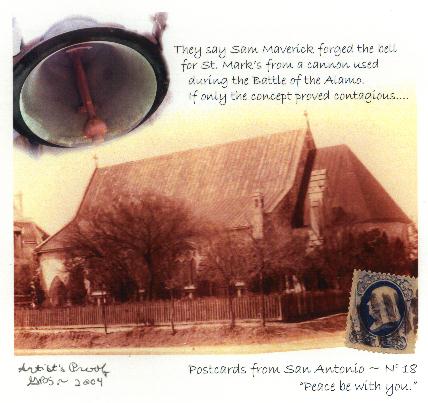
“They say Sam Maverick forged the bell for St. Mark’s from a cannon used during the Battle of the Alamo. If only the concept proved contagious….” Postcards from San Antonio – No. 12, “Peace be with you.” http://postcardssanantonio.com/other-themes.html
Empress Carlota and Emperor Maximilian of Mexico, circa 1864, from the Lusher Collection and included in exhibit at the Witte Museum February 1 through March 30
City of Mexico, Thursday, Jan. 10, 3 p.m., 1867 – Yesterday morning Col. Paulino Gomez Lanadrid, commanding 700 reinforcements of Imperial troops sent to succor the besieged garrison at Cuernavaca, was killed near that place during an attack by a body of Liberals, who were lying in ambuscade….
More than 500 families, mostly Mochos and French, will leave here on the 20th with 4,000 French troops….
Maximilian is waiting for the last French soldier to leave. The shadow of the last of the expeditionary corps will not be lost sight of by the Archduke, who is now residing in a humble house between here and the Castle of Chapultepec.
And so, Maximilian, the falling emperor of Mexico, awaited his fate.
“Execution of Emperor Maximilian of Mexico” by Edouard Manet, 1868 (not part of exhibit at the Witte)
The French installation of the Archduke Maximilian and his Belgian-born wife Charlotte to reign over the politically unstable Mexico of 1864 was bound not to end well. But the story is a rich one of international intrigue on both sides of the Atlantic.
As Trinity University Press prepares to release Maximilian and Carlota: Europe’s Last Empire in Mexico by Mary Margaret McAllen, the Witte Museum is opening a companion exhibit, “Maximilian and Carlota: Last Empire in Mexico,” focusing on the fascinating lives of the ill-fated royal couple. The exhibit of portraits, photographs and artifacts opens on February 1, while the author will read from her book and be available to sign copies during a reception from 4 to 6 p.m. on Saturday, February 8, at The Twig Book Shop.
Fell in love a few year’s ago with C.M. Mayo’s masterful novel, The Last Prince of the Mexico Empire, focusing on a child caught up in the political turmoil – Principe Agustin de Iturbide y Green. A Library Journal review in 2009 perhaps summarizes the complexities involved most succinctly:
Once upon a time, there was a little half-American boy who briefly became heir to the Mexican throne—until his distraught parents sued the doomed Emperor Maximilian for his return.
I highly recommend Mayo’s book, and am looking forward to reading McAllen’s. And if these and the exhibit leave you thirsting for even more glimpses into the lives of Maximilian and Carlota, Mayo maintains an ongoing blog Maximilian ~ Carlota, described as “resources for researchers of the tumultuous period of Mexican history known as the Second Empire, or ‘French Intervention.'”
I’m hoping one of the two authors will suddenly contact me with a sliver of information (a very unlikely record to stumble upon, so am certainly not holding my breath) about a San Antonio connection to the royal rulers. Among the Austro-Hungarians enlisted to serve in support of their reign in Mexico was Baron George Ritter von Tomasini (1818-1912). As the Second Empire of Mexico collapsed, Tomasini and his wife made their way to New Orleans and to San Antonio by 1872. Here, they joined the community of dairy farmers at the Coker Settlement, about which I am writing a book for the Coker Cemetery Association. Geographically, the heart of the Tomasini farm was located where the cluster of shops and restaurants known as The Alley on Bitters are found today.
February 3, 2014, Update: Read Steve Bennett’s review of McAllen’s book in the San Antonio Express-News
March 19, 2014, Update: David Martin Davies will moderate a discussion with McAllen from 10 to 10:45 a.m. in the Story Room on the 3rd floor of the Central Library during the San Antonio Book Festival on Saturday, April 5.
January 5, 2016, Update: C.M. Mayo has posted a podcast of a conversation with McAllen recorded in The Twig in October 2015.
Images clockwise: Stuart Allen, Ice No. 1; Judith Cottrell, Untitled; Mira Hnatyshyn, Temptation 1; Mark Blizard, Remembering the City
Fifty artists offering works for $250 each. Interested? Unfortunately, it’s an exhibit interrupted by city inspectors. If you want to see it, you will have to do so online.
A gallery/design studio/coffee bar/plant shop adaptively reusing an historically commercial building sounds an ideal fit for an inner-city neighborhood. An urban planner’s dream attained.
But French & Michigan needs a zoning change to make this possible at 115 Michigan Street and French, just off Fredericksburg Road.
The building obviously had its origins as a commercial structure, but current zoning lists it as residential. The building is bisected by the boundaries of the neighborhood master plan, half falling in residential and half in mixed-use.
Following a presentation by the owners, the Beacon Hill Neighborhood Association approved of their pending request for a zoning change to allow mixed usage, according to a TPR story by Ryan Loyd.
But neighborhood feelings about zoning are so much more personal. I’ve been there. When the Monte Vista Historical Association did not oppose a zoning change from residential on the corner of Mistletoe and Howard years ago, I had to go make my case I opposition in front of City Council. My emotional, shaky-voiced pleas were heard, and, probably because of former Councilwoman Maria Berriozabal, the zoning approval was overturned.
So I pay attention when she speaks in opposition to a zoning case. She commands respect for always looking out for individuals. And Berriozabal is speaking out against this zoning case, according to Josh Baugh writing in the San Antonio Express-News, because of neighborhood fears of “gentrification.”
Yes, there are other concerns in the neighborhood, but this one makes the zoning case so much more complex. Rather than being fearful that letting commercial usage return to this structure will lead to a domino effect of residences turning into businesses, some neighbors fear an invasive takeover by aggressive newcomers who want to buy houses and fix them up. Artists move in, and their patrons follow. Soon the housing stock rises in value, and, before long, the income level of the people who can afford to live there rises. Long-time residents fear being shoved out of their own neighborhoods.
And the bones of the housing in the surrounding neighborhood are good, even if some of the houses appear in need of a facelift. It is apparent that the neighborhood was highly desirable when it was developing in the first half of the 1900s, and fresh restorations indicate its popularity is rising today.
Ironically, in a neighborhood where some fear gentrification, one of the reasons a portion of the area was slow to develop, according to the history of the Beacon Hill Neighborhood, was a nine-hole golf course smack in the middle of it – the original San Antonio Golf and Country Club. As with many historic neighborhoods, perhaps the term should be regentrification?
And $250 artwork? Baugh interviewed neighbor Jessica Fuentes who said:
A lot of us in this neighborhood can’t sustain that business, so who’s going to sustain them? Outside people.
But, historically, those are the people who supported many of the locally owned businesses on Fredericksburg Road. The mom-and-pop shops that have disappeared, leaving vacant storefronts. Back before I-10.
When the way to Fredericksburg and all the farms in between actually was Fredericksburg Road, people would drive into town to patronize the businesses along that commercial corridor. A business such as Burke’s Wood Workers, opening at 115 Michigan in 1945, did not have to depend solely on its immediate neighbors for all of its income. Instead of waiting for Mrs. Jones down the street to wear out her sofa and chairs, Burke’s had customers who were, yes, “outside people.”
Baugh also spoke with City Councilman Diego Bernal:
Bernal, whose district includes several inner-city neighborhoods, said he is working on gentrification issues and zoning cases.
“I believe in areas like Beacon Hill, Alta Vista, Tobin Hill, that longtime residents are starting to see a change,” he said. “And sometimes change can be scary.”
People in Beacon Hill, he said, have channeled that fear into the French & Michigan project.
“I believe that’s unfair,” he said. “They’re not trying to take over the neighborhood — they’re trying to be part of it.”
Zoning changes are tricky, but the struggles in Beacon Hill are far from unique. They are constant even in old gentrified King William, often pitting neighbor against neighbor. Reactions are subjective, making them unpredictable. All sides should be given voice.
But…. that formerly commercial structure on French & Michigan sure looks great rehabbed as a gallery/design studio/coffee bar/plant shop. Hope it gets welcomed into its neighborhood.







 Postcards from Barton Springs