Postcard from Naples, Italy: Always on the prowl for vegetables

Large mixed vegetable plate, changing daily, at Un Sorriso Integrale

As seen in an earlier post, seafood often dominated our orders in restaurants. Great seafood often proved easier to locate than the vegetables we found ourselves craving.

Un Sorriso Integrale – Amico Bio Napoli was our salvation. We probably ate there five or six times for vegetable catch-up days. The selection is diverse and always changing to take advantage of the best vegetables of the season. And all are amazingly inexpensive. Always start with a dish of their spicy, truly spicy, fried chickpeas. Rather than make up my mind, I loved getting their mixed plate, which comes with a bowl of soup and six different vegetable combinations. The Mister was hooked on the wok plate. Oh, and a little picante chocolate soufflé to round out the meal.

Paccheri, an extra-large tubular pasta, seems to be a favorite regional pasta, with good reason. Antipasti combinations, such as the five-plate selection spread over two photos at Trattoria Scugnizzi Vomero, invite exploration. Two distinctively Neopolitan dishes we tried once but failed to understand their popularity were pasta e patate (pasta and potato is quite a starchy overload) and fried pizza (way too much fried dough).

Most of these restaurants are frequented by locals and were mentioned in the seafood post, so this time around I will just post their links to click in case a photo inspires you to investigate whether to add them to your list of places to try. Since most of these are not tourist-dependent, I am hoping they will survive the current slow-down.

In the Vomero neighborhood:

Trattoria Scugnizzi Vomero

Godot Restaurant

Olio e Pomodoro

Pizzeria Errico Porzio Vomero

In the historic center:

Re Lazzarone Trattoria Contemporanea
Anonymous Trattoria Gourmet

Antichi Sapori Partenenopei

Ristorante L’Ostricaio


Artist and architect collaboration creates “red” home for contemporary art

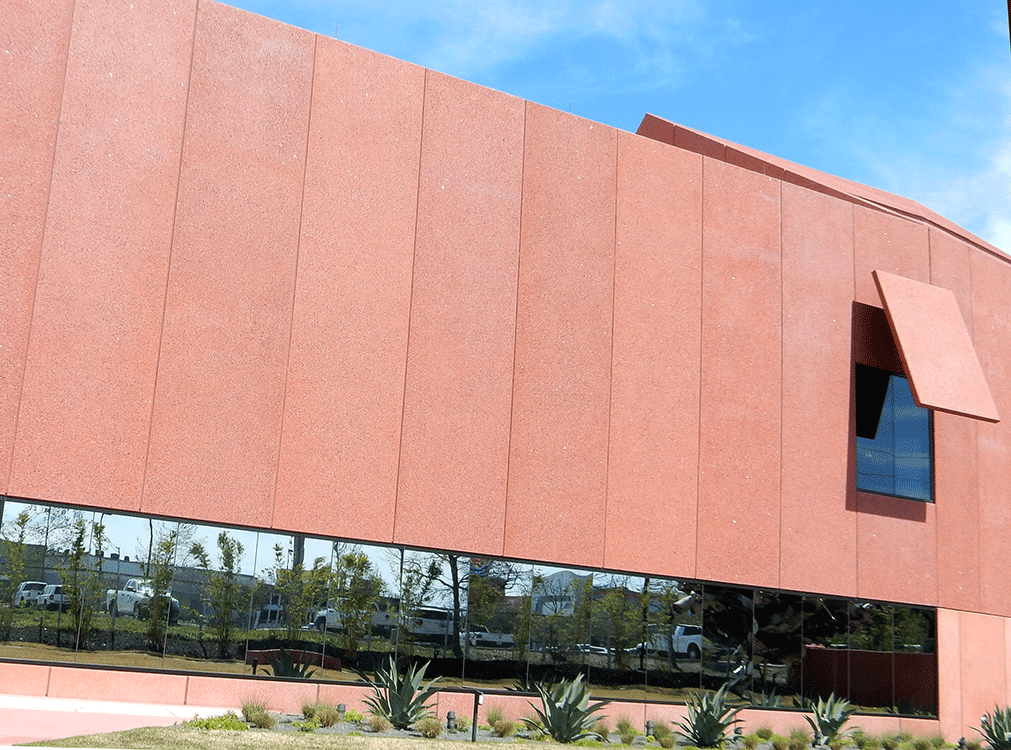
Ruby City, designed by architect Sir David Adjaye Obe

I like to collaborate with artists that see space and structure as integral to their work. It involves a merging of skills and aesthetics to create something that has more potential than either discipline can achieve on its own.

Architect David Adjaye

That desire must have made Linda Pace (1945-2007) an ideal client for the architect of international renown, for the passionate collector of art was an artist herself. Writing for The Guardian just prior to the October 2019 opening of the Linda Pace Foundation’s Ruby City in San Antonio, Adjaye noted that Ruby City is an:

…example of how place and history are always important. Linda… had cancer and it had just become aggressive. She knew she was starting to go down. She became fascinated with dreams and their interpretation…. Then she drew this place she called Ruby City. Her drawing looks like a shining city on a hill or a Russian Orthodox church. For her it was a vessel, a hope…. a hope that her disappearance would have an impact.

I became fascinated by it. Red had become so important to her that I wanted to use that as a start point. From discussions we had, I looked at San Antonio and the missionaries who came to the region and the structures they built, the incredible monasteries. I also looked at pre-colonization America and Mesoamerican culture and their relationship to making architecture out of mud and raising these incredible citadels all over that part of Texas and New Mexico. The commonality for me between the monasteries and citadels is that they’re both about religion but also about death and communing with the afterlife – and they’re habitation spaces. Those ideas, mixed with her idea of the form, became an idea about architecture articulating light as a revealer of different facets of her art collection….

So the Ruby City building is about Linda, Texas and the collection.

Linda Pace left behind a collection of more 900 works of art in the hands of the foundation that bears her name. The immense collection will be displayed in rotating exhibitions in the new Ruby City and her former studio and Chris Park across the street. Entrance to the campus and galleries is admission-free.

For now, Ruby City addresses the back service vehicle parking lot of an inartistic branch of the United States Post Office, but that dismal view will be dramatically changed as part of Phase Two, now in the planning stages, of the San Pedro Creek Project.

Postcards from Naples, Italy: Palazzo adapted to showcase contemporary art

Mimmo Paladino, 2006 rooftop installation at MADRE

The 19th-century Palazzo Donnaregina, referred to as “an example of historical stratification,” was purchased in 2005 by the Campania Regional Government for rehabilitation as a contemporary art museum. Much of the work was completed under the guidance of Alvaro Siza Veira, a Portuguese architect. By 2006, two floors of MADRE – Museo d’Arte Contemporanea Donnaregina – opened to the public. Daniel Buren’s brightly colored and illuminated installation in the entryway of MADRE sets the tone for the contemporary contents.

When we were there this past fall, there was an impressive exhibition of work, “Whisper Only To You,” by a South Korean artist, Yeesookyung. During her residency in Naples, she incorporated pieces of Capodimonte porcelain into the design of her large shapely vessels.

The master potter was trying to create the perfect piece each time, and he would discard even the ones with the slightest flaw. So I chose to create new forms from them, because perhaps, I don’t believe completely in that kind of perfection. To me, a piece of broken ceramic finds another piece, and they come to rely on one another. The cracks between them symbolise the wound.

Yeesookyung, interviewed in The Business Times, 2013