Centenarian Santa still shining bright

“‘Twas the night before Christmas….” Time to wake Little Santa Light up from his annual estivation/hibernation.

Covered with nicks as one would expect with his years, Santa spends 364 days carefully cradled in fluffy cotton to extend his life as long as possible. We are unsure of this Saint Nicholas’ actual age, but family lore passed down by the Mister’s grandmother, Virginia Lamar Hornor (1895-1988), traces his birth back before World War I.

With expensive early electric bulbs regarded as fragile and unreliable, Santa was treasured even at a tender young age. Grandma said the Lamar family would light him each night during the holidays, keeping Santa burning to guide her brother, Lucius Mirabeau Lamar, III (1898-1978), safely home from World War I.

Through the ensuing decades, the jolly old elf became regarded as a good luck omen – as long as he would light. And he has continued to do so.

Partially crediting Little Santa Light with his own safe return from World War II, Louis Hamilton Hornor, Jr. (1922-2005), coddled him for years. The Mister’s uncle bought Santa his own little Charlie-Brown-esque tree and found a sturdy box to serve as his bed. Uncle Louis fretted over the proper voltage for the aging family relic, so he attached a voltage attenuator to ensure no powerful electrical surge would knock the little guy out.

The annual Christmas Eve lighting is always tinged with excitement and a bit of fear. Suppose this is the year Santa refuses to rouse? What would a burned-out Santa signify?

Once again on December 24, family members took a deep breath as the Mister’s younger brother screwed Santa in tight. Sighs of relief and cries of good cheer burst forth as Saint Nick suddenly glowed.

Not wanting to exhaust the family’s oldest member for much more than a flash, he was quickly unscrewed and tucked snugly back in his bed. As we closed the lid once more on his lair, I am sure I heard him whisper as he went out of sight: “Happy Christmas to all, and to all a good night.”

Clement Clarke Moore (1779-1863) wrote the enduring poem, “A Visit from St. Nicholas,” in 1822.

Edward Hibberd Johnson of the Edison Lamp Company first hand-wired 80 red, while and blue light bulbs and strung them around a tree in the shop’s window in 1882, according to an article in Smithsonian Magazine.


Postcard from Turin, Italy: Letting the graveyard provide introductions

Carlo Tancredi Falletti (1782-1838), Marquis of Barolo, was mayor of Turin in 1827 when he determined the city needed an elegant new cemetery. At the time, Turin was the capital of the Kingdom of Piedmont-Sardinia.

The Monumental Cemetery of Turin (Cimitero Monumentale di Torino) occupies almost 150 acres of land. And, once again, this taphophile is introducing you to a city via a visit to its residents of yore.

A woman after my own heart, Manuela Vetrano has written a book on this particular cemetery – Torino Silenziosa.

It was 2011 and I was walking through the most ancient part of the Cemetery of Turin, surrounded by magnificent works of art by important names in Italian history. I started wondering why there was no one else but me. Superstition? Fear? I thought it would be nice to let others know about this rich and important place. I started looking for books and documents about the Cemetery and I spent many hours inside it to observe and study tombs and monuments. I collected so much material that it allowed me to open my blog, lead guided tours, and write a book, too. The stories that struck me the most refer to almost unknown personalities.

“The Monumental Cemetery of Turin: Interview with Manuela Vetrano,” Emanuela Borgatta Dunnett, Wall Street Journal, December 1, 2018

Postcard from Marfil, Guanajuato, Mexico: Wait, are you sure we are not in Italy?

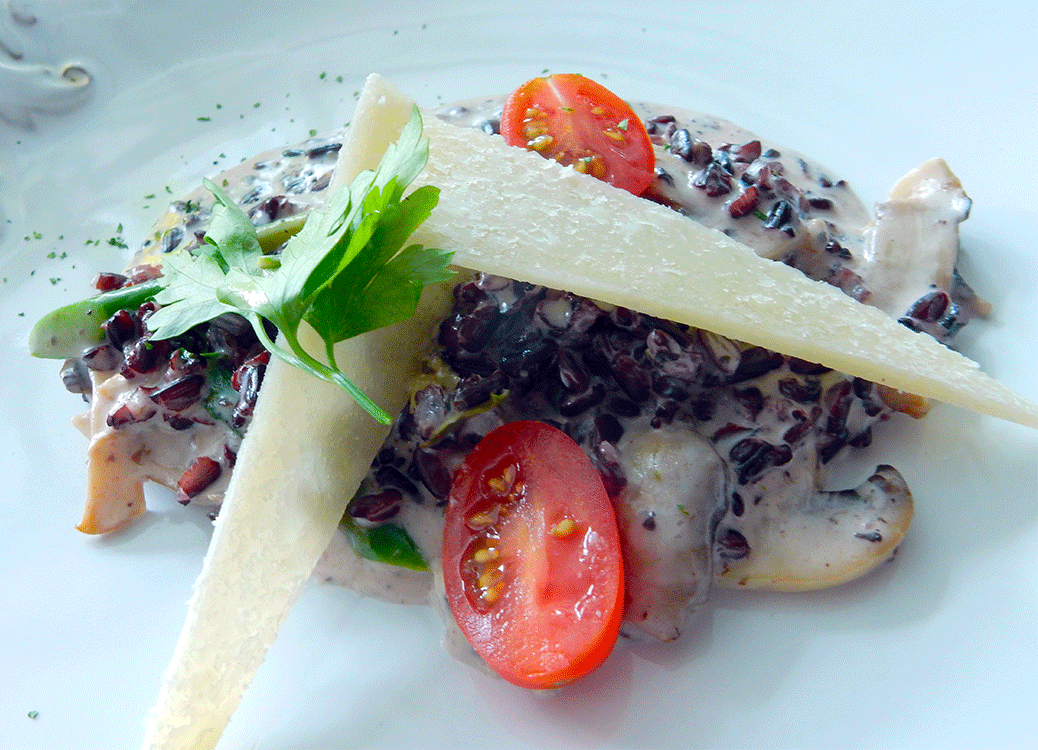
The creamy rich black rice risotto above was one of the best risotti we had in Italy. Wait. We were not in Italy any longer. We were in Guanajuato.

But Peccato di Gola is so good, I dare plop a post about it right here in the middle of “postcards” from Italy. We went to Marfil on the edge of Guanajuato to visit the Casa Museo Gene Byron (more to come about it after delayed Italian posts are delivered). People rave about the food at the museum’s restaurant, but it was closed on a Monday – often an issue when traveling.

So we walked past the ancient dam to the other side of Marfil, not a major hike, to an at-first unappealing strip of restaurants right on the side of the roadway. But stepping inside the comfortably furnished Peccato di Gola quickly altered that first impression.

We were considering opting for pizza, but the owner/chef (who we think is from Rome) piped up that Monday was our lucky day. On Mondays the restaurant offers a 300-peso (about $15) fixed-price lunch. This is not your normal fixed-price offering; no, it is one inviting you to fully understand the restaurant’s name. For our 300-peso per person investment, we could order anything on the menu, except steaks, until we wanted nothing more. Peccato di Gola translates as the sin of gluttony. And we fully consented to commit it.

With a large selection on the menu, we sat back and let him pick our starters while we tried not to fill up on the freshly baked olive bread. The chef definitely had my attention when he bypassed the wood-fired stove to a smoldering grill and placed something over the coals for us. Oh my, grilled octopi. He followed that with fried zucchini blossoms filled with gorgonzola and topped with shrimp. And then a plate layered with rounds of salmon carpaccio and a board bearing caprese salad.

Did we stop there? No, not I said the glutton. We sampled lobster ravioli, again topped with shrimp. And perfectly cooked salmon. Then he brought out a dessert board for us.

I do promise, though, that these photos are from more than one meal. We sinned twice, and then went back one more time to try the pizza.

Although the pizza topped with vegetables popped out from the wood-burning oven looking perfect, it actually was our least favorite dish there. The crust had good texture but had the issue we generally find true in Mexico. Pizza crusts in Mexico often have too much of a white-flour taste compared to what we are accustomed. While not up to Italian standards, this still was the best pizza we found in Guanajuato.

But no matter what day you decide to head to Marfil – a short and inexpensive cab ride from downtown – let Peccato di Gola transport you to Italy. Aside from the pizza, everything we sampled on the menu comes highly recommended.

Oh, to have the opportunity to sin like that again.