Postcard from Siracusa, Sicily: Sturdy columns of Greek temple recycled by several religions

Above: Façade of the Duomo di Siracusa, or Cattedrale della Nativita di Maria Santissima

The chapel where some of Santa Lucia’s relics, featured in a recent post, are housed in the Cathedral of the Nativity of Mary Most Holy. A statue of her reigns up high on its façade to the right of the Virgin to whom the church is dedicated. Up on the left is San Marciano of Siracusa with San Pietro and San Paolo flanking the entrance down below.

Over the past 2,000 years, the history of Saint Marcian of Syracuse has become somewhat muddied. One version is that he was a follower of Peter the Apostle, who dispatched him to Sicily to preach in the year 40. His conversion rate was so high that the ruling Romans deemed him dangerous, and he was put to death. San Marciano became known as the first bishop of the city and is the patron saint of the archdiocese.

The “new” façade of the cathedral dates from after the 1693 earthquake and reflects the style categorized as High Sicilian Baroque. But the rest of the building has much deeper roots. The site was occupied by a 5th-century BC temple of Athena, possibly constructed under Dionysius I. Thirty-six substantial columns surrounded the outer perimeter of the temple – columns so substantial they withstood the devastating earthquake and can still be viewed on the north side of exterior and within the cathedral itself.

Continue reading “Postcard from Siracusa, Sicily: Sturdy columns of Greek temple recycled by several religions”
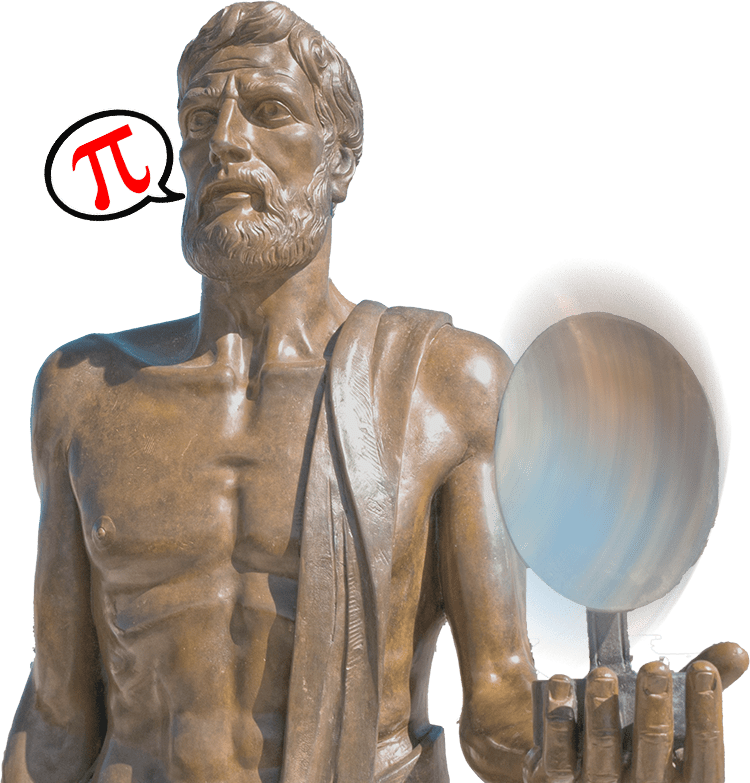
Postcard from Siracusa, Sicily: Why everybody wants math nerd on their side

Above: Monument commemorating a hometown hero, Archimedes

Certain things first became clear to me by a mechanical method, although they had to be demonstrated by geometry afterwards because their investigation by the said method did not furnish an actual demonstration. But it is of course easier, when we have previously acquired by the method, some knowledge of the questions, to supply the proof than it is to find it without any previous knowledge.”

Archimedes (About 287-211 BC)

Seriously? The above is an example of Archimedes-speak that is babble to me. Math is far from one of my languages – Greek to me. In fact, I would almost consider Archimedes an enemy – the Father of Mathematical Physics, the Father of Integral Calculus and the man who tortured himself long enough to figure out such seemingly unsolvable puzzles as Pi.

Except, a visit to Siracusa convinced me that in times of war, or peace, you definitely would want Archimedes with all his math and inventions on your side.

Continue reading “Postcard from Siracusa, Sicily: Why everybody wants math nerd on their side”

Postcard from Siracusa, Sicily: Where Plato tested and failed tyrant-taming

Above: Caves created by ancient Greek quarries, including the notorious Ear of Dionysius, line a bluff in the Archaeological Park of Neapolis

Long ago, Siracusa became an important outpost of the Grecian Empire. For strategic reasons, the ancient city first developed on the small island of Ortigia.

A major vestige of this are the ruins of the Temple of Apollo in the heart of the city adjacent to the island’s bustling outdoor market. Forty-two monolithic columns once framed the sixth-century-BC Doric temple dedicated to the sun god. These remnants of the temple incorporated into several private homes and 16th-century military barracks occupying the site were “rediscovered” in the 1890s.

Continue reading “Postcard from Siracusa, Sicily: Where Plato tested and failed tyrant-taming”