Postcard from Sevilla, Spain: The most celebrated mother in Spain

My childhood memory might be as hazy as the incense clouds at midnight mass, but I think the head covering of a rather homely statue of the Virgin Mary at Star of the Sea church was a humble blue cloak.

In Spain, things are different. La Virgen generally wears richly embroidered gowns with an elaborate silver or gold crown perched upon her head. And she is mesmerizingly beautiful.

In Adalusia, she appears everywhere (see La Virgen tiles of the streets of Seville here). In Seville, one stunning representation of Mary per church is rarely enough. Although Holy Week theoretically revolves around the story of Jesus’ last days before his crucifixion and resurrection from the dead, the candlelit floats bearing Mary through the streets are the stars.

The most cherished of these is La Macarena, or La Virgen de la Esperanza (above). The 17th-century carved wooden figure resides on the altar of her Basilica in the Macarena neighborhood in Seville. When she emerges at midnight on Good Friday, the assembled faithful gasp and cry, with some scrambling to touch her cloak. She is paraded through the streets for 12 hours, with candles lit, according to Margaret Galitzin, to prevent her from seeing her son’s suffering on the float preceding her.

The wooden representation of Our Lady of Sorrows with her dramatic glass tears generally is attributed to Pedro Roldan (1624-1699). She received numerous makeovers through the years, particularly after a not-very-pious drunk hurled a bottle at her resulting in a “bruise.” Legend claims no cosmetic alterations could erase the damage. According to Galitzin:

When the man who committed this terrible offense against the Mother of God became sober, he saw the bruise and repented for his crime. For his penance, he resolved to walk before the statue each Holy Week with chains on his feet and carrying a cross to expiate his sin. After his death, his descendants continued this practice. To this day, it is said, a family member continues this act.

In addition to her elegant attire and shining crown, La Macarena wears several emerald floral brooches. The jewels were a gift from one of Seville’s most famous matadors, Jose Gomez Ortega (1895-1920), Joselito. A Canonical Coronation in 1913 added these precious stones to the garments of La Virgen.

You might have noticed the year of Joselito’s death and realized it seems premature. His faithful tribute failed to spare him from a fatal goring 99 years ago.

Yet La Virgen went into mourning. She wore widow-black robes for a month following his death – the only time she has shed her embroidered fashions. La Macarena remains the patron of bullfighters.

The photographs collaged here are regal representations of La Virgen from numerous churches in Seville.


Belated Mother’s Day wishes to all.
Postcard from Ravenna, Italy: A pair of baptisteries

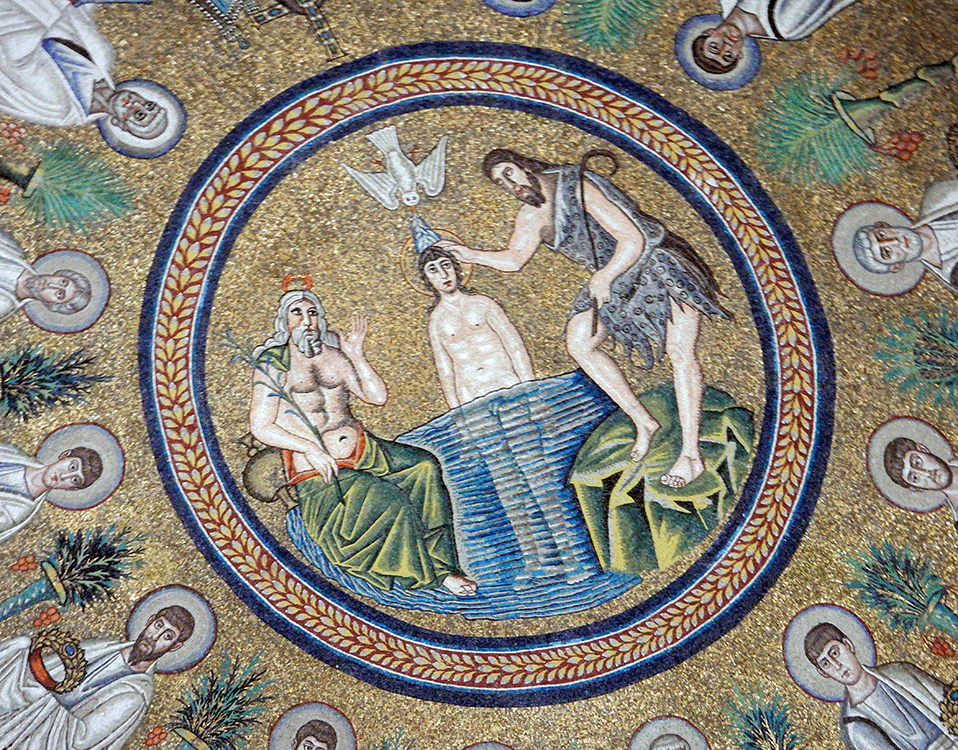
Ravenna has a pair of octagonal brick baptisteries dating from the first 500 years or so of Christianity. The oldest of the two, the Neonian Orthodox Baptistery, is named for Bishop Neon who had the existing structure crowned with a masonry dome. The second baptistery was built by Theodoric the Great, the King of the Ostrogoths, because…?

Maybe Theodoric wanted one closer to his palace; although Ravenna certainly is walkable. Plus, Theodoric was an Arian Christian, as opposed to Orthodox or Roman Catholic. To those mainstream Catholics, Arian Christians were heretics. Not a theologian, I have little understanding of the distinctions. Obviously, the differences are major or there would not have been two baptisteries, and the Ostrogoths and those they battled probably would have gotten along better.

The followers of these religions all believed in Jesus, but differed concerning the balance of power. Arians made Jesus subservient to God, His Father, and there was no Trinity. Arians, therefore, were not haunted by the Holy Ghost as part of the religious triumvirate. That made things much simpler to explain to potential converts because the Holy Spirit is conceptually difficult to grasp, particularly since the image is not personified.

Theodoric’s mosaic artists probably were not Arian because the Holy Ghost, represented as a dove, is hovering above spurting water over the scene above to assist the John the Baptist, modestly clad in a leopard-skin cloak. This was fortunate because, when the Arians were kicked back out of Ravenna only a couple of decades later, the mosaics were not destroyed as heretical.

The duplication of baptisteries is particularly interesting because, according to an article by Annabel Jane Wharton, the ceremonial structures were rarely used:

In the early Church, the principal baptismal liturgy took place once a year, on Easter Sunday eve: the of the Resurrection was deemed the most appropriate moment in which to die and be reborn in Christ…. Enrollment of those to be baptized took place at the beginning of Lent…. In the weeks of Lent efforts were made to prepare initiates for their admittance into the full fellowship of the Church through an arduous routine of fasting, catechism, and daily exorcism.

Wharton wrote participants entered the baptisteries and faced west first to renounce the Devil, then east to embrace Christ. Garments probably were removed before the baptism, leaving the new believers as exposed as Jesus above, with his navel the geographical center of the artistic composition and the dome. Then the baptized donned white garments as a sign of their new-found purity.

Because I feel fairly confident few religious scholars would read very far into my posts, I have taken the liberty of jumbling the photographs from the two baptisteries together into one collage. When returning from trips and sorting through images, I sometimes feel as though someone took the whole proverbial slide tray, dumped them out and shuffled them to confuse me. I do believe all of these photos belong to one baptistery or the other.

While years of Saturday catechism classes at Star of the Sea left me with a rather hazy understanding of the role of the Holy Spirit, I am sure happy the nuns opted for a rap on the knuckles instead of requiring daily exorcism during Lent.

Postcard from Ferrara, Italy: Seeking signs of miracles

The nuns of Star of the Sea instilled the fear in me long ago. Never touch the host as Father Habit placed it upon your tongue. Suck on it gently, very gently, as you head back to your pew to pray. And, no matter how strong a vacuum it creates adhering it to the roof of your mouth, do not prod it loose with your finger and, never, never, never ever chew it before swallowing.

They insinuated that something major would occur if you violated these rules. I mean major. Like suddenly your whole pew full of people would be swallowed up by the earth or a lighting bolt would flash through the ceiling striking you dead upon the spot. They had me convinced.

Things are different today. God is more tolerant and forgiving; he no longer minds if you touch the consecrated host.

But a miracle in Ferrara left me wondering whether the nuns were wise in issuing their strong prohibitions.

Father Peter of Verona was celebrating mass in Ferrara on Easter Sunday in 1171, when he raised and broke the consecrated host, now the body of Christ. Blood sprayed and splattered upon the vault above the altar. A miracle.

Pilgrims from around Italy flocked to see the bright red proof left upon the ceiling. The church, the Basilica of Santa Maria in Vado, was expanded greatly to accommodate them in 1495, and a special vault was constructed within the sanctuary to safeguard the site.

Alas, I climbed the stairs to examine the bricks but failed to spot the spots. Perhaps that failure is the fate of lapsed Catholics – missed miracles.

On the other hand, maybe those red spots simply are faded. The evidence of the miracle appeared on that vault more than 800 years ago.