Postcard from Sevilla, Spain: A piece of a saint to answer almost any prayer

Above is simply the underside of one low altar found along a wall of San Luis de los Franceses. The photo probably is not clear enough for you to really get the picture, but the entire length of it is a repository for bones. Sacred bones. Remnants of saints. And they are found everywhere in this former church. Some shards are almost microscopic and certainly appear so in our photos.

But most people probably visit San Luis for its unusual architectural bones.

By way of introduction, the building is dedicated to Saint Louis of France, King Louis IX (1214-1270). San Luis was the favorite saint of the woman who originally donated the land to the Society of Jesus if they agreed to honor him.

The titular honor also represented a politically correct move for the always-in-trouble Jesuits as a respectful tribute to the Bourbon monarchs ruling over Spain at the time. Appropriately, a majestically crowned portrait of San Luis by the prominent artist Francisco de Zurburan (1578-1664) dominates the main altar.

The Baroque structure was designed by architect Leonardo de Figueroa (1650-1730) on the plan of a Greek cross. The cross is crowned by an ornate cupola and features major gilded altars at the end of each of its four arms. Figueroa also incorporated a heavy dose of my favorite columns – helical or Solomonic twists.

Distinctive octagonal towers top the sculptural façade, a façade difficult to appreciate on such a narrow street. The four evangelists, the three archangels – they were all meant to address a major plaza below. The plaza envisioned did not materialize. Despite their tribute, the Jesuits ran into problems with the powers that were.

With the expulsion of the Jesuits from Spain in 1835, their properties came under the control of the crown. It is hard to imagine how much it pained the Jesuits to abandon the hundreds of precious relics of saints stored and displayed in every nook and cranny in this former church.

Repurposing of San Luis never resulted in irrevocable alterations affecting its original architectural integrity. The Provincial Council of Seville refurbished San Luis and reopened it to the public only two years ago.

While the former church is not consecrated, the bones still attract the faithful. Many of these probably received Vatican authentication for veneration centuries ago.

Think there is a portion of a patron saint housed within San Luis to meet almost any need for prayers that could arise.
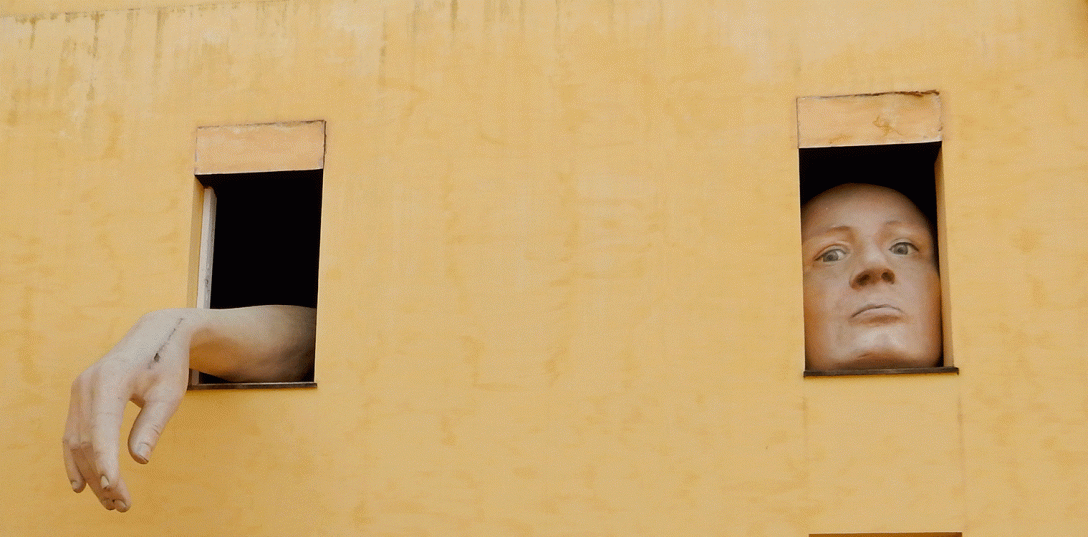
Postcard from Sevilla, Spain: Contemporary art invigorates former Carthusian monastery

The giant “Alice” by Cristina Lucas is indeed stuck in a curiously odd place on the Isla de la Cartuja. Sevilla is bustling on one side of the Guadalquivir, but crossing the river on foot to this part of the island at first appears to be heading into somewhat of a remote no-man’s land.

For centuries, much of the clay for the city’s azulejos came from the island. In 1400, Archbishop Gonzalo de Mena chose the location for a Carthusian monastery. The founding of Monasterio de la Cartuja was in the nick of time to provide a suitable permanent home for the archbishop to rest, as he died in 1401. Christopher Columbus’ body was placed in the Capilla de Santa Ana from 1509 to 1536, but the archbishop’s tomb in the Capilla de la Magdalena Chapel is not the only one remaining within the ancient walls of the monastery.

Patrons of the monastic order, members of the Ribera family reside in sculpturally rich tombs dating from the 16th century and dominating the Sala Capitular. The 15th-century chapel with its colorful tiles serves a prime example of Mudejar architecture. Some of the bizarre images incorporated in the ornate motifs surrounding the tombs appear as though they emerged from the mind of someone who swilled some Wonderland “drink me” potion.

Government seizure of ecclesiastical property in 1836 left the monastery available. Englishman Charles Pickman rented and soon purchased the property to manufacture La Cartuja de Sevilla Pottery. Enormous brick chimneys erected there demonstrate both the size and modernity of the production facilities. In addition to tiles reflecting the city’s heritage, the facility produced mass-market earthenware dish patterns. A wall of rows of tiles serves as an outdoor “showroom” of sorts of the patterns available from La Cartuja.

The pottery factory still is in operation elsewhere in Seville, while the monastery and its grounds were refurbished when the city hosted the Universal Exhibition of 1992. Today the monastery is home to Centro Andaluz de Arte Contemporaneo.

Instead of turning left into “Argadedinam” or “Ebajodelaban” to explore the contemporary cultural center, it is wise to follow the right arrow on the whimsical directional sign. In addition to visual art, the café on the grounds is often a site for weekend jazz concerts.

Postcard from Sevilla, Spain: The most celebrated mother in Spain

My childhood memory might be as hazy as the incense clouds at midnight mass, but I think the head covering of a rather homely statue of the Virgin Mary at Star of the Sea church was a humble blue cloak.

In Spain, things are different. La Virgen generally wears richly embroidered gowns with an elaborate silver or gold crown perched upon her head. And she is mesmerizingly beautiful.

In Adalusia, she appears everywhere (see La Virgen tiles of the streets of Seville here). In Seville, one stunning representation of Mary per church is rarely enough. Although Holy Week theoretically revolves around the story of Jesus’ last days before his crucifixion and resurrection from the dead, the candlelit floats bearing Mary through the streets are the stars.

The most cherished of these is La Macarena, or La Virgen de la Esperanza (above). The 17th-century carved wooden figure resides on the altar of her Basilica in the Macarena neighborhood in Seville. When she emerges at midnight on Good Friday, the assembled faithful gasp and cry, with some scrambling to touch her cloak. She is paraded through the streets for 12 hours, with candles lit, according to Margaret Galitzin, to prevent her from seeing her son’s suffering on the float preceding her.

The wooden representation of Our Lady of Sorrows with her dramatic glass tears generally is attributed to Pedro Roldan (1624-1699). She received numerous makeovers through the years, particularly after a not-very-pious drunk hurled a bottle at her resulting in a “bruise.” Legend claims no cosmetic alterations could erase the damage. According to Galitzin:

When the man who committed this terrible offense against the Mother of God became sober, he saw the bruise and repented for his crime. For his penance, he resolved to walk before the statue each Holy Week with chains on his feet and carrying a cross to expiate his sin. After his death, his descendants continued this practice. To this day, it is said, a family member continues this act.

In addition to her elegant attire and shining crown, La Macarena wears several emerald floral brooches. The jewels were a gift from one of Seville’s most famous matadors, Jose Gomez Ortega (1895-1920), Joselito. A Canonical Coronation in 1913 added these precious stones to the garments of La Virgen.

You might have noticed the year of Joselito’s death and realized it seems premature. His faithful tribute failed to spare him from a fatal goring 99 years ago.

Yet La Virgen went into mourning. She wore widow-black robes for a month following his death – the only time she has shed her embroidered fashions. La Macarena remains the patron of bullfighters.

The photographs collaged here are regal representations of La Virgen from numerous churches in Seville.


Belated Mother’s Day wishes to all.