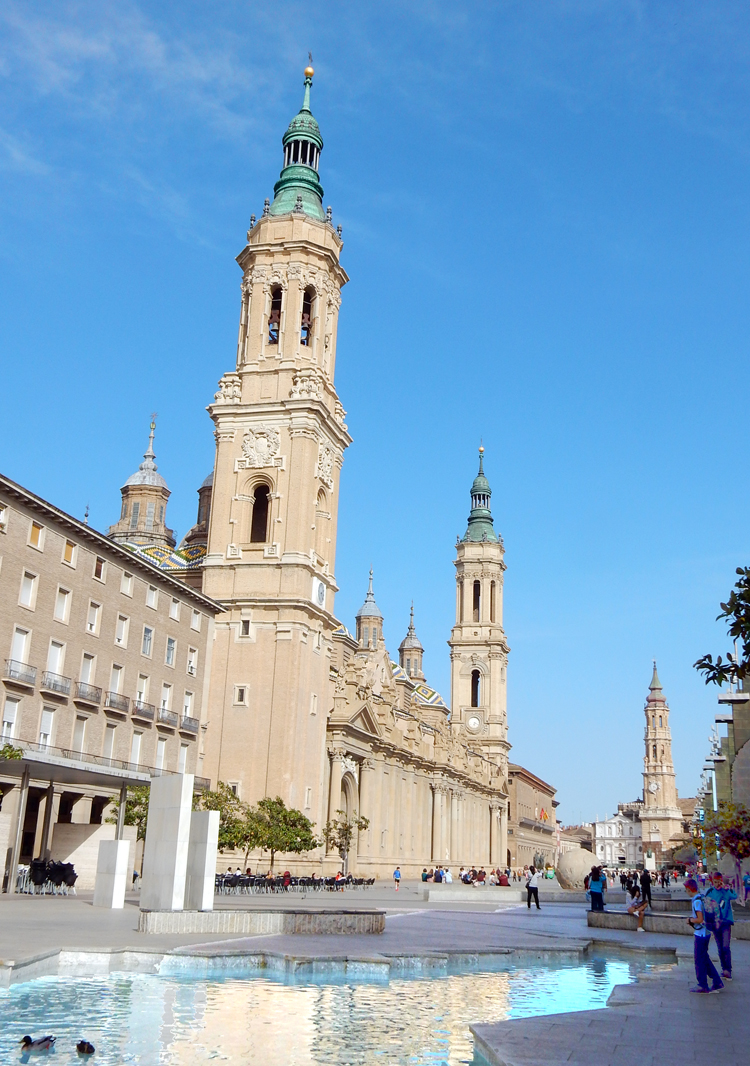
Postcard from Zaragoza, Spain: Competing patron saints and cathedrals, plus some miracles

Above: La Basilica de Nuestra Senora del Pilar is on the left while La Seo de Zaragoza anchors the far end of the plaza.

Although conquered by The Battler, Alfonso I (1073-1134), the Moorish rulers of Zaragoza left rich architectural contributions in their wake. The main mosque was an impressive one, so The Battler opted for adaptive reuse, making alterations for Christian purposes and consecrating the new church in the name of San Salvador in 1121.

The Battler’s predilection for war unfortunately extended to his life with his wife, with no heirs produced from the contentious marriage. Leapfrogging over the resulting confusion following Alfonso I’s death, Ramon Berenguer (1114-1162), the Count of Barcelona, was betrothed to one-year-old Petronilla of Aragon (1136-1173) in 1137. The toddler’s father, known as Ramiro II (1086-1157), transferred the rule of the kingdom of Aragon to his new son-in-law so he could retire to a normally peaceful monastic life. As this post is not really about Ramiro the Monk, we will not dwell on his priestly qualifications that include the legend of his beheading of a dozen nobles who opposed him and using the head of their leader as the clapper for the bell of Huesca.

Demonstrating his dedication to the marriage-acquired territory of Aragon, Ramon had much of Zaragoza’s mosque/Catholic church razed to begin construction of a Romanesque replacement in 1140. This church became the home for coronations of Aragonese kings, and, with the papal appointment of an archbishop of Zaragoza in 1318, a cathedral.

Continue reading “Postcard from Zaragoza, Spain: Competing patron saints and cathedrals, plus some miracles”
Postcard from Toulouse, France: Church-hopping, so genuflect quickly

Above, Altar for the Privileged in the Basilica of Notre Dame de la Daurade. Is the skull an invitation to enter or a dire warning not to dare trespass within? I elected not to test it.

Time for a final round of visits to churches in Toulouse. First stop is the Basilica of Notre Dame de la Daurade. The Virgin Mary’s “golden” designation came from shimmering mosaics in the original 5th-century church adjacent to this site. The church’s prized statue of the Virgin was stolen during the 15th century and replaced. Particularly revered by pregnant women, the figures of the Virgin and Child became so blackened by the smoke of votive candles lit by supplicants that the Virgin became known as the Black Madonna, or La Vierge Noire, by the 16th century.

Riverside, the Black Madonna’s original home was demolished in 1761 for the construction of wharves. Rebuilt, a new church served as the Virgin’s temple for only a short time before the 1789 outbreak of the French Revolution. Revolutionaries repurposed the church as a tobacco factory and set the icon ablaze in the Place du Capitole, reducing the treasured statue into a pile of ashes.

Continue reading “Postcard from Toulouse, France: Church-hopping, so genuflect quickly”

Postcard from Toulouse, France: Centuries of alterations craft a catawampus cathedral

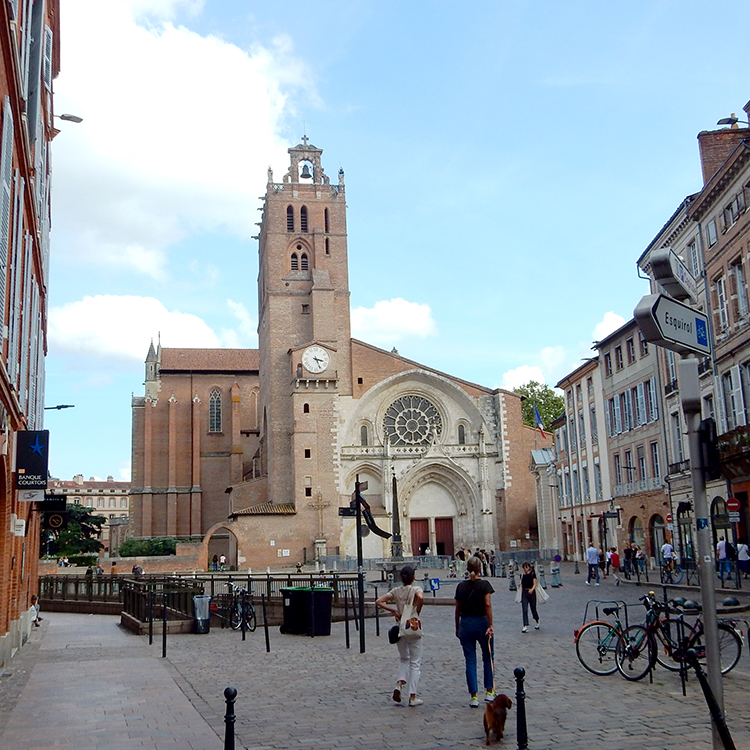
Cathedrale Saint Etienne de Toulouse

The approach makes it obvious. The Cathedral dedicated to Saint Stephen (5-33 A.D.) in Toulouse is the product of numerous architects over numerous centuries. And the interior is equally as cobbled together, held together by a column so inartistically enormous in circumference that I neglected to take its picture. But those incongruities make it all the more interesting to explore.

The first church buried underneath all of this brick dated from the 3rd century and was later topped by a Romanesque cathedral. At the beginning of the 13th century, an expanded French Gothic nave was completed in the regional “flavor” known as Raymondine, for Raymond VI, the Count of Toulouse. Raymond VI (1152-1222) was a key player in the constant tug of war, actually wars, waged for control between the King of France and King Henry II of England and his wife Eleanor of Aquitaine. And also the Holy Roman Emperor and Alfonso II of Aragon. Alliances were complicated and always shifting.

Continue reading “Postcard from Toulouse, France: Centuries of alterations craft a catawampus cathedral”