
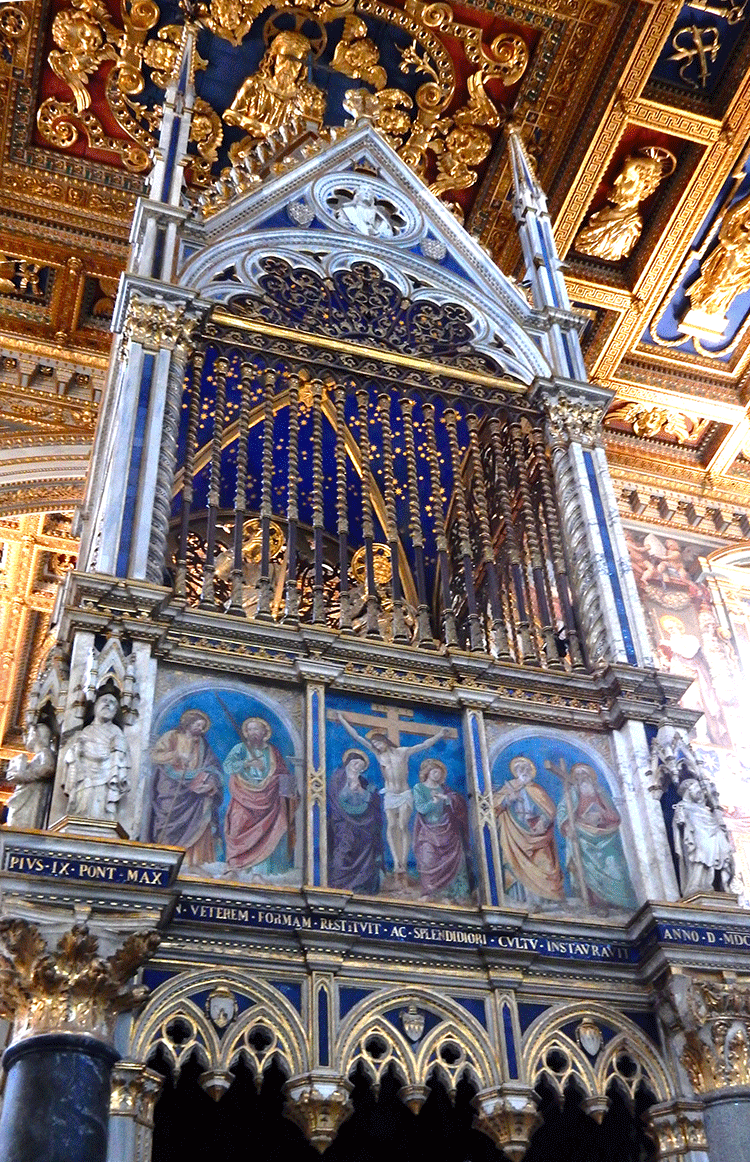
With rumors spreading that the great fire that burned for six days in Rome in the year 64 was ignited to clear away existing structures for construction of his grand palace on the Palatine Hill, Emperor Nero (37-68) found a scapegoat. Christians must have started the fire. So Christians were hunted down and persecuted, with the gruesome brutality one might expect from an emperor who deemed even the lives of his mother and a wife or two disposable.
For the sake of explaining the featured photo of the top of the ciborium erected over the papal altar in the Archbasilica of San Giovanni in Laterano, we will mention only two of the emperor’s victims. Under the orders of the emperor, Saint Peter (30-64 or so) was crucified upside down, the position the martyr requested to demonstrate his humble position in relation to Jesus. Most of the remains of Saint Peter are believed to rest under the Basilica bearing his name. As a Roman citizen, Saint Paul the Apostle (5-64 or so) was afforded a “more humane” death sentence, beheading. Legend has it that his head bounced high three times after its separation from his body, with fountains of water spraying up for the ground at each bounce. His body was buried outside the walls, under what is named, appropriately, the Basilica of Saint Paul Outside the Walls. The head might have been retrieved later from amongst a pit of severed heads.
According to tradition, the golden reliquaries encasing the heads of Saints Peter and Paul peer out from that deep-blue golden cage at the top of the ciborium. There is no question that two skulls reside there side by side on high, but some wonder whether they are the actual ones that once rested on the shoulders of Peter and Paul. But that is just being nitpicky. The importance of these relics to the church is illustrated by the fact that only the Pope is permitted to say mass from this altar.
This Gothic-style feature was not added inside Saint John Lateran until the 14th century, the origins of the archbasilica, dedicated to both Saint John the Baptist (BC-28 or so) and Saint John the Evangelist (15-100), are much earlier. Much of the site belonged at one time to the Lateranus family, but a family member was accused of conspiracy by Nero, who used that as an excuse to confiscate the property. Later, Emperor Constantine I (272-337) donated it to the Bishop of Rome, the Pope. In 318, the site became the home of the first church built in Rome and the papal home under Pope Silvester I (?-335).


While the Baptistry dates from the early years, an earthquake in 896 destroyed much of the church. Strangely, this destruction coincided with the one-year reign of Pope Stephen VI. The pope was not fond of his predecessor, Pope Formosus (816-896). Not content to leave final judgment in the hands of Saint Peter at the gates of heaven, Pope Stephen VI had the body of Pope Formosus exhumed and propped up in the Lateran Palace. The corpse was put on trial on numerous charges of prior papal intrigue. Unable to mount much of a defense, Pope Formosus was deemed guilty. His papal robes were removed and replaced with those of a common man, and, before he was reburied, his three “blessing fingers” were chopped off and thrown into the Tiber.
The church was rebuilt after the earthquake, but a series of fires resulted in it having to be resurrected from ashes several times in the 1300s. The fires spared the 13th-century cloisters.
When the papacy returned from Avignon in 1377, the church again was restored but the papal residence was moved to Santa Maria in Trastevere. Pope Sixtus V (1521-1590) hired architect Domenico Fontana (1543-1607) for work on the church, and Pope Innocent X (1574-1655) hired Francesco Borromini (1599-1667) for more interior remodeling. Pope Clement XII (1652-1740) then commissioned Allessandro Galilei (1691-1737) to add the unusual façade fronting an enormous plaza anchored by a 455-ton obelisk.
The ancient obelisk, commissioned by Pharaoh Thutmose III (1481-1425 B.C.) for Thebes, attracted the interest of Emperor Constantine I. He ordered it shipped to Constantinople, but it was waylaid in Rome and erected in the Circus Maximus in 357 instead. Toppled and buried at some point, it was rediscovered, excavated and moved to the plaza by Sixtus V in 1588.




 Postcards from Barton Springs