Postcard from Burgos, Spain: A few parting impressions

Above, pollarded plane trees framing Paseo del Espolon

The Scarecrow, who was in the lead, walked forward to the tall tree where there was an opening to pass into, but just as he came under the first branches they bent down and twined around him, and the next minute he was seized by the long branches and raised from the ground and flung headlong among his fellow travelers.”

The Wonderful World of Oz, L. Frank Baum, 1900

Remove the brilliant blue sky from the picture, and these trees appear as frighteningly eerie as those in The Wonderful Wizard of Oz. The severe winter haircut, pollard, of these relatives of American sycamores lining Burgos’ beautiful Paseo del Espolon reaps a huge reward for pedestrians. The trimming encourages the trees to produce a dense canopy of green leaves shading all who pass below throughout the summer, and whimsical-shaped topiaries soften the impact during the winter months.

Continue reading “Postcard from Burgos, Spain: A few parting impressions”
Whoopee, biannual roundup: Favorite postcards from this blog

Above: Remnants of the South Austin Museum of Popular Culture are found at its former home on South Lamar Boulevard.

Yes, I know. This blog is suffering a bit of an identity crisis. First, 2020 abruptly cut short my boulevardier ways, and then in early 2021 we pulled up stakes and moved up the road to Austin.

This blogger entertained herself throughout much of the pandemic by posting her entire novel – An Ostrich-Plumed Hat, and, Yes She Shot Him Dead – online, slowly unfolding it chapter by chapter. A few of my readers actually followed Hedda Burgemeister all the way through her 19teens trial for murder; although, I had been hoping for a little more feedback and filming rights have yet to be sold. Others have embraced posts about our new neighborhood as we started boulevardier-ing north and south off Lamar Bouldevard.

Continue reading “Whoopee, biannual roundup: Favorite postcards from this blog”

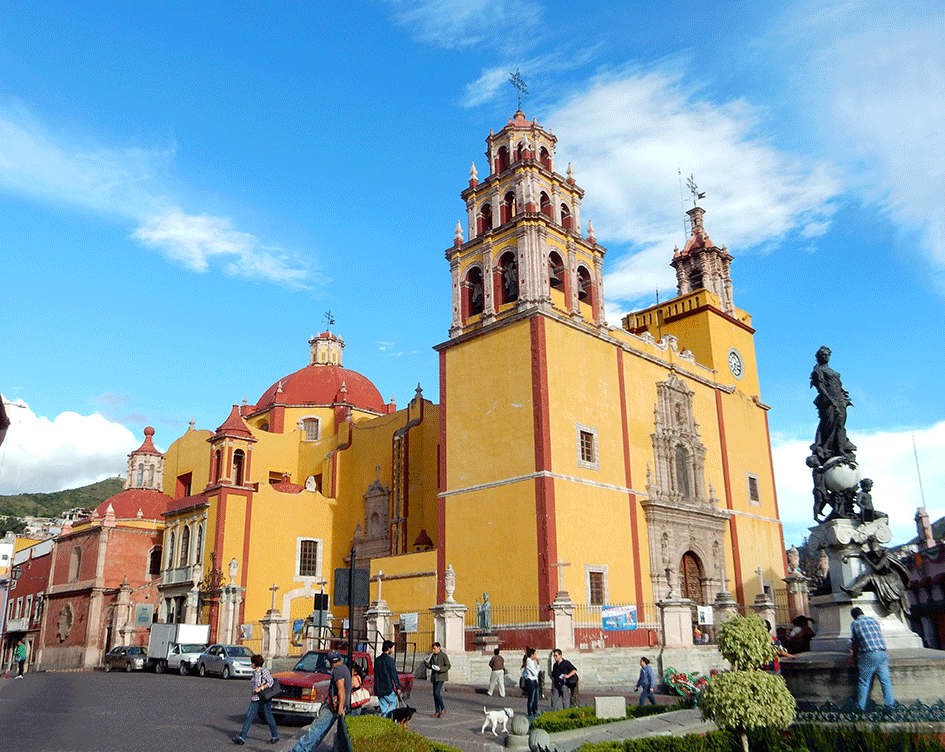
Postcard from Guanajuato, Mexico: Basilica of the City’s Patron Saint

No matter from what direction one approaches, the rich hues of the Basilica of Our Lady of Guanajuato make it stand out against the city’s blue skies. Built between 1671 and 1696, the church houses an Andulusian statue of the Virgin and Child encased in glass on its altar.

The statue was a gift from King Felipe II (1527-1598) of Spain presented to the city in 1557 in recognition of all the riches sent from the mines to enrich the crown. The Virgin represents the city’s patron saint and is believed to be the oldest image of the Virgin sent to the Americas. Along the way, her scepter was replaced with a rose, particularly appropriate as the basilica fronts the Plaza de la Paz.


Tucked around the images and statues of the saints inside are reminders of the prayers of those who visit. A silver arm or leg left in hope of a mended limb. A heart milagro for assistance for an organ beginning to falter with age or a young heart broken. Photos of babies in need of cures. Ribbons of wishes for the safe return of family members who have crossed the border to seek work in el norte.