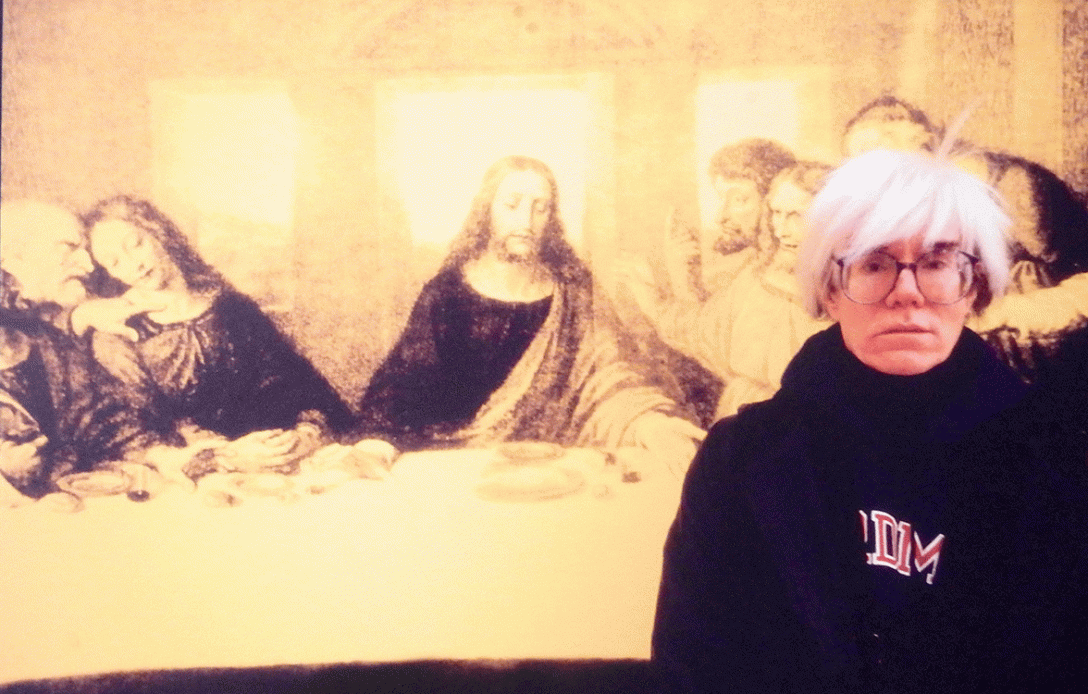
Postcard from Naples, Italy: The church of Andy Warhol

In 1984, gallerist Alexandre Iolas commissioned Warhol to create a group of works based on Leonardo Da Vinci’s Last Supper (1495-97) for an exhibition space in the Palazzo Stelline in Milan, located across the street from Santa Maria delle Grazie, home of Leonardo’s masterpiece. Warhol exceeded the demands of the commission and produced nearly 100 variations on the theme. Indeed, the extent of the series indicates an almost obsessive investment in the subject matter, which takes on an added significance in light of the revelation of the secret religious life revealed after Warhol’s death, which occurred only a month after the opening of the Milan exhibition in January 1987.

“Andy Warhol: The Last Supper” from Past Exhibitions of the Guggenheim

Encountered an Andy Warhol exhibition our first weekend wandering around Naples. The setting seemed so unlikely. The Basilica di Santa Maria Maggiore alla Pietrasanta, constructed atop the remains of a Temple of Diana by a Bishop of Naples in the year 525 and purportedly the first sanctuary dedicated to the Virgin Mary.

Of course, that church was remodeled numerous times, and I really am unsure how it became an art venue. But Pop art is occupying the sanctuary through February 23: “The True Essence of Warhol.” The exhibition is presented by the Arthemisia Association.

The pairing of pop culture and religious altars is unusual. A neon “Warhol e il Brand” crosses in front of a painting of the Virgin Mary. “Warhol e l’Italia” glowing in front of a crucifixion. Mick and Keith staring down from niches?

Church is not what my memory associates with Andy Warhol (1928-1987). My memories place him more in the throbbing celebrity melee of the Studio 54 disco scene. Or hanging with the Rolling Stones.

His art was sensational via his calculated and stated commercial associations.

Mr. Warhol’s keenest talents were for attracting publicity, for uttering the unforgettable quote and for finding the single visual image that would most shock and endure. That his art could attract and maintain the public interest made him among the most influential and widely emulated artists of his time.

“Andy Warhol, Pop Artist, Dies,” Douglas C. McGill, The New York Times, February 23, 1987

We played around in this church of Warhol….


But it was not until several months later I learned that Andy Warhol’s Catholic upbringing was lurking close to the surface of his wild partying veneer. He was frequently spotted on Sundays in a pew of St. Vincent Ferrer on the Upper East Side of New York.

People are complicated.

I always thought I’d like my own tombstone to be blank. No epitaph, and name. Well, actually, I’d like it to say “figment.”

Andy Warhol

It does not. His headstone in Saint John the Baptist Byzantine Catholic Cemetery in Pittsburgh bears standard name and dates, and he rests amongst his Warhola relatives. His memorial mass was held in Saint Patrick’s Cathedral in New York City.

Postcard from Naples, Italy: Seconds on that seafood platter, per piacere

“Leftovers” from a crudo platter at Pesheria Mattiucci

Maybe that photo is not appetizing, but it does represent how incredibly good and fresh the platters of raw fish served at Pesheria Mattiucci are. The freshness is key for the fishmongers who run this small place that still resembles more a fish market than a dining spot. Each type of fish on the platter is paired thoughtfully with an appropriate fruit, light sauce, herb or fresh flower to compliment its individual delicate flavor.

By all appearances, the Pesheria is not our kind of place. Only a handful of no-backed stools awkwardly perched at metal counters with no leg room. And no red wine (The Neapolitans worked hard to reform us on the importance of pairing their dry white wines with raw seafood, and we must admit they are right.). But despite the humble surroundings, the seafood was so amazing we went twice. Oh, and the fishmongers can cook fish perfectly, too.

The other “best raw seafood” spot for us during our stay was in the Vomero neighborhood. Panamar was only marginally more formal, part of the trend of chefs who want to focus on food – tablecloths and tableside service be damned. Sandwiches are their specialty, and they begin with large firm  buns.

Our favorites? The fuoritonno with cubes of red tuna, smoked burratina cheese, sundried tomatoes, smoked eggplant cream and fried arugula; and the mezzosalmone with cubes of salmon, buffalo mozzarella, grilled zucchini and a sauce of honey and red peppers.

Since those first two restaurants were seafood-centric, I pulled out most of the other seafood photos from our stay in Naples. Several of these places will be mentioned again later.

We had gotten hooked on fried anchovies in Spain, and found them abundant in Campania as well where they are called alicci fritte. With a squeeze of fresh lemon, pretty addictive. The pasta most associated with Naples is paccheri, sort of like giant rigatoni.

Perched at hightop tables on a fairly busy street, we loved the casual neighborhood vibe of Re Lazzarone downtown near the Archaeology Museum. Anonymous Trattoria Gourmet is tucked away on a lower street downtown in a location that helps keep it anonymous from tourists. The inside is spartan but packed with locals.

Godot, up in the Vomero neighborhood, is pricier and still well off the tourist track. Loved the gnocchi with peas and calamari. And the surprising find at the end of the trip was on the fringe of Vomero, Trattoria Scugnizzi. An inexpensive place popular with neighbors that seems way off the visitor radar. The only photo included with this post is a sample of the chef’s daily seafood pasta special, a sample because he was disappointed we already had over-ordered.

The others lumped into this seafood post were in more high-profile locations, but they still managed to keep some loyal Neapolitan diners: Anticchi Sapori; Ristorante L’Ostricaio; and Stritt Stritt.

More food later.


Postcard from Naples, Italy: The most bejeweled saint

164 rubies, 198 emeralds and 3,326 diamonds adorn the gold mitre created by Matteo Traglia in 1713 for a bust of San Gennaro

Gennaro, or Januarius, ascended through the ranks of early Christians to become Bishop of Naples. Unfortunately for him, this was during the time period when Emperor Diocletian was at his most testy. In the year 305, the bishop and some of his fellow practitioners were sentenced to be thrown to the bears awaiting them in an amphitheater. Legend claims the bears refused the proffered meal, so the emperor was forced to change their sentence to beheading, which proved more successful in achieving their martyrdom.

Later, San Gennaro’s remains were moved to catacombs in Naples that bear his name. But his remains no longer are found there. At some point, his body went elsewhere while his head remained in Naples. Finally in 1497 a cardinal in Naples, where Gennaro is the city’s primary patron saint, managed to regain the body and reunite them in a handsome crypt below the cathedral, which bears the name of San Gennaro as well.

Back in 305, one of San Gennaro’s followers salvaged two ampules of his blood after his beheading. Their whereabouts for the next thousand years or so are uncertain, but they surfaced and were secured in the church. Not surprisingly, the blood had dried up by then. But soon after, its caretakers observed it spontaneously liquifying.

Creating much excitement among the faithful, the liquification supposedly occurs to this day three times a year – on the Feast Day of San Gennaro, September 19; on December 26, the celebration of his patronage of Naples; and finally in May to mark the reunification of his body parts. Sometimes one of the ampules liquifies when visited by popes. This miracle failed to occur when Pope Paul II or Pope Benedict XVI arrived at San Gennaro, but supposedly an ampule half-liquified for Pope Francis, demonstrating San Gennaro’s strong support for his reign.

Survivors from several 16th-century disasters wanted to show their gratitude to the city’s patron saint and decided to erect a chapel adjacent to the cathedral to honor him. Citizens stepped forward to donate huge numbers of gemstones to commission appropriate tributes. One is a stunning necklace created by Michele Data in 1679; another is the jewel-encrusted mitre at the top of this post.

Additional treasures were accumulated to add to San Gennaro’s treasures. Major silver statues of saints among them.

The unusual aspect of the Treasures of San Gennaro is ownership. They belong to the citizens of Naples themselves, not the Catholic Church. They escaped confiscation by the state of Italy when it was unified. Periodically rumors spring forth the Vatican is trying to get control of them, sparking major protests in Naples, one as recent as 2016.

Sorry, so distracted by the shimmering jewels that have neglected to make much mention of the Cathedral of Naples, Cattedrale di San Gennaro, itself. The initial construction of the cathedral was commissioned by King Charles I (see earlier post) but was not completed until the 14th century. Mosaics from the 4th century are found in an adjacent baptistry predating the cathedral.