Postcard from Herculaneum, Italy: Hot volcanic ash buried town for centuries

View of Mount Vesuvius from Vomero neighborhood in Naples

Although a gorgeous backdrop on the Sea of Naples, Mount Vesuvius is not sleeping. The only active volcano on the mainland of Europe erupted as recently as 1944, showering ash and rocks upon the Allied forces establishing an airbase nearby.

But the volcano is most known for its spectacular explosion in the year 79, an event reputed to have killed as many as 16,000 citizens of the Roman Empire.

From “Visiting Pompeii” on World Archaeology:

At peak intensity, the eruptive column reached a height of 30km (about 18 miles) or more as the mountain ejected 150,000 tons of material per second…. The air-fall of ash, pumice and occasional rock fragments, accumulating at about 15cm an hour, eventually covered Pompeii to a depth of almost 3m (close to 10 feet)….

The mountain had not finished its work, however, and only now, in the final six hours or so of the eruption, did it became truly lethal….

“A fearful black cloud,” Pliny reports, “was rent by forked and quivering bursts of flame, and parted to reveal great tongues of fire, like flashes of lightning magnified in size. …Soon afterwards the cloud sank to earth and covered the sea ….”

It took perhaps five or six minutes to reach Pompeii from the lip of the crater: a dense, rolling, ground-hugging mass of gas, ash and rock (the pyroclastic flow), preceded a few seconds in front by a scorching blast like that from a flamethrower…. At its hottest, where temperatures reached anything from 400 ° to 800 ° C, the ‘black cloud’ carbonized wooden timbers, doors and shutters, and killed those it struck instantly, as brains boiled and skulls exploded in the flash. Others, where the heat was less, were asphyxiated as they breathed in hot gas and incandescent ash….

In the 24 hours plus that the eruption had lasted, it is estimated that Vesuvius had unleashed thermal energy 100,000 times greater than that of the atomic explosion at Hiroshima.

Strangely, the destruction of Pompeii and other towns around the base of the volcano preserved the ruins for thousands of year.  Ancient cities frozen in time.

I was fortunate to have visited Pompeii in college, but much has been uncovered, restored and opened to public since then.

The flaw is that the 163-acre archaeological park is no secret. The number of tourists swarming through the treasured ruins is creeping toward 4-million annually. Photographs such as the lead one for an October story in the New York Times, “Can a Restored Pompeii Be Saved from ‘Clambering’ Tourists?,” scared us away. Paige McClanahan writes that nearly 450,000 people overwhelmed Pompeii in the month of July.

In contrast, only about 300,000 tourists visit Herculaneum a year. So instead, we opted for the much smaller town, a little closer to Naples, not as spectacular but not over-crowded.

The first official explorations at Herculaneum were begun in 1738, yet only a small portion of the once-wealthy port town has been excavated. While the archaeological zone is modest in size compared to Pompeii, the affluence of its residents is evidenced by abundant use of marble throughout.

For centuries, it was believed that almost the entire population of the town had been evacuated by sea before the worst of the eruption. But in the 1980s, digs uncovered skeletal remains of hundreds, huddled together under the arcades of the then-seaside boat houses, buried under ash while waiting ships that failed to save them.

We left them unmolested, as the hoards of tourists in Pompeii left us unmolested to explore Herculaneum at our own pace in peace.
Postcard from Malaga, Spain: Perusing 2,000 years of art

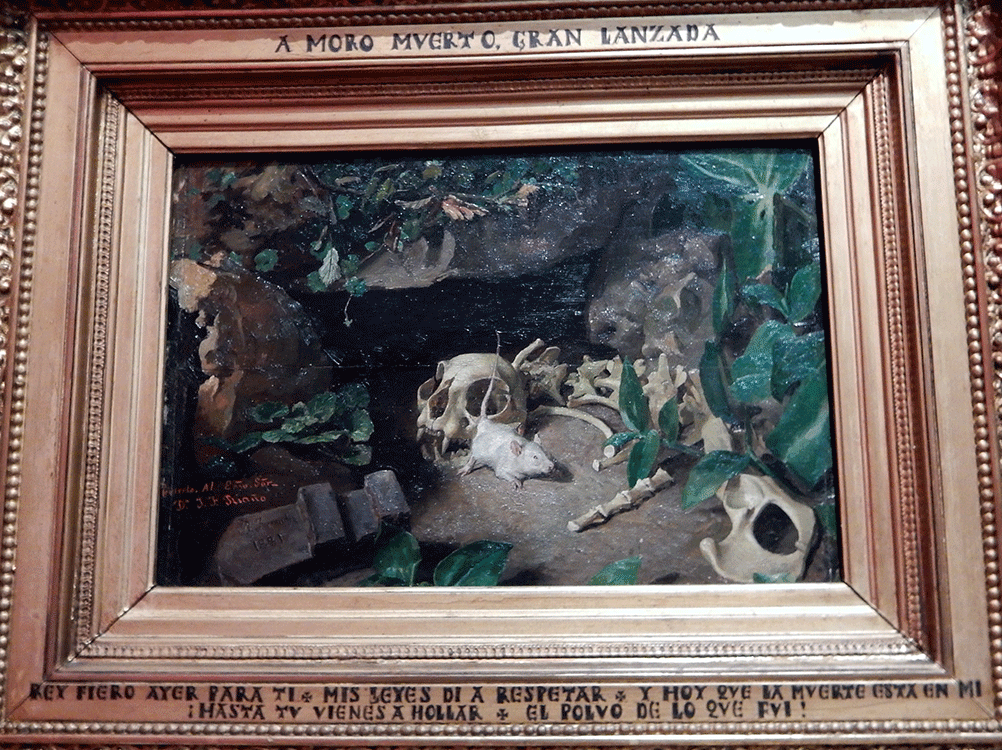
“Dying Moments: Kicking a Man When He’s Down,” Bernardo Ferrandiz y Badenes (1835-1885), 1881

From Museum of Malaga label: This allegorical composition alludes to an episode in the artist’s life. A man of choleric temperament, he had a run-in with a fellow Academy member… which resulted in Ferrandiz being tried and sent to prison. Deeply shaken by this event, which led to his removal from the post of director of the San Telmo Fine Art School and social and personal disgrace, the once-haughty artist depicted himself as the skeleton of a cat. Only then, when the feline is “down,” so to speak, does the weakest of its sworn enemies, the mouse, dare to scurry among its remains.

Pondered how to pick a piece of art to represent a museum’s enormous collection…. Not sure why this painting by the man regarded as a founder of the Malaga School of painting was nominated, except Day of the Dead has been on my mind.

The Mister spied the painting first, perhaps drawn by the unusual printing painted directly on the frame. Somewhat illiterate in Spanish (understatement), I am label dependent. But what a great personal story – a tale of the politics of art – lurks within that frame.

The Museum of Malaga occupies the Palacio de la Aduana. The former customs house was commissioned by King Charles III (1716-1788) in 1787 in recognition of Malaga’s major role as a maritime trading center.

Two collections, one of fine arts and one of archaeology, were merged to become the Malaga Museum of Art and moved into the almost 200,000 square-foot neoclassical building in 2016. A lot to wander through and absorb, but here’s an abbreviated armchair tour.

Loved the horse “volunteering” his serum to inoculate a child in the 1900 painting by Enrique Borras. But my particular favorite is Enrique Simonet’s 1890 painting of an autopsy – “Anatomy of the Heart: And She Had a Heart.” Alas, now she has none. Seems a screen-shot from a macabre film.

Postcard from Sevilla, Spain: A trio of Mudejar-Renaissance palaces

Elderly and disabled priests needed a suitable place to live out their lives, so the Brotherhood of Silence undertook construction of an elegant residence to accommodate them in 1675 – Hospital de los Venerables Sacerdotes, or the Hospital of Venerable Priests. No expense appears spared during the Baroque palace, with altars and murals by some of Spain’s most famous artists. The project was completed under the direction of architect Leonardo de Figueroa (1650-1730), who designed San Luis de los Franceses. The former residence of aging priests was restored by the Focus Foundation in the late 1980s and now serves as the foundation’s headquarters and as an elegant exhibition space for the impressive artwork of the collection of its Velazquez Centre as well as contemporary acquisitions.

Among the numerous private palaces open to the public by its owners is Casa de Salinas. The 16th-century Mudejar-Renaissance style palace was purchased and restored by the Salinas family in the 20th-century. As in Casa Lebrija, Roman mosaic flooring found its way from an ancient site into a private home.

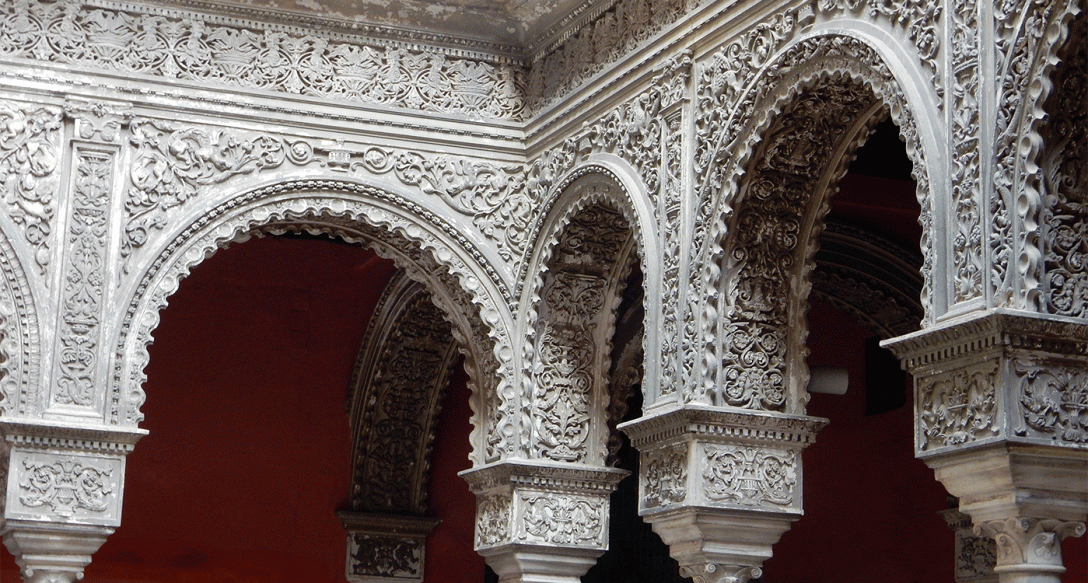
Another palace with origins in the 15th century is the Casa de las Duenas. In 1496, the house was sold to a member of the de Ribera family, and its rich combination of mudejar and Renaissance architectural details resembles the family’s Casa de Pilatos. Later, a Ribera descendant married a Duke of Alba, transferring the palace to the House of Alba.

The architectural interest of the house is perhaps overshadowed by the flamboyance of one of its owners, the 18th Duchess of Alba, who died in 2014 at the age of 88. The long-named María del Rosario Cayetana Paloma Alfonsa Victoria Eugenia Fernanda Teresa Francisca de Paula Lourdes Antonia Josefa Fausta Rita Castor Dorotea Santa Esperanza Fitz-James Stuart y de Silva Falco y Gurtubay also was multi-titled. According to Cayetana’s obituary in The Telegraph:

According to the Guinness Book of Records, she had more titles than any other person on the planet, being a duchess seven times over, a countess 22 times and a marquesa 24 times. Yet the Duchess always insisted she was not rich: “I have a lot of artworks, but I can’t eat them, can I?” she once said. Apart from thousands of paintings by Goya, Velazquez, Titian and others lining the walls of her numerous palaces, her collection included a first edition of Don Quixote, Columbus’s first map of America and the last will and testament of Ferdinand the Catholic, the father of Catherine of Aragon.

Her first wedding in 1947 to a son of the Duke of Sotomayor was held in the Cathedral of Seville, according to The Telegraph, the opulent ceremony:

…cost an estimated £2 million in today’s terms and was described at the time as “the most expensive wedding in the world.” The ceremony was so grand that there was concern it would overshadow the nuptials of Britain’s future Queen, held a month later in austerity Britain. The bride wore a white satin gown (view here) modelled on the dress worn by Napoleon III’s bride Empress Eugenie (1826-1920).

The couple had six children, with only one rumored to be fathered not by her husband but by a flamenco dancer. After her husband’s death in 1972, she next wed a former Jesuit priest 11 years younger than she. Outliving him as well, she shocked society, and her children, by marrying a civil servant 24 years younger in 2011. By then, much plastic surgery had transformed her former natural beauty into an almost cartoonish mask. The obituary includes photos of her with her final husband.

Most of her vast fortune, running into the billions, was divided amongst her children. One of her sons opened the first floor of the family residence to the public in 2016.