Postcard from Queretaro, Mexico: Pondering contemporary art scene

A postage stamp featuring a portrait of a female figure, depicting a nun with a religious emblem, surrounded by books, with the text 'ARTE Y CIENCIA DE MEXICO' and 'AEREO' printed on it.

Above: “Ensenan Mas las Obras…,” Miguel Angel Hernandez Vences, lost-wax bronze, 2025; and “Dibujos en la Piel,” Enrique Hernandez Rivera, oil on canvas, 2025. Among pieces selected for the “MAQRO’s First Biennial of the Human Figure.”

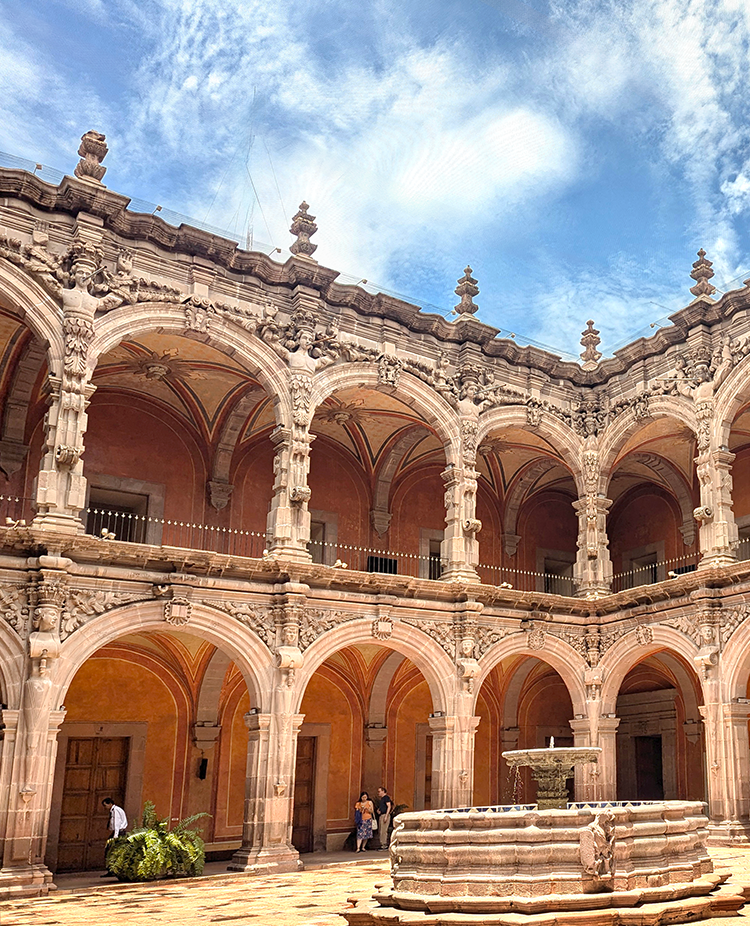
Baroque architecture of the former convent of San Agustin, featuring arched colonnades, intricate stone carvings, and a central fountain, under a blue sky.

Never would we visit Queretaro without ducking in to admire the exquisite Baroque courtyard for the former convent of San Agustin. But there’s more than early 18th-century colonial architecture to experience there.

The rooms surrounding the courtyard are refurbished as galleries of Museo de Arte de Queretaro. This summer those galleries were overflowing with exhibitions showing the vitality of the creative community of the city.

Continue reading “Postcard from Queretaro, Mexico: Pondering contemporary art scene”

Old and New World artistry merge in Hispanic Baroque

A 1893 one-cent postage stamp depicting Christopher Columbus and indigenous figures, surrounded by an ornate border. The inscription reads 'Columbus in Sight of Land.'

Above: “Annunciation and Saints,” Jose de Paez, Mexican (1727-1790), oil on copper, 1750-1760.

Spirit & Splendor: El Greco, Velázquez, and the Hispanic Baroque” surveys 150 years of Spanish art leading to the Baroque period with works culled from the collection of the Hispanic Society of America in New York City. Some of Spain’s most renowned and respected artists are represented in this ongoing exhibition at the Blanton Museum of Art, but don’t expect much more than a dozen of these works.

What I love are the pieces demonstrating the Baroque style translated by transplants and native-born artisans in the Americas. Artists took advantage of materials available in this so-called “New” World – copper, shells and, of course, more precious metals. They added a magical sheen to art designed to convert “pagans” to the foreign beliefs held by the Catholic conquerors.

Continue reading “Old and New World artistry merge in Hispanic Baroque”

Postcard from Puebla, Mexico: Sprouting a new crop of enthusiastic chefs

A green and yellow stamp featuring a corn plant and flower, labeled 'FLORA DE MEXICO' and 'maiz' with a moon in the background.

Above: Seafood soup at Mucho Bueno Pesca y Pisto

Our prior trip to Puebla was a decade ago, and the food scene has changed dramatically since then. You will find only one revisited restaurant represented in this alphabetical summary of places we enjoyed. While you might be expecting photos loaded with plates of the region’s famed chiles en nogada, we were not there during their season, which is now.

A bunch of fresh huauzontle, a green herb with small flowering buds, displayed against a white background.
Above: Fresh huauzontles

Chefs’ elevation and celebration of herbs and vegetables native to the Americas has increased, often corn-centric. Several places introduced us to huauzontles, a bushy, wild herb related to quinoa and amaranth.

Augurio compressed huauzontles into breaded patties filled with fresh goat cheese afloat in a pool of chile pasilla mole. The restaurant manages to combine an upscale contemporary feel with traditional ingredients and recipes of “baroque” Puebla.

Continue reading “Postcard from Puebla, Mexico: Sprouting a new crop of enthusiastic chefs”