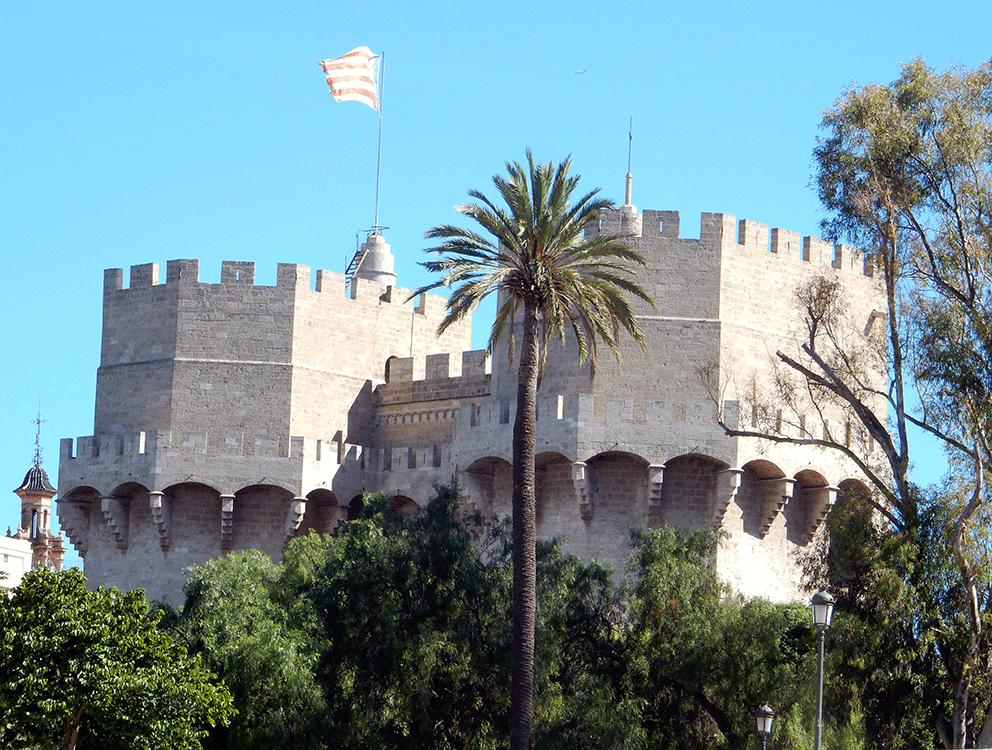
Postcard from Valencia, Spain: Massive gates remnants of medieval past

There once were a dozen of them, but only two remain. Once the walls surrounding the medieval city of Valencia were torn down, most of the gates lost their raison d’être.

But the architecturally impressive Torres de Serranos, built in 1392, continued to function in other ways. For many years, the fortification made a suitable prison for upper crust nobles and knights finding themselves no longer in favor. During the Spanish Civil War, paintings from the Prado were stored there for safe-keeping.

But most dear to Valencians, the royal entryway always has served as a ceremonial heart of the city, the place where Las Fallas festival is kicked-off every year. Like Alamo Plaza has been but might never be again for San Antonians.

The smaller Torres de Quart perhaps was permitted to remain standing so its pock-marked walls serve as a reminder of its assault by those nasty Napoleonic forces in 1808.

From my point on the plaza observing even some of the young and fit clinging to nonexistent finger-holes on the steep descent bounded only by a skinny railing way too low to grasp, I concluded not to ascend the steps of Torres de Serranos. Jimmy Stewart convinced me long ago of my tendency toward vertigo. Shy of a helicopter rescue atop, I would have had to unflatteringly back down on all fours, hindquarters first.

I wisely opted for more of a Rear Window approach, happily sipping a beer while people-watching. The Daughter, on the other hand, scampered up and down on two occasions.

Postcard from Bologna, Italy: Trying to untangle a towering perspective challenge

Went to a talk this weekend in San Antonio at Blue Star Contemporary given by photographer Robert Langham, III, whose works are featured in “Hold Still.” The topic was “How to revolutionize your camera work,” and that was what I wanted to do. In one easy lesson, of course.

Langham focused on six things critical to photographic composition. He explained these clearly. But, as my version was 30 minutes instead of the full semester version of his course, I’m not sure he managed to truly revolutionize my awkward efforts to capture our travels.

But, attempting to apply the critical points from the lecture, I returned to the photos we took of the two most famous towers in Bologna. Bear in mind, these images are all of the same two towers. Which one should make it to the blog? Should the church behind be visible? Do we need to people the photo for perspective? Should signage be there to emphasize the contemporary urban intrusions?

The most straightforward shot of the taller of the two, Torre degli Asinelli, surely was taken by the Mister. I have issues with straightforward framing of my subjects because I don’t seem to look at things squarely. I want to stand at the bottom of a tower and capture the dizzying height I see when looking upward. That angled perspective rarely works for others.

Of course, this pair of medieval towers makes that even more of a challenge because they themselves do not stand up straight. They lean, possibly even more than their cousin in Pisa.

The Asinelli Tower soars 330 feet upward, and visitors still can climb up its claustrophobic stairwell to enjoy views of Bologna. I stayed with feet planted firmly at street level. The Garisenda Tower tilts more than twice as much as its taller neighbor. This shorter tower – 167 feet – used to be the taller of the two, but it was decapitated back in the 14th century for obvious safety reasons.

From a perspective point of view as captured by our camera, it’s hard to believe these photos are all of the same two towers. The Mister actually managed to take a photo showing both that makes them look as though they both still stand perfectly upright – correcting centuries of sinking.

I think I need the full semester version to even begin to attempt to understand the photographic challenges presented by these two towers.

View some of Langham’s fine black and white images for his current project, “100 Tylerites,” on his blog. Wonderful lessons in portraiture.