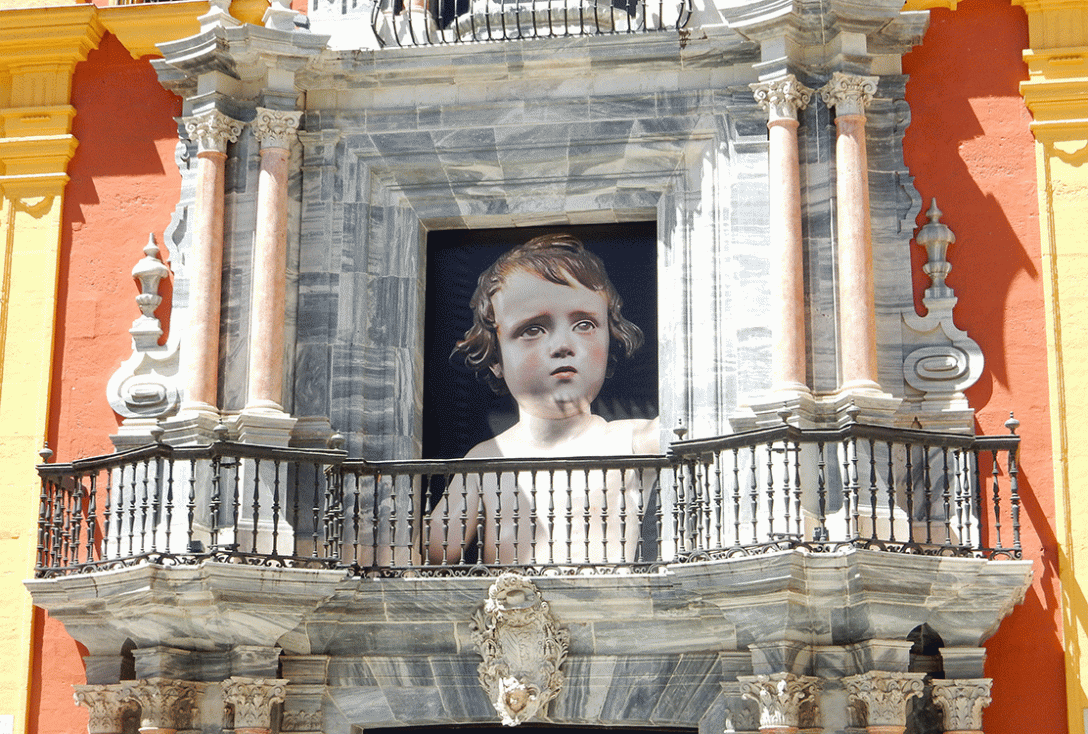
Banner on Palacio Episcopal promoting Ars Malaga exhibition of polychrome sculpture by Pedro de Mena (1628-1688)
Combining a few images from some remaining museums representing the diversity of the city’s offerings from a private 18th-century house museum containing a private Coleccion del Vidrio y Cristal to the only four-year-old impressive Coleccion del Museo Ruso showcasing works on loan from St. Petersburg in a former tobacco factory.

Coleccion Museo Ruso

Coleccion Museo Ruso

Portrait of Z.D.R., Ilya Mashkov, 1927, Coleccion Museo Ruso

Ars Malaga, Palacio Episcopal

Vera Ivanovna Zhukova, 1890, Coleccion Museo Ruso

Coleccion Museo Ruso

former tobacco factory housing Coleccion Museo Ruso

Gift Shop, Coleccion Museo Ruso

Museo del Vidrio y Crystal

Ars Malaga, Palacio Episcopal

Ifergan Collection, Egypt

Santa Paraskeva Piatnitsa, 17th century, Coleccion Museo Ruso

Coleccion Museo Ruso

Ars Malaga, Palacio Episcopal

Ars Malaga, Palacio Episcopal

“Woman Combing Her Hair,” 18th century, Coleccion Museo Ruso

Museo del Vidrio y Crystal

Coleccion Museo Ruso

Gift Shop, Coleccion Museo Ruso

Ifergan Collection, Islam

Portrait of Catherine II, Dmitri Levitski, 1782, Coleccion Museo Ruso

Museo del Vidrio y Crystal

Museo del Vidrio y Crystal

Museo del Vidrio y Crystal

Coleccion Museo Ruso
And there are museums with exhibits where no photographs were allowed. Several of these are dedicated to Malaga’s favorite son, Pablo Picasso (1881-1973).
From a white father and a small glass of water of Andalusian life was I born. Born from a mother, daughter of a daughter aged fifteen from the district of Percheles in Malaga, that beautiful bull that engendered my forehead crowned with jasmines.
Pablo Picasso, 1936
He was born in a home on Plaza Merced, now a house museum, Museo Casa Natal. Although the last time Picasso was known to visit the city of his birth was in 1901, purportedly he always held affection for Malaga. Receiving a commitment from Andalusian authorities to construct a museum, a daughter-in-law and grandson of Picasso donated work that makes up the core of the collection of the Fundacion Museo Picasso Malaga in 2009. The works are now housed in the Palacio de los Condes de Buenavista, a Renaissance building with Mudejar elements, and adjacent new construction.
The Olga Picasso exhibition there, which closed in June, was among my favorites of the trip. The exhibition pairs period paintings by Pablo Picasso paired with letters and personal photographs a grandson found in Olga’s portmanteau.
Olga Khokhlova (1891-1955) was born in the Ukraine but left when she joined the Ballets Russes under the direction of Sergei Diaghilev (1872-1929). Pablo Picasso was working on the décor and costumes for one of the ballet productions when he encountered the young dancer in Rome in 1917. They married in Paris in 1918 and had one child, Paul.
In the first years of their marriage, Olga often served as the model for his work. His increasingly unflattering depictions of her reflected the deterioration of their relationship. And, by 1927, Picasso had a new muse attract his interest, Marie-Therese Walter (1909-1977).
Picasso’s first marriage resulted in a separation in 1935, but the couple never divorced. Olga continued to follow him around with Paul in tow and wrote letters to her estranged husband almost daily. All unanswered.




 Postcards from Barton Springs