Postcard from Vicenza, Italy: Art packs punchlines and metaphors

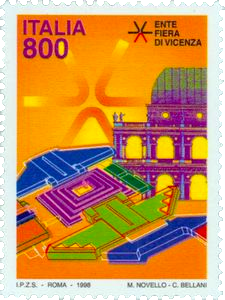
A brightly colored postage stamp depicting the architectural outline of a building with bold geometric shapes and vibrant colors, labeled 'ITALIA 800' for an event in Vicenza.

Above: Blogger’s unnecessary and intrusive fusion of Javier Jaen’s “Goya” banana (see below) with Francisco Goya’s “The Naked Maja.”

I have an interest in making things as immediate and easy to understand as possible…. It’s not always about how things look technically, but about what they say.”

Javier Jaen interviewed by Molly Long for Design Week, October 20, 2020

And artist/graphic designer Javier Jaen (1983-) succeeds in that immediacy. Without glimpsing the “Goya” title, anyone familiar with “The Naked Maja” by Francisco de Goya (1748-1828) would instantly recognize the banana as referencing it.

A large, artistic representation of a banana peeled and lying against a vibrant pink background.

“Goya” by Javier Jaen

Continue reading “Postcard from Vicenza, Italy: Art packs punchlines and metaphors”

Postcard from Oaxaca, Mexico: ‘Nobodies’ populate walls

Above: Detail of “Los Nadies,” or “The Nobodies,” woodblock print murals by the Colectivo Subterraneos in the Xochimilco barrio of Oaxaca

Existimos, porque resistimos. Por los oprimidos, por los invisibilizados, por aquellos que quisieron enterrar, los subterraneos, existimos.

We exist, because we resist. For the oppressed, for the invisible, for those who wanted to bury, the underground, we exist.

Artist Statement of Colectivo Subterraneos

The one-story building at the corner of Calle Jose Lopez Alavez and Calle Bolanos Cacho, Barrio de Xochimilco, was a deep burnt red color until a team of enthusiastic artists armed with rollers gave it a new coat of deep pink this fall. They quickly papered the rough stucco canvas with a series of large, exquisitely detailed woodblock prints the young artists created as part of Colectivo Subterraneos.

Continue reading “Postcard from Oaxaca, Mexico: ‘Nobodies’ populate walls”

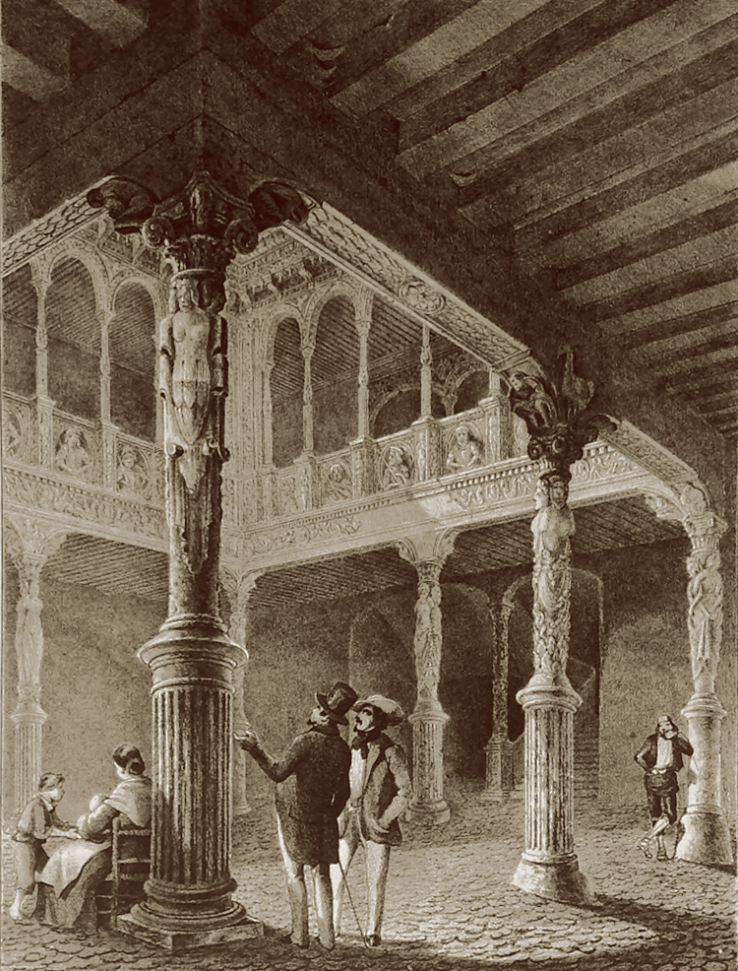
Postcard from Zaragoza, Spain: Renaissance landmark rescued from Paris

Above: Contemporary painting depicting Patio de la Infante (by Jacqueline Treloar?)

“Courtyard of the Princess,” F.J. Parceriso, lithograph, circa 1850

On the edge of the former Jewish Quarter in Zaragoza, Micer Gabriel Zaporta (abt 1500-1580) built an 18,000-square-foot house in 1549 in honor of his second wife. Zaporta himself was born into a Jewish family whose members converted to Catholicism in compliance with the Edicts of 1492 and enforced by the Inquisition. The elegant house built around a central courtyard with elaborate Italianate ornamentation reflected Zaporta’s success as a merchant and a banker who served as treasurer to King Charles I of Spain (1500-1558).

Continue reading “Postcard from Zaragoza, Spain: Renaissance landmark rescued from Paris”