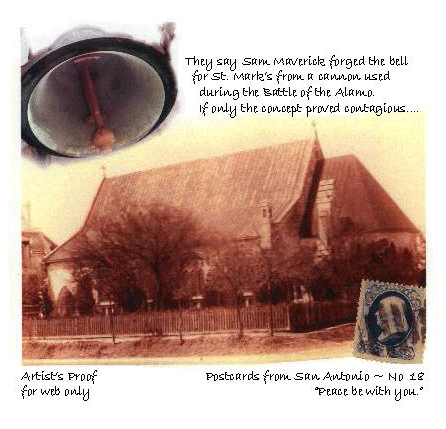
Sam Maverick’s bell is still there. Melt more guns.

stmarkstemp

Don’t know why I have been so worried. But every time I pedaled by St. Mark’s Episcopal Church while it was undergoing renovation, I fretted the bell would disappear when the scaffolding was removed. The bell and an old image of the church inspired me to make “Peace be with you” in 2005.

Hanging in an arch on Jefferson Street, the bell’s past was not peaceful. Legend says it saw service during the Battle of the Alamo. According to the church’s website:

The church bell was cast from a bronze cannon found buried near the Alamo on the grounds of the home of founding members Samuel and Mary A. Maverick.

Abe Levy writes in the San Antonio Express-News the completion of work on the sanctuary will be celebrated on February 3:

St. Mark’s Episcopal Church has had a storied past with the likes of Robert E. Lee among its flock, and Lyndon Johnson marrying Lady Bird inside its native limestone walls.

Among the city’s oldest Protestant churches, it is a downtown landmark with a rich history, especially for generations of Episcopalians.

After 15 years of studying plans and raising money for a campus-wide  restoration, St. Mark’s is celebrating its $15 million overhaul. Its most recent phase is a $2.6 million facelift of its sanctuary, originally completed in 1875….

Established in 1858, St. Mark’s is considered the flagship congregation of the Episcopal Diocese of West Texas, producing many bishops through the years and lending the most financial support to diocesan operations among the diocese’s 90 congregations in South Central Texas….

Led by architecture firm Ford, Powell & Carson, renovation work included repositioning the altar to face the congregation. Care was taken to use original colors in plastering and paint, said Father Mike  Chalk, rector.

“We took our history very seriously,” he said. “We went back to early pictures of the building, and as we did the restoration, we noticed some colors associated with the original colors of the building…. We’re really trying to  reclaim the beauty of the building.”

The entire project was aimed to enhance the original architecture by the celebrated Richard Upjohn, who designed Trinity Church on Wall Street. St. Mark’s is a rare example of Upjohn’s work west of  the Mississippi River and is believed to be his only design in San Antonio.

From my print:

They say Sam Maverick forged the bell for St. Mark’s from a cannon used during the Battle of the Alamo.

If only the concept proved contagious….

That bell means a lot to me.

As I pedal by, often with the melody of some ancient hymn echoing in my mind from the carillon at St. John’s Lutheran Church, I wonder how all those semiautomatic assault rifles would sound ringing in church towers throughout the country.

Certainly a lot better than the sound of parents crying.

Note: Apologies for such a low-resolution image. Many of my print images temporarily are trapped in my old computer. My website is also in transition and in somewhat of a state of decomposition, but “peace” is there, albeit in equally low resolution.
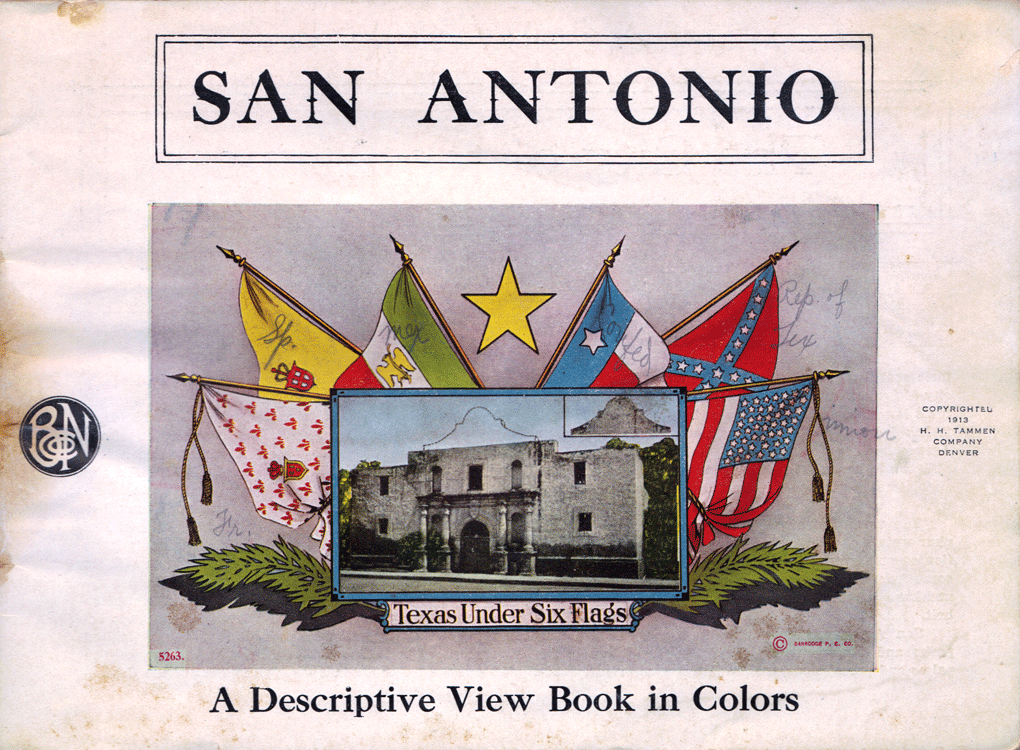
How would you feel about the Alamo with a crewcut?

The treatment of the Alamo on the frontispiece of San Antonio, a 1913 “Descriptive View Book in Colors” – a birthday present from a friend – caught my eye with its unusually frank acknowledgement of the major alteration of the facade of the former Mission San Antonio de Valero.

The frontispiece of this booklet showed the Alamo with the added architectural frontispiece removed.

The distinguished curving outline of the facade has become a symbol not only of the battle that took place there in 1836, but of the city itself. The widely replicated outline, commercialized into many a business logo, is recognized worldwide. 

But the distinctive parapet was not part of the original church built nearly 300 years ago; nor was it there during the famous battle in 1836.

According to the Handbook of Texas Online, the curvilinear addition is thought to have been the brainchild of an architect and builder by the name of John M. Friese, who designed the Menger Hotel next door to the Alamo a few years later. Friese’s client was the United States Army, which was renting the former mission from the Catholic Church. The project fell under the supervision of Major Edwin Burr Babbitt, assistant quartermaster for the post. According to the Handbook, Major Babbitt actually wanted to tear the Alamo down and erect a completely new building. General Thomas S. Jesup vetoed that idea, fortunately for today’s tourism industry, and the parapet was added in 1850 as part of the adaptation of the building for the Army’s needs.

Through the years, many changes have taken place on the plaza in front of the Alamo, the plaza that was enclosed by crumbling mission walls at the time of the battle.

A group has emerged with plans to recapture those grounds from the city that has encroached upon them. The Texas History Center at Alamo Plaza, Inc., has developed elaborate presentations for what it calls the Alamo Restoration Project.

The stated goal of this proposed project is:

to enhance the visitor’s pilgrimage to the “Cradle of Texas Liberty” by providing a historic atmosphere for personal reflection, inspiration, and learning. We encourage people to seek out their heritage, explore the rich and diverse history of the region, and immerse themselves with the texture of the past.

While this sounds noble on the surface, there are some who think the part of this site’s “heritage” and “diverse history” that is more important than a lost battle might be its much earlier role as a mission outpost.

Another major issue is the problem of a historic landmark built atop of the original western wall of the mission compound. The handsome Crockett Block, designed by architect Alfred Giles, was built only 30 years after the Army added the parapet to the Alamo. The project’s plan is to simply move the massive building, as The Fairmount was relocated in 1985.

What would be left would be a huge open footprint of the grounds at the time of the 1836 battle, but what I see is hot. There are just not many days of the year where people are going to want to stand in the middle of a treeless, shadeless plaza contemplating the battle. Five minutes in the middle of the plaza on a day like today would be more than enough to make one pray for the return of the raspa vendors.

To accomplish this restoration project would mean major battles with not just the Daughters of the Republic of Texas but also with the yellow-hatted ladies of the Battle of Flowers Association, whose parade has a strong historical connection to Alamo Plaza.

While there are pictures on the group’s website showing the Alamo without the added parapet, there is nothing written online that I see calling for its removal. But, to be true to the group’s goals, it obviously should be.

Calling attention to the need for better treatment and interpretation of our most famous tourist site is worthwhile, but stripping the area back to the battle era seems extreme.

And, would San Antonians ever be willing to let go of that distinctive frontispiece for an Alamo with a crewcut? If nothing else above were, those seem like fighting words to me.