Preserving the Art of ‘Papel Picado’

The American translation I grew up with is hardly picturesque – brightly colored plastic triangles strung along roadways, noisily flapping in the breeze in vain attempts to motivate you to “stop here for gas” or “trade in your car today.”  But, as with many humble or utilitarian objects in Mexico, banners were elevated to a form of art and signified celebrations important to the community.  Papel picado, or punched paper, artists use hammer and chisel to punch designs out of stacks of up to 40 layers of tissue at a time.

As part of the San Antonio Conservation Society’s celebration of Historic Preservation Month, a display of papel picado, or punched paper, by artist Kathleen Trenchard is on exhibit in the Visitors Center of The Steves Homestead.  While her work includes traditional papel picado banners, Kathleen’s contemporary interpretation of the art form includes portraits, buildings and major public art installations – at the AT&T Center, the South Texas Blood and Tissue Center and the Grand Hyatt Hotel.  Kathleen also designed the official Fiesta pin for the Conservation Society’s major fundraiser, A Night in Old San Antonio, or NIOSA.

The legendary printmaker and satirical cartoonist Jose Guadalupe Posada (1852-1913) created his oft-reproduced “La Calavera Catrina” to satirize the lifestyle of the upper class in Mexico in the late 1800s.  In one of the works on exhibit at the Steves’ Visitors Center, Kathleen crafts a skeletal “self-portrait” as a dancing partner of La Catrina.  

“Portraits” of architectural landmarks featured in the exhibit include the Bexar County Courthouse, the Japanese Tea Garden, the silos at Blue Star and the Pig Stand.  The one must suitable for the cause of preservation follows the satirical style of Posada:  “Demolition:  1123 Brooklyn.”

In recognition of her artistic perpetuation of this form of Mexican folk art, the Conservation Society will bestow its Lynn Ford Craftsman Award upon Kathleen at its Historic Preservation Awards Dinner on Friday, May 14.  The Conservation Society established the award in 1978 in honor of Lynn Ford, a craftsman, cabinetmaker, builder and teacher.

Preserving the Art of Papel Picado will be on display at the Visitors Center located behind The Edward Steves Homestead and House Museum, 509 King William Street, through June.  The Visitors Center and Museum are open daily, but hours vary depending on scheduled tours.  For more information, telephone 210.225.5924.

Tickets for the Conservation Society’s Awards Dinner are $75 for individuals or $600 for a table of eight.  For reservations, telephone 210.224.6163.  To find out information about other Preservation Month activities, visit www.saconservation.org.

So what could the “prodigious poster” learn from a form of art where what is eliminated paints the picture?  Cut.

Added on May 3:  Great article on the area of Puebla known for papel amate
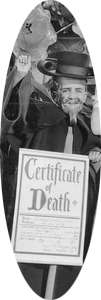
Bless the Daughters of the Republic of Texas

Driving through Alamo Plaza yesterday morning, I peered through the remaining bleachers, a hangover from Fiesta, for a glimpse of the familiar blue.  Could it really be gone?  

A reconnaissance mission on foot this morning revealed it truly had disappeared.  All that remained was an unblemished view of the Alamo, minus what had seemed a permanently installed pop-up tent

Hallelujah!

The ground where the pop-up had stood for so long resembles a large, freshly-dug, unmarked grave.   The spot cries out for a rest-in-peace sign, but I doubt the ever-present Alamo guard would permit the erection of one. 

Magically appearing, as if to allay fears the popping-down of the pop-up is temporary, was a man with a tape measure.  The Alamo groundskeeper was sizing up the plot to determine the amount of sod needed to restore it as greenspace.

The morning moment seemed out of The Wizard of Oz, the Munchkin chorus whizzing through my head: 

Coroner of Munkinland
Ding-dong, the pop-up's gone.

As Coroner, I thoroughly examined her
And she’s not only merely dead,
She’s really most sincerely dead….

(Munchkin 1)
We thank you very sweetly for doing it so neatly

(Munchkin 2)
You’ve killed her so completely,
That we thank you very sweetly

(Glinda)
Let the joyous news be spread….


It seems there should be pomp and ceremony, a service excluding prayers for resurrection; this calls for a celebration.  Ah, but I guess there was one – Fiesta San Antonio.

Note Added on April 28Remember the Trademark?

Note Added on April 30:  “DRT Drive for Trademark”

Don Draper Would Drink Here

My father had the hat, always had a cigarette going in an ashtray in every room and favored old-fashioneds.  His resemblance to Mad Men’s Don Draper ends there. 

When faced with the classic cocktail menu of Bohanan’s Bar, 219 East Houston Street, it would seem an old-fashioned would be a sentimental favorite.  But I must have sampled a few too many sips during one of my parents’ parties, because, even if “Dapper Don” himself were buying, I just cannot go there.

Mad Men is credited with igniting the classic mixologist craze; so it seemed fitting to order a drink invented by ad men with the swagger of Don “What-you-call-love-was-invented-by-guys-like-me-to-sell-nylons” Draper.  The Moscow Mule.  The refreshing drink with fresh lime and a strong ginger flavor seems more tropical than its name that reflects the Russian origins of the product the mule was supposed to push to gin-drinking Americans, Smirnoff’s vodka.

According to Cocktail Times, the Moscow Mule was invented in 1941 by Heublein executive, John G. Martin, and the owner of the Cock ‘N’ Bull Bar, who wanted to bolster his flailing ginger beer franchise:

They ordered specially engraved copper mugs and Martin set off to market it in the bars around the country. He bought one of the first Polaroid cameras and asked barmen to pose with a Moscow Mule copper mug and a bottle of Smirnoff vodka.  Then he would leave one copy of the photo at the bar and take a second copy to the bar next door to show them that their competitors were selling their concoction.  Between 1947 and 1950, thanks to their invention, Smirnoff vodka case columns more than tripled and nearly doubled in 1951.

Surely, Don Draper would approve.  Bohanan’s Bar seems to have the original drink down pat, even offering it in a copper mug General Manager Scott Becker says they had custom-made in New York.  My friend and I are hooked.  But wait, Lainey told us we had to try the food.

Mark Bohanan sheds some of the formality of the restaurant upstairs by offering a selection of traditional sounding sandwiches with upscale twists:  the BLT features Kurobuta – the Kobe beef of pork – bacon; the grilled cheese has aged gouda, heirloom tomatoes and basil; and the roasted lamb has caponata, goat cheese and arugula.  He even makes a nod to that traditional San Antonio snack, Frito pie.

We headed for other sections on the menu.  Raised on the Atlantic Ocean by the Chesapeake Bay, I tend to be more than a bit snooty about crabcakes.  The Bar at Bohanan’s makes a great Old Bay-seasoned one dominated, as it should be, by the flavorful lump crabmeat itself.  The Bar’s take on a Nicoise salad features several small rounds of perfectly seared sashimi-grade tuna, and the blackened snapper arrived blanketed with freshly prepared vegetables.  We bucked all wine-pairing rules and enjoyed a glass of a Chilean Carbenere blend from San Lorenzo Estates.

Jill Giles worked with Bohanan’s on the interior design, and the care she lends any project with which she is connected is clearly evident in the Bar.  The traditional dark wood used for the bar and trimmings is counterbalanced by the large storefront windows fronting on Houston Street and overlooking the courtyard.  Seating and tables vary in size and arrangement, creating comfortable spaces for couples or groups of friends. 

Attentive service, fresh presentation of food and cocktails Don would drink are all good qualities.  But what makes a body want to return to the Bar at Bohanan’s is that it is quite simply a great place to talk.

Note added on April 23:  Perhaps we had never heard of the Moscow mule because McCarthyism and the Cold War dampened enthusiasm for anything Russian.  Booze News offers a more extensive history of the impact of politics on the drink, including the following:

In particular, the drink caught on with the Hollywood crowd until 1950 when not unlike a few Hollywood screenwriters, Smirnoff and its flagship drink, the Moscow Mule, took heat for the Russian association.  Assuming that Smirnoff was a Russian import, unionized bartenders in New York announced a Moscow Mule boycott, refusing to “shove slave labor liquor across the wood in any American saloon.” 

Smirnoff rushed to testify that its vodka was not, and never had been a member of the Communist Party.  In support, Walter Winchell wrote in 1951, “The Moscow Mule is US made, so don’t be political when you’re thirsty.  Three are enough, however, to make you wanna fight pro-Communists.”