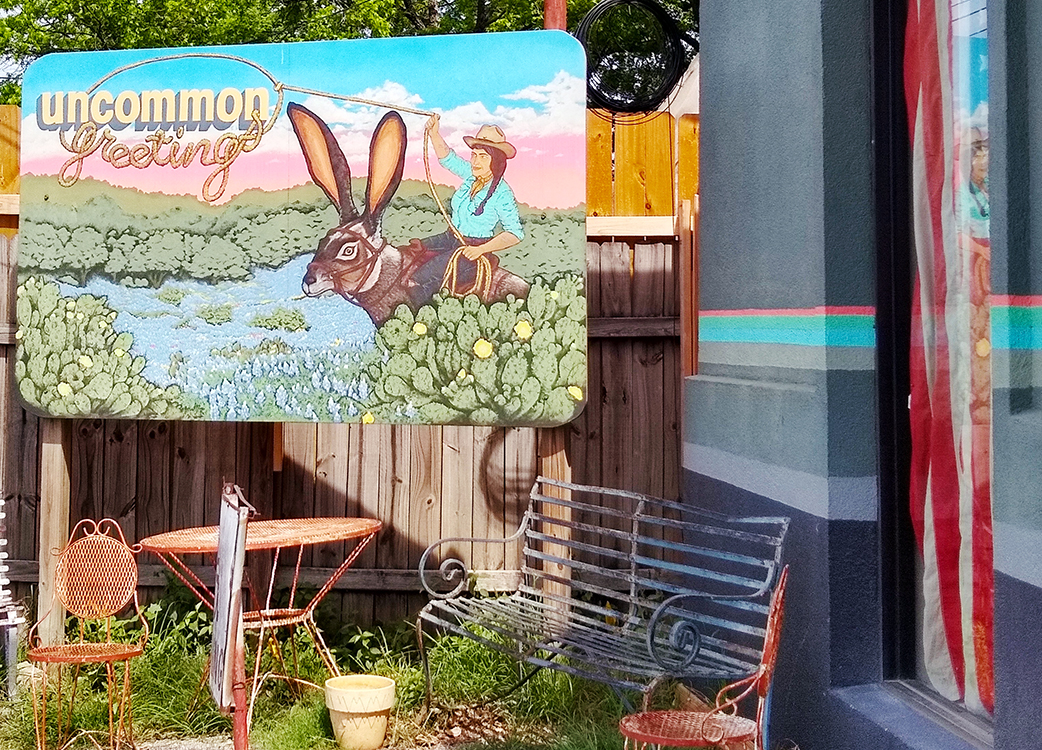
“Uncommon Greetings” postcard perfect

‘Curiouser and curiouser!’ cried Alice (she was so much surprised, that for the moment she quite forgot how to speak good English).

Alice’s Adventures in Wonderland, Lewis Carroll

Funky bud vases. I was supposed to be on a mission, but everything else was so distracting – the collective labels it “transcendent junk” – that I’m not sure I would have noticed a bud vase unless I knocked it over accidentally and it shattered it on the floor.

Continue reading ““Uncommon Greetings” postcard perfect”

Walking among the dead seeking hints about our past

Let us endeavor to live our lives that when we come to die even the undertaker will be sorry.

Words of Mark Twain engraved on the memorial for Bertie Lee Hall (1926-1999), member of the Texas House of Representatives, storyteller and writer

Getting to the cemetery first is not a race you normally want to win, but, when General Edward Burleson (1798-1851) died, leaders of the Republic of Texas realized they were caught flat-footed as to where to honor their heroes. Burleson had served with Ben Milam in San Antonio; fought at San Jacinto; and served as Vice President of the young republic. House member Andrew Jackson Hamilton (1815-1875) offered his own property in East Austin, with the state assuming responsibility for the burial ground in 1854.

Other prominent figures from the early days of the Republic of Texas gradually were reinterred in places of honor in the Texas State Cemetery. The remains of Stephen F. Austin (1793-1836) were moved from Peach Point to a commanding spot by Governor Oscar Colquitt in 1910. The statue of him was made by San Antonio sculptor Pompeo Coppini (1870-1957), creator of the currently controversial Cenotaph in Alamo Plaza.

Continue reading “Walking among the dead seeking hints about our past”

Sisters like two peas in a pod: Perhaps they shared a wedding dress as well

agnes and william marmon

Above, William C. Marmon wed Agnes Zacharriah Autry in a double wedding ceremony in the Coker Church in 1899. Photograph courtesy of Virginia Heimer Ohlenbusch from Haunting the Graveyard: Unearthing the Story of the Coker Settlement

In the late 1800s, itinerant photographers wandered the Texas countryside, making a living talking hardworking farming families into the need to document their lives on their homesteads. The result was that neighbors often had their farmstead portraits taken during the same time period.

In Haunting the Graveyard: Unearthing the Story of the Coker Settlement, published by the Coker Cemetery Association in 2019, I organized the book by a combination of themes and timelines. This meant that I used most of the itinerant farm photos in a chapter describing the efforts of those making a living in the area of San Antonio known as Buttermilk Hill. But this also meant my favorite details in two of these remained unlinked in the book.

Continue reading “Sisters like two peas in a pod: Perhaps they shared a wedding dress as well”