‘Skyscrapers Soon to Stand Where Wolves Once Howled’

The 1928 headline was a bit premature for the neighborhood, but we did live in their shadow briefly. Or at least the shadow of the freeway. Right there on their street. Ostrom. As close to 281 as possible. Yet in the midst of a neighborhood of fairytale cottages.

You’ve probably driven by it often, yet not through it. The freeway, the golf course, Mulberry and the river cut it off from any through traffic.

The River Road neighborhood. Filled with eccentric little cottages inhabited by some of San Antonio’s most wonderfully eccentric characters.

Some of these modern-day opinionated residents quickly would have taken sides in the “Goat Case” as covered by the San Antonio Daily Light on June 8, 1889:

Mrs. V.C. Ostrom, a well known lady of San Antonio, who has made herself quite famous in San Antonio by her untiring efforts in the cause of temperance and prohibition, was in court yesterday afternoon and all hands concerned had a lively time of it. This lady sued Jose Rodriguez, a neighbor living near San Pedro springs for damages for allowing his flock of goats to devastate her garden. Rodriguez’s goats have long been a nuisance to dwellers of the new fourth ward, even down to Marshall street, and time and again the city, through its recorder, has imposed light fines upon him for violating the ordinance in allowing said goats to run at large. Alone and unaided the lady attempted to defend herself against the evil and, what with the lawyers of the defendant and the crowd of spectators whose sympathies, on account of her prohibition sentiments, were decidedly against her, she had a hard time of it, and it may as well be mentioned, Rodriguez’s lawyer also had a pretty hard time of it.

But Sarah Hummer Ostrom and her daughter Frances were firm in their beliefs. They were willing to put their money on the table to spread the Good Word. They helped build and run a place of worship in their yard on Jones Avenue to minister to those who lived in the quarry area in “houses of tin strips, flattened-out tin cans and waste lumber.” According to a November 23, 1913, article in the San Antonio Light, they:

…set up a little mission among the jacals of Mexican squatters in the rock quarry district and spread the Christian Gospel among the lowly sons and daughters of the Moctezumas.

…she (Mrs. Ostrom) “works at her religion.” She does not save it merely for Sunday use.

This slideshow requires JavaScript.

But growing crops and saving souls on their farm soon yielded to the surrounding pressures to grow houses instead. Bess Carroll’s copy in an April 1928 edition of the San Antonio Light is so dramatic, I decline to edit her descriptions of a booming city stretching northward:

Over many a road blazed by adventurers, long ago, the huge stride of progress has marched into San Antonio, leaving great monuments in its footprints. And now this Titan whose breath is the stream of power, whose blood is an electric flow, has followed an old wagon road to the door of an ancient farmhouse.

Though phantom wolves may still howl their hymns to the moon there, San Antonio’s last prairie is being linked to the heart of her business being.

Beside the banks of the San Antonio river, where a tented city once stood buried in the mist of prehistoric oblivion, steam rollers snort and machinery does its superhuman work as the geographical end of St. Mary’s street is gradually dragged along by iron horses – the street-building equipment of the city of San Antonio – to meet Jones Avenue….

For the gigantic march of development is taking its parade of houses and money down an old Indian trail, across the path of the ragged Texas army of 1836, and along the course of what was, until recently, a shady country lane….

Along Jones avenue wide acres of oats and grain stretched out “once upon a time,” and only a short while ago the last remnant of the sole surviving farm gave way at last to development. That was when Miss Frances Ostrom, 1910 Jones avenue, converted the old Ostrom farm into a residence district known as “The French Village.”

When V.C. and Sarah Ostrom bought their nine-acre farm in ’69 they acquired water rights issued by the crown of Spain to this land when San Fernando cathedral was still young. But because it occupied a rise in the flat prairie surrounding it, the Ostrom farm very seldom “took the water” from the Upper Labor Ditch, a canal dug in early times for irrigation purposes….

(Miss Ostrom recalled) “The nearest store was Costanola’s, occupying the site of the present Robert E. Lee hotel; it was in the brush. Brackenridge park was largely a pasture. Later Rubiola’s ‘country store’ opened; soon after came a rural saloon. It was not until about 1885 that any houses were built on the North Side this far out. The mule car street ‘railway’ caused some development.”

The last stone of the Ostrom farmhouse was torn down in 1926. It had been a typical old stone house – four rooms and an eight-foot hall….

Land that had been green and virgin once was paved for the first time, in April, 1926. The last of the old prairie, plowed by oxen when at last its fertile acres were claimed by civilization, had its face covered over with a black veil of asphalt. It had been widowed, verily.

Now an avenue of trade will link the lost furrows of the Ostrom farm with San Antonio’s downtown district. In 1927 alone eight million dollars, according to real estate estimates, were spent in new building alone on St. Mary’s. Included in the principal buildings are: The Plaza hotel, Public Service building, Aztec theater, Smith Brothers-Young building – which is to be the tallest office structure in Texas – and the San Antonio Drug company, St. Mary’s Catholic church, The Gunter building, the Real estate building, Builder’s Exchange, Travis building, Lanier hotel, Commercial Loan and Trust company and the Brady building.

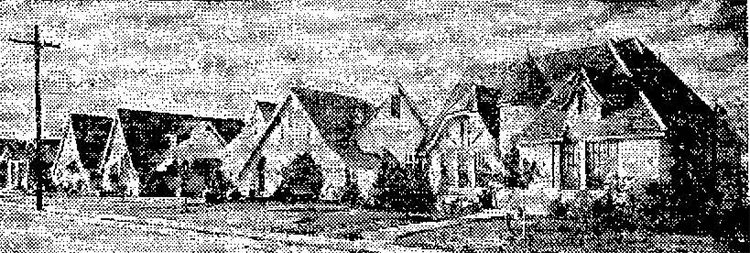
The picturesque houses of the “French village,” with roof lines mimicking those of major chateaus, albeit miniature in scale, still line several of the narrow streets, scarcely wide enough to accommodate two-way traffic, in the River Road neighborhood. Park in Brackenridge Park one day and follow trails across Mulberry to walk among the cottages and along the tree-lined banks of this natural portion of the San Antonio River. You will understand why the neighbors feistily defend this magical spot against any additional modern-day incursions.

Jimmie Draper: Rain, shine, sleet, heat

mariachi-festival

This post needs a soundtrack. Nothing would be more fitting than San Antonio high school students belting out mariachi music, so please play this while you read. For Jimmie.

1968. I think James Miller Draper, Jr., was there when the Paseo del Rio Association started, raising his hand to volunteer to do whatever it took to get attention for the River Walk.

It might be hard to imagine now, but the few businesses opening along the river were desperate. There were times when the only live things walking down the sidewalk in the heart of the river bend were pigeons. Things were so dull, there was even a night when some bored unnamed river operators shot fish. With guns.

Jimmie served as president of Paseo del Rio Association twice, in 1975 and 1984. But assumption of that responsibility is minor compared to his continual presence through thick and thin for more than four decades.

The coldest mornings in December always were the Fridays we placed luminarias along the river’s banks. Bob Buchanan made the coffee, and Jimmie brought the doughnuts. Without fail. For decades. Nancy Hunt, current executive director of Paseo del Rio Association, said that even last year Jimmie rode the bus downtown to deliver sweets to those delivering bags to the river’s banks.

No weather forecaster was more accurate than the first night of the annual Great Country River Festival the first weekend in February. Guaranteed sleet. Jimmie was always there.

The event closest to his heart always, though, was the Fiesta Mariachi Festival. It was his. I believe he was the first and only chair of the festival for more than 40 years. He threatened to retire one year. Paseo even threw him a party to recognize chairing the event 25 years or so. That just made him sentimental and mushy about the whole thing, so he kept coming back. Every year, he gave up four nights of Fiesta to meet the high school students boarding the barges. Without fail. Until this past year. Being 86 is a pretty good excuse for easing up a bit.

Generally Jimmie had the patience of Job. The time he really lost it, although not publicly, was at City Hall. The Paseo’s contract with the city in the late ’70s required we continually appear before Council to request approval for each event.

It should have been routine, but poor Mayor Lila Cockrell had a rather rowdy bunch to try to keep corralled. Those were colorful times.

I could almost see the hairs on the back of Jimmie’s neck bristle as a councilman went off on a rant about gringos being in charge of putting on a mariachi festival.

Then there was without a doubt the most incredible remark I ever heard at City Hall. Councilman Joe Webb interrupted the diatribe: “Mariachis. Cucarachas. What’s the difference? They’re all the same to me.”

Councilman Bernardo Eureste leapt to his feet and challenged Councilman Webb to duke it out. The scuffling councilmen went out in the hall to settle things, but were restrained before striking any serious blows.

Permission to stage the admission-free festival was granted, but, on the way out of City Hall, Jimmie said that was it. He would never go back there and be insulted like that again.

But he kept on volunteering again and again and again. Rain, shine, sleet, heat. No matter.

Gringo Jimmie might not have been known for shouting loud gritos in public, but, in those early years working with Belle San Miguel, his belief in bolstering the talents of young musicians gave fledgling programs in public schools a stage on which to shine. Before there were statewide competitions, the Mariachi Festival was the event inspiring students to strive for professionalism in their performances. Jimmie loved to see students board the barges, proudly wearing their festival medals from each year they had participated.

This spring will bring the 44th annual Fiesta Mariachi Festival. Jimmie was there for 42.

luminaria

Light a luminaria for Jimmie this holiday season. If it goes up in flame, it’s his unselfish and generous soul flying up to heaven.

Visit those quiet little missions before the reenactors remember the Battle of Espada

One of the nicest features of the Mission Reach of the San Antonio River Improvements Project is that it invites you to visit the missions strung along the banks of the San Antonio River.

And not just the first two you normally take visitors from out of town to see before you get missioned-out and head for margaritas.

But the oft-overlooked San Juan Capistrano and San Francisco de la Espada, which, true confession, the Mister and I had not seen for at least two decades (but, true confession, not as long as it’s been since my last confession). Their histories easily can be found online, so I will not attempt to rewrite. This post is simply meant to entice you through pictures to rediscover what we tend to forget on the south side of town.

This slideshow requires JavaScript.

Mission San Juan Capistrano was founded in 1716, with much of the mission compound not completed until 1756. San Juan himself must of have been incredibly pious because he was governor of Perugia, the chocolate capital of Italy, before becoming a Franciscan. However, since chocolate came from the New World, maybe lording over Perugia around the year 1400 was not as flavorful as it would be today.

When the Mister and I made a mid-morning stop at the mission, the information center was staffed by a volunteer from the parish. What was wonderful was that he peopled the mission for us with his own ancestors, photographs of ancestors he did not realize had lived within the protective mission walls until seven years ago. Plus, he told us how a window at each of the missions is positioned to let illuminating rays of light shine on the statues of each one’s patron saint on the appropriate feast day. Clever calculations by the priests; miracles to the Native Americans they were converting.

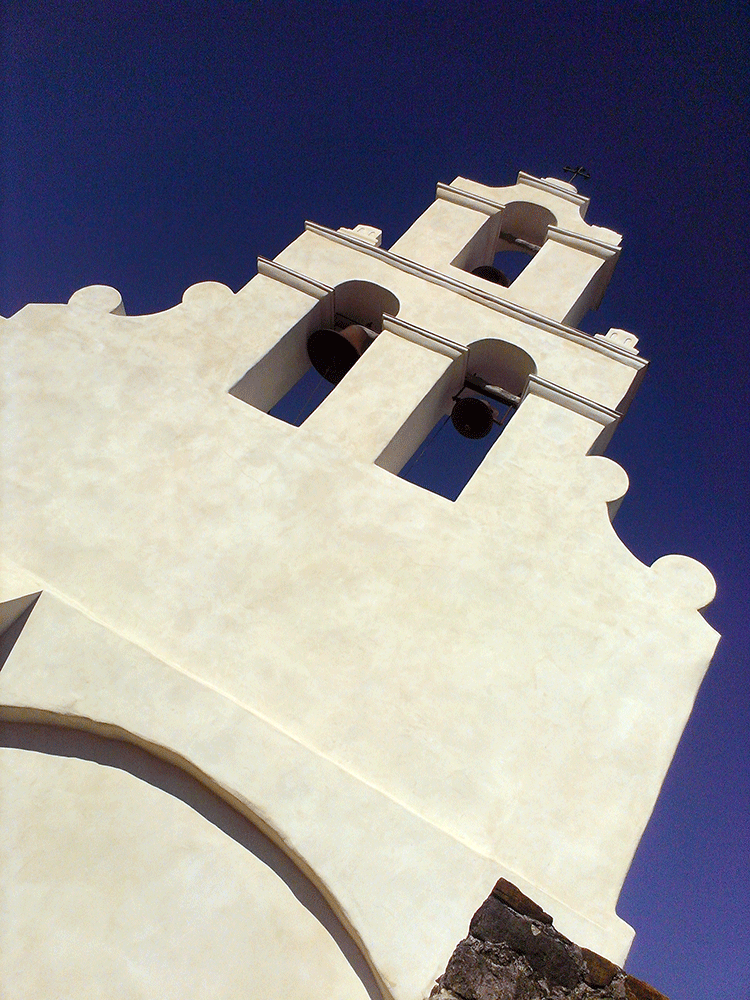
The National Park Service seems proving a good steward of the grounds, and Father David has been applying the funds he has raised successfully through the nonprofit Old Spanish Missions to re-stucco the church for the first time in about 250 years. The church now gleams against the blue Texas sky. Unfortunately, the priest does not keep the same hours as the park, so we did not view the interior. Probably the most reliable time to view the interior is during a scheduled Mass, but I’ll probably stick with more random attempts.

Visiting Mission San Francisco de la Espada should become a more fashionable pilgrimage now with the popular Pope Francis in charge at the Vatican. More attention undoubtedly will be focused on Saint Francis, about whom I have written before in this blog. It would help if San Antonians, including myself, would incorporate the Francisco instead of shortening the name to Mission Espada.

Of course, if the National Park Service really wanted to market Espada to Texans, maybe the thrust of the story should change away from the agrarian and vocational skills the friars taught the inhabitants.

I mean, look at the Alamo. If you make it about guns, they will come, as Land Commissioner Patterson recently showed us.

If more people were aware of the battle fought there in October 1835, Espada would soon be mobbed.

The following is from a report submitted to General Austin by James Bowie and James Fannin following the battle, according to Wallace McKeehan on the Sons of Dewitt Colony Texas website:

Mission of Espadas, Saturday morning 7. oclk AM 24th octr 1835 Genl S F Austin Half an hour since we were attacked by the enmy, who were repulsed, after a few fires being exchanged Only a few men were seen-say about fifty-tho, from the dust etc. it is believed 200 or more, were in the company-Dr Archer says that Col. Ugartichea was the commandant, as he plainly saw him, and recognised him-The place is in a good condition, or can be made so in an hour, for defence, and until we know, of the advance of some aid, or what was intended by this feint, we will continue to occupy this station, where we have provisions enough for the army provided means are supplied to purchase….

If the Alamo attracts millions of visitors to a site where virtually all the Texians were slaughtered, wouldn’t people love to visit the spot where Bowie and Fannin were victorious?

Espada is the spot.

Visit it now. Before the word gets out. While it is still a peaceful place at the end of the Mission Reach.

A place to celebrate the Feast Day of St. Francis on October 4, perhaps even witnessing the rays of light illuminating his statue.

And well before reenactors decide they need to start shooting off noisy guns at 6:30 a.m. every October 24.

Update Added on August 12, 2014: As August 15th brings a solar illumination to Mission Conception in time for the Feast of the Assumption of Mary, an article in Today’s Catholic by Carol Baass Sowa sheds light on the phenomenon that would amaze Native Americans:

It was the Franciscan missionaries’ knowledge of astronomy, he related, that was responsible for the incorporation of solar illuminations in a number of their churches. They served to symbolically communicate the friars’ Catholic faith to the Native Americans, much as medieval churches used stained glass windows to tell the story of Christ and Gothic arches pointed upwards towards highly decorated ceilings to symbolize the heaven men should strive to attain.

Arriving in what was a wilderness, the Franciscan founders of Concepcion had little to work with, Father (David) Garcia explained, so they built into the church the symbols and signs that would tell the indigenous people about God and Christ. “They had a ray of sunshine come in and illuminate the sanctuary,” he said. It was a way to tell the native people “God is moving among us…..”

The friars were highly educated men, (George) Dawson explained, and the Catholic Church used churches as solar observatories since the 15th century as a means to figure out such things as when Easter fell. Also leading credence to the case for the Franciscans is research on the California missions, which has shown one or two Franciscan priests were in charge of construction for several of the missions there which feature the majority of the solar illuminations….

Mission Espada also has an illumination, he related. On the morning of Oct. 4, the Feast of St. Francis of Assisi, (the Franciscans’ founder), light from the rectangular window on the eastern wall bathes the statue of St. Francis on the altar in a golden glow. Again, there is a duplicate display on March 9, which happens to be the feast day of St. Frances, a woman mystic who died in the 1400s.