Around Alamo Plaza: Been a long time, but the signs are still there.

There have been many posts in this blog ranting about haphazard appearance of the front door for many a visitor to San Antonio – the Alamo Plaza Historic District.

Most businesses evidently believe duplicate signs are critical; even the city’s newly remodeled Visitor Information Center has two extra, twin signs flanking its doorways. I thought the Hotel Indigo was going for cool, but apparently not. And, although it’s not in the district, the city’s recently redone plaza with its strangely homuncular statue of Henry B. gets graced with an illegal sandwich board advertising a garage a block away.

There is no need for many words this time; the photos of illegal signs speak for themselves.

This slideshow requires JavaScript.

If you have the stomach for more ugly signage greeting our millions of visitors annually, here is a small sampling from older posts:

Please complain about the lack of enforcement of signage regulations in the Alamo Plaza Historic District to your city council representative and consider dialing 311 to report violations you see.

Saplings to Shade the Next Generation

Reports from Spanish missionaries exploring what was then northern Mexico almost 300 years ago described a river with lush, tree-lined banks. Native Americans, who called the land Yanaguana, valued these trees for much more than shade from the brutal summer sun. Trees provided wood for fuel and tools and bark for medicinal purposes. Brasils, Mexican plums and persimmons all provided fruit, and pecans and walnuts provided food that could be stored for months. 

The much maligned, homely honey mesquite tree was among the most useful. The hard wood could be hewn into tools or musical instruments; the gum and bark served as an antiseptic. While the tough seeds were discarded, the blossoms and pods were eaten. But don’t expect mesquite pods to be the next gastropub trend in the locavore movement. According to Texas Beyond History:

The Cahuilla utilized mesquite in three different forms – blossoms, green pods, and dried pods. Blossoms were collected and either boiled or roasted on heated stones, squeezed into balls, and consumed. Green pods were pounded into a juice using a mortar and pestle. Most of the harvest probably was pounded into meal using a mortar and pestle. The meal was moistened with water, then allowed to harden into flatcakes a few inches thick. It was stored in this form, but often bruchid beetle eggs would hatch and the cakes would become infested with larvae (Bean and Saubel 1972). The Pima, at least, are on record as saying that the larvae simply added some zest to the meal. Informants said that the pods could be consumed without any preparation by breaking them into small pieces and chewing them (Russell 1908).

While the area off Avenue A adjacent to the River Road neighborhood provides a glimpse of what the river might have looked like in its natural state, the recently opened stretches of the Mission Reach of the San Antonio River Improvements Project are virtually treeless. 

Flood-control projects of years ago were single-minded; trees impeded flood waters so were removed leaving a barren flood channel. Native grasses and wildflowers planted the past several years as part of the San Antonio River Improvements Project have improved that landscape dramatically, but 100-degree summer days cry out for shade.

My grandmother always said, “Little acorns grow into tall trees;” although she was reassuring a young girl she would one day blossom bosoms. And in greenhouses and fields outside of Lubbock, the Texas Forest Service is nursing acorns and those pesky Anaqua seeds that embed themselves in the ridged valleys of my walking shoes into a huge crop of saplings to shade the next generation hiking along the banks of the San Antonio River. 

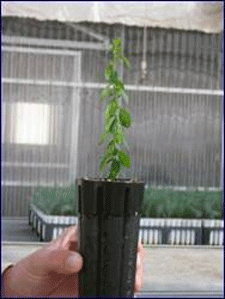
In November, crews from the San Antonio River Authority will begin planting 3,000 saplings ranging in height from a few inches to a few feet in the first phase of the Mission Reach. Depending on the species – including cedars, willows, cypresses, cottonwoods, elms, Mexican sycamores, possumhaws and redbuds – the trees will take from 10 to fifty years to reach full maturity.

To provide a preview of some of the native trees soon to grace the banks, the San Antonio River Foundation worked with the Parks and Recreation Department of the City of San Antonio to plant 15 trees at Roosevelt Park by Mission Road. The trees were planted in honor of the hard work of the volunteers on the San Antonio River Oversight Committee who have shepherded the project along through the years. This anaqua sporting a Treegator skirt, slowly releasing water to nourish the roots through the drought, is among them.

The River Foundation will be sharing saplings for you to take home and plant from 4:30 to 6 p.m. on Thursday, October 20, at Confluence Park, 310 West Mitchell. In addition a free tree, you will be able to view the Master Plan for this neighborhood park reestablishing the historical connection from the river to Mission Concepcion.

And, the best news: By the close of 2015, the River Authority will have planted another 20,000 trees along the Mission Reach. The next generation might not even need to wear sunscreen on morning walks.

January 24, 2012, Update: Want to add this link to another blogger’s recent post about plantings along the Mission Reach.

Oh, no! Not the Alamo (again). Can the lost mission of St. Anthony be found?

Oh glorioso San Antonio!…. Tu alcanzaste con tus oraciones que las cosas perdidas fueran halladas….

Prayer from a holy card

St. Anthony, St. Anthony
Turn around.
I’ve lost something
That can’t be found.

one of many versions of traditional rhyming appeals to St. Anthony of Padua

He is petitioned for help in finding almost everything that is lost, from car keys and misplaced papers to a lost job, a lost lover, or a straying partner. People who are regarded as “lost souls” may also be placed in his care…. Quechua Indian charm vials from Peru containing tiny blue-robed St. Anthony statuettes are carried for the return of a lost lover; they also always contain a piece of the coiled jungle vine called “vuelve vuelve” (“come back, come back” in Spanish).

from luckymojo.com

St. Anthony, the patron saint of miracles and finding lost things. A preacher so effective fish in the river once raised their heads out of the water to hear his words. But can he find his mission now lost in the heart of the city named in his honor?

According to The Handbook of Texas Online, Mission San Antonio de Valero was founded on May 1, 1718, at San Pedro Springs. Heavily damaged in a hurricane, St. Anthony’s mission was moved to the east bank of the river in 1724 to a location now known as Alamo Plaza. Despite epidemics of smallpox and measles and attacks from marauding Apache, the Native Americans – including Karankawas, Yutas, Tacames and Payayas – populating the mission numbered more than 300 in the 1750s.

Their lives and the first half of the history of what is now called the Alamo seem mainly forgotten, overshadowed by a mixture of folklore and fact surrounding a siege that ended on March 6, 1836. Mexican troops under the command of General Antonio Lopez de Santa Anna were the victors in this battle.

Few countries commemorate the battles or wars they lost, but the lost battle at the Alamo survived the days of the Republic of Texas as the centerfold of Texas history. Perhaps the Texas psyche finds it far less painful to demonize the enemy and embrace the battle lost than to celebrate the eventual victory at San Jacinto, where Texians gained their bloody revenge threefold.

“Mission San Antonio de Valero Missing,” digital collage on display at King William Art through July 27, view online at http://postcardssanantonio.com.

My personal battle of words over the banner hung to commemorate the 175th anniversary of the fall of the Alamo only represented a continuation of a series of unheeded rants about rampant signage violations in the historic district encompassing the remnants of the Mission San Antonio de Valero. I’m not saying we need to forget the Alamo, but seeing the gigantic 175th on the side of the Emily Morgan Hotel constantly reminds me of the missing mission.

Should not the upcoming 300th anniversary of the founding of St. Anthony’s mission be something for his entire city to rally around? This heritage is what distinctively flavors San Antonio – our most precious quill. Dallas, Houston and Austin don’t share it; they weren’t even born until more than a century after San Antonio.

The banner compelled me to create a rather uncomplicated digital collage – not quite as unappealing as my two earlier signage protest pieces – drawing attention to the prominently missing mission. St. Anthony wistfully gazes down from his holy card (Okay, I confess. This antique card was not originally his; I helped him “find” it. It belonged to a teenage image of Jesus. But, since I made Jesus younger, gave him a friend for company and gave them both better halos than they had, I don’t think I really need to say two “Our Fathers” and three “Hail Marys” over the appropriated card.) at a hand-tinted postcard of the Alamo as though looking for “his” church. Despite the size of the 175th, the lace of the holy card curls around the date – 1718. I slipped this protest piece into my current show at King William Art.

This photo of “Flippin’ San Alamo” is from the June 14, 2010, online edition of the San Antonio Express-News.

This token print pales beside the protest slated for 6:30 p.m. on Monday, June 13, on Alamo Plaza – the Flippin’ San Alamo Fiesta. St. Anthony not only gets asked to turn around but ends up upside down. The event was the brainchild of artist Rolando Briseño and received extensive media coverage last year, including this from the San Antonio Express-News:

Briseño called the performance art piece “part of a cultural adjustment for the Alamo” and the lore that surrounds it. He describes the Alamo — a hallmark emblem for Texans most often used to inspire loyalty and patriotism — as a symbol of Anglo hegemony that ignores the role played by Tejanos and slaves of African descent in early San Antonio.

“I decided to let some of the skeletons out of the closet on the Alamo,” Briseño said Sunday. “Some days they try to get the history right, but they need to try harder.”

The event began with actors representing African slaves, Tejanos and indigenous Americans carrying a sculpture of Saint Anthony standing on a replica of the Alamo. Once they mounted it to a bar, the actors continually flipped the statue — when Saint Anthony was upright, the Alamo was upside down, and when the mission was upright, the saint stood on his head.

Briseño said he wanted the event to reaffirm the contributions of Mexican Americans to the United States.

Cartwheels seem a larger transgression than the absconded holy card; Rolando might need the full confessional prescription.

We’re not sure how St. Anthony would feel, but Gene Elder recently sat sculptor Tony Villejo on his “chartreuse couch” for an interview for Voices of Art Magazine. Villejo said:

Just a short mention of the spinning Alamo project…. It has gotten to be a bit unsettling with me…. it’s been a bit odd walking into a gallery or whatever the venue may be and seeing this piece making the rounds, thinking about the very personal connection I have to the sculpture.

And then there is the spiritual connection. As Gene’s interview with Tony continued, Tony said he was commissioned to create a bronzed St. Anthony holding Jesus for an actual church – St. Anthony Catholic Church in Spring Branch:

…the whole process from start to finish was the most difficult project I had ever been involved with. Technically, it was fine, but emotionally it drained me. Just the fact that it was to be a saint that was to be viewed by a serious Catholic community.

The project was so successful, Tony received another private commission for a plaster St. Anthony. And he delivered again.

Although Tony refers to himself as “the biggest skeptic I know,” strange things have been happening in his client’s backyard since St. Anthony took up residence. Tony described the events to Gene:

Well, this guy is new to the neighborhood. Keep in mind that every single home in the area has its own six-foot privacy fence. A couple of weeks later his neighbor informs him that the night before he had seen this really bright light radiating from his patio. That happens to be where this statue is situated….

A few days later, same scenario, from the other neighbor. Another incident happened during a very hard downpour. This time it’s the neighbor directly behind his home….

Well, he has a friend visiting for a few days and at around 3 a.m. his home alarm goes off. He rushes out of his bedroom and lo and behold, through the blinds there is this really bright light or aura radiating from you know what. The good thing is that he woke his guest from the other bedroom and had him sit there and experience this with him.

I’m just repeating things. But maybe I’m thinking the San Alamo sculpture might possess some powers unaccounted for by logic.

Maybe it’s not a mere coincidence that after St. Anthony – the patron saint of miracles – cartwheeled around the plaza, the Daughters of the Republic of Texas are turned all topsy-turvy by the State Legislature.

St. Anthony, St. Anthony,
Please look down.
Maybe there’s a mission
To be found.

Messing with miracle-makers might be dangerous. Maybe the Daughters need to sign that agreement and rush to set up committees to plan the 300th anniversary of Mission San Antonio de Valero in 2018.

By the way, did you ever hear the story of St. Anthony and the miser’s heart? The scolding he gave Ezzelino? Or the shamed simpleton who severed off his own foot?

Just saying. Just in case, maybe it’s time to sign on the dotted line.

Update: View event photos and video in this follow-up post