Two Roads to the Alamo* and the Conservation Society Book Awards

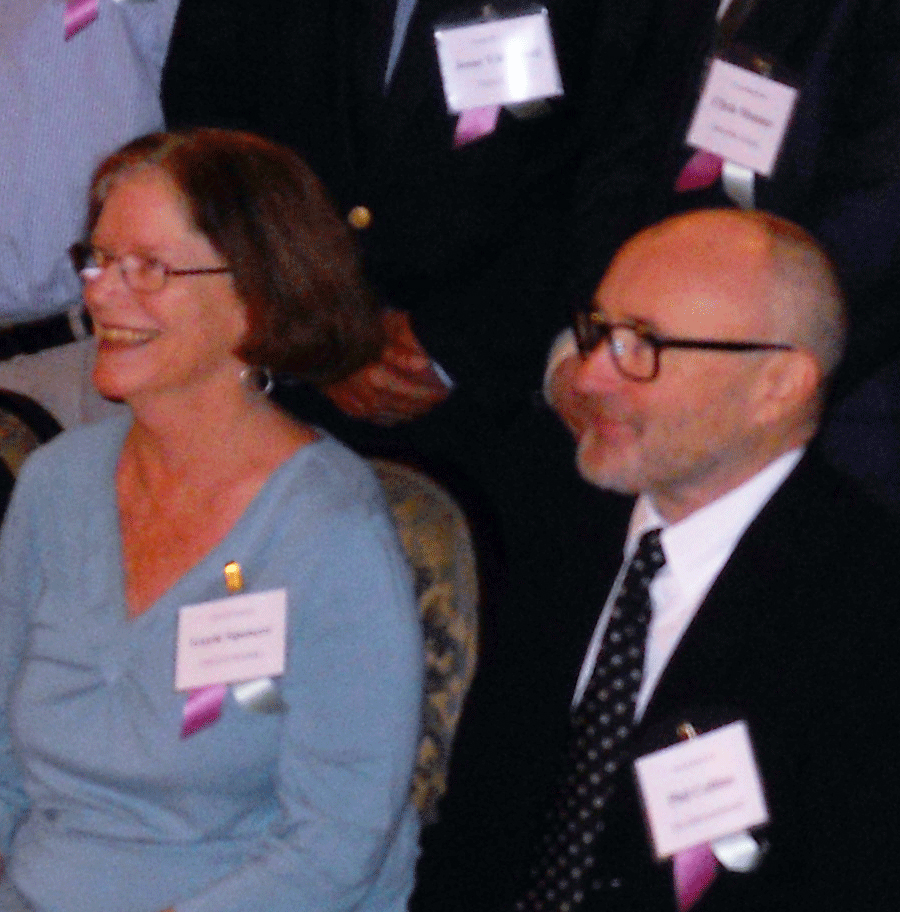
book-awards-closeupThere we were, sitting beside each other. Phil and I.

I’m talking about Phil Collins. But I just call him Phil now. Because I sat beside him for about one minute.

As you can tell this is leading to one of celebrities’ worst curses: people who don’t know them writing about them.

But, of course, this is different. Because I know him. Because I sat beside him for about one minute. And he politely introduced himself to me and shook my hand.

That, and we have several things in common.

Davy Crockett, for one.

When Phil Collins was a kid growing up in a London suburb, he would often watch an amazing show on his family television.  There, in black and white, was Fess Parker as Davy Crockett, King of the Wild Frontier.  As he matured, Collins not only acted out the exploits of his new hero, but he often refought the Battle of the Alamo with his toy soldiers.

Texas History Store introduction to The Alamo and Beyond

While I’ve never sure been it’s psychologically healthy to adopt Texans’ fascination with the battle they lost, playing Alamo seems a better alternative than the Davy** Crockett chapter that influenced me as a child in Virginia Beach.

I sat alone in my room, playing the record. Over and over and over.

It wasn’t this one, or, if it was, it was part of a much longer recording. I can’t find the version in my mind online.

Perhaps what I remember didn’t exist except as a compilation in my jumbled file cabinet of a mind. But it was Davy Crockett. Or Fess Parker. And it was a life and death struggle with bears and Indians… and the part that haunted me.

I have no idea how many times I listened to that recording, but definitely many times too many.

Even I knew my mother was exasperated.

I would wet my bed. We’re not talking about a three-year old. I was six.

But I had my reasons.

I ran screaming to my parents one night about the bears in the house – my visiting Great Aunt Mary snoring.

There were Indians in my closet. I finally learned keeping the light on in the closet kept them at bay.

But the light filtering through the louvered door did not help with the Crockett family’s other adversaries.

Alligators.

http://blog.nyhistory.org/davy-crockett-almanacs/
Davy Crockett’s Almanack, 1837. Tenn. 1837 .D38 N3. New York Historical Society Museum and Library. http://blog.nyhistory.org/davy-crockett-almanacs

The women then slacked the rope a little and made it fast round a hickory stump, when my oldest darter took the tongs and jumped on [the alligator’s] back, when she beat up the “devil’s tattoo” on it, and gave his hide a real “rub a dub.”…My wife threw a bucket of scalding suds down his throat, which made him thrash round as though he was sent for. She then cut his throat with a big butcher knife. He measured thirty seven feet in length. (Davy Crockett’s almanack,*** of wild sports in the West, life in the backwoods, & sketches of Texas. 1837, p. 10).

My self-preservation instinct was strong. Who in their right mind would risk getting out of bed with alligators on the prowl? Alligators hungry for a “tongariferous” fight. Bladder be damned if I would.

Not only would I not set foot on the floor when alone in my room at night, I would not let a pinky slip over the edge because…. Snap! Those alligators were fast.

And I had a family to protect – a toucan whose name now escapes me; George the green monkey whose rubbery pink hands and feet were comforting to chew nervously upon when trying to make it through dangers lurking in the night; and Nipper, a huge RCA dog who took up easily half of my single bed. I never once let George’s tail hang over the edge. I would sleep rigidly, never ever tumping one over the edge into the alligator pit.

To dream of an alligator, unless you kill it, is unfavorable to all persons connected with the dream.

“Dream Interpretation,” spiritcommunity.com

The flaw, of course, was no one understood this was why I wet the bed. And, when I finally managed to explain, no one took the danger seriously. Of course, now they have books about this. But that was the late ’50s, and they had not yet been written.

Finally, midway through first grade, a solution was found. A path of folding chairs was set up each night between my bed and the bathroom. Somehow, I was able to summon the courage to imperil myself by crawling across this wobbly bridge to the safety of the bathroom, and, of course, everyone knows alligators would never cross the threshold onto the tile floor.

So, as I was writing, Phil’s interest in perpetually fighting – probably trying to change the outcome – the losing battle at the Alamo seems a preferable Davy chapter in which to be stuck.

And Davy seems to have stuck with both of us, Alamobsessive souls that we are.

I focus on and fret about the Alamo as the city’s front door. I constantly nag, in blog form, the city to enforce its historic ordinance to keep illegal signs from multiplying at night. I have even used some of the historic postcards I have assembled to create protest collages.

weve-lost-the-alamo
Postcards from San Antonio ~ No. 21 ~ “We’ve Lost the Alamo.” 2010 edition of 25. Yes, Numbers 21 and 22 are the ugliest collages ever to reflect the overwhelming commercialization of Alamo Plaza. Even Waldo (Yes, he’s there.) is easier to find than the Alamo. An early 1900s postcard of a parade float, “Save the Alamo,” and “Letter from the Alamo” from a plaque on the grounds are surrounded by some of the plaza’s clutter, including a dinosaur, Stumpy, snow cones, the Odditorium, the t-shirt bearing the unheeded message “Don’t Mess with Texas, San Antonio” and even the Daughters of the Republic of Texas’ own unsightly addition of a pop-up tent pushing their “Live the Drama”‘ guides (Fortunately, this pop-up was removed). http://www.postcardsfromsanantonio.com
“They’ve Breached the Walls.”
Postcards from San Antonio ~ No. 22 ~ “They’ve Breached the Walls.” 2010 edition of 25. Mary Bonner’s tasteful woodblock print originally made to help raise funds for the San Antonio Conservation Society is paired with an inscription from the Cenotaph, “In Memory of the Heroes…at the Alamo, March 6, 1836.” The images are overwhelmed by surrounding offers to shop at “Liber-T,” view repulsive world records, obtain henna tattoos or consume ice cream cones and hoagies. Sorry to have left out the coonskin cap. http://www.postcardsfromsanantonio.com

These efforts have had limited effect. And, not surprisingly, these particular collages have not resonated well with art collectors.

Now, legislation has been filed to form a commission to study the state of Alamo Plaza. Good news to some, but the bill would go farther than my Alamobsession wants by giving the commission the mission to “reclaim its original footprint.” I might not love Ripley’s, but I love the Alfred Giles’ Crockett Block.

Plus, if returning Alamo Plaza to its appearance at the time of the battle is taken literally, the Alamo would get a crewcut (Click here for a long-winded post about that particular issue).

"San Antonio: A Descriptive View Book in Colors," 1913
“San Antonio: A Descriptive View Book in Colors,” 1913

I don’t know how Phil feels about this. Because how much ground can you cover in one minute?

But I do know, while I was collecting postcards of chili queens on Alamo Plaza, Phil was collecting everything else Alamo. When Phil does something, he doesn’t fool around. He gets serious. He even collected a building off the plaza. This is from his myspace page:

From Bill Wyman’s metal detecting to Alex James’s cheese-making, every self-respecting musician is obliged to cultivate a hobby to relieve the stresses of the rock star life. Collins is no exception, utilizing the basement of his Swiss home for his twin enthusiasms: building model railways and tending to his vast collection of Alamo memorabilia.

“… it’s an all-consuming thing for me. I spend as much time in San Antonio as I can. I rent a little property out there on the walls of The Alamo itself where I’ll dig for artifacts. I’m always looking for stuff to buy and the collection is growing fast. I’ve got a huge number of cannonballs, muskets and bowie knives that were used there, Lady Crockett’s pouch and many documents that were written by the main protagonists. One of my prized possessions is a receipt signed by Commander William B. Travis for 32 head of cattle used to feed the Alamo defenders.

“My kids are convinced that I was present at The Alamo in a previous life. Just recently I attended a convention out there and met a clairvoyant who is married to a man who’s attempting to restore the Alamo compound. She walked up to me and said, ‘’You’ve been here before. In a previous life you were John W. Smith, one of the major couriers who survived the Alamo and become one of San Antonio’s first mayors.’ Oddly enough one of the first documents I bought for my collection was the receipt for Smith’s saddle. So maybe my kids are on to something.”

philcollinsbook31Phil collected so many Alamo things that photos and information about them now fill a 400-page book, which brings us to another thing we have in common.

We are both authors, which is how we met. Our books – his, The Alamo and Beyond: A Collector’s Journey, and mine, Last Farm Standing on Buttermilk Hill: Voelcker Roots Run Deep in Hardberger Park – both were honored with awards presented by the San Antonio Conservation Society at a luncheon on Friday.
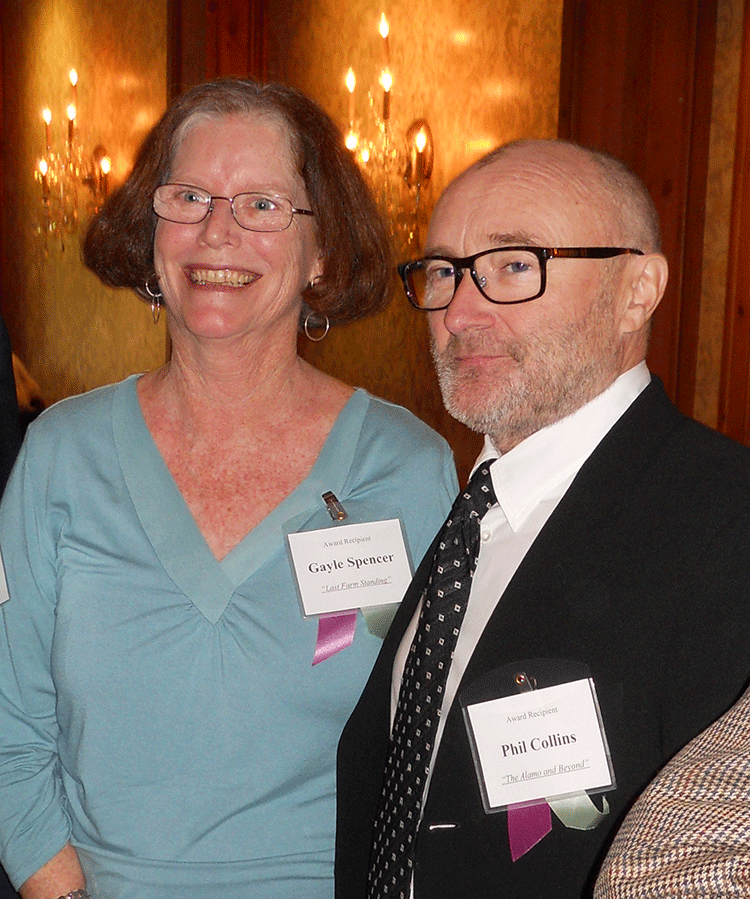
phil-collins-1-closeupYes, there were eight other publications about Texas history recognized, but those authors need to write their own blogs. Because this one is about Phil and me.

Because I sat beside him for about one minute. And, as you can see, we obviously engaged in animated conversation. Probably because we have so much in common. And I didn’t even get a chance to tell him I’m married to a bluesman.

Somehow, KSAT-TV failed to catch this important connection on camera, which is good because I would not have wanted to end up in the pages of some publication, such as The Star, where they zoom in on the superficial shortcomings of someone my age – the preponderance of wrinkles, protruding bellies and falling bustlines.

Another thing Phil and I share is we have changed careers. I have changed career directions several times and feel free to sprint off in any direction I choose. If I choose to write books, that’s fine. No one objects; no one cares.

But, poor Phil. He’s worked hard his whole life – “I enjoyed Genesis when I was 19” – and wants to pursue his hobbies now:

Reporters repetitively bombard him with “why?” Some fans of the Grammy-winning star express anger at him for retiring from concerts. This, even though, according to his myspace page:

His less prolific work rate is partly down to health reasons. Since 2000 he has suffered from loss of hearing in his right ear. More recently he was diagnosed with severe nerve damage to his hands, making drumming extremely challenging. During recording sessions for his new album, he was forced to tape his sticks to his hands.

Owsers. That sounds totally painful. Give this man a well-deserved break.

Keen to accentuate the positive, he explains that his medical concerns have forced him to take stock of his life. “I never used to think of myself as a workaholic,” he says. “I used to work non-stop because I couldn’t believe my luck that I was able to do all these things that I loved. I was everywhere and I can see why that must have been annoying to some people. Then I reached a point where I no longer felt the need to go zooming around the world and attend the opening of every envelope. Basically I stopped.

“I’ve got a nine-year-old and a five-year-old. I take them to football. I like to take them to school and pick them up. That’s my life now. I love doing the things that other people probably find tedious because they’ve been doing them for so long. I never did those things in the past as I was always working flat out. That was my loss. Now I’m able to do all that and also have time to indulge my passions.”

Besides, somehow I feel this man’s Alamobsession will end up helping shape the future of Alamo Plaza. I’m sure it will accomplish more than my haranguing collages and blog posts.

Oh, and, Phil, if you get tired of staying in hotels when you visit San Antonio, the Mister and I might be able to work out a house swap with you. The Alamo’s less than a mile away from our door. Call me next time you are in town and you’ve got a minute. Who knows what else we might have in common?

*With apologies to William C. Davis, author of Three Roads to the Alamo: The Lives and Fortunes of David Crockett, James Bowie, and William Barret Travis. Hey, at least I didn’t title the post My Life with Phil Collins. Now that would have been a stretch.

** David would be more historically correct, but does not represent the popular culture upon which we – Phil and I – were weaned.

***Oh, dear. I had to stop in the middle of this post to order a copy of Davy Crockett’s Riproarious Shemales and Sentimental Sisters: Women’s Tall Tales from the Crockett Almanacs, 1835-1856, for which I paid a penny, plus $3.99 shipping – quite a bargain unless the alligators return ‘neath my bed. And, as that is an “our” bed, I’m positive the Mister would not relish the thought.

Update on March 25, 2013: John Spong of Texas Monthly spent considerably longer than a minute with Phil Collins.

Phil Collins at age 5, an image (now blog-altered) originally appearing in the San Antonio Express-News

Update on March 27, 2013:

A follower reminded me to look back for this photo of Phil Collins, coonskin-hatted at age five playing Davy, that appeared alongside an article by Steve Bennett in the San Antonio Express-News last May.

Which reminded me of another obvious thing Phil and I have in common – the Battle of San Jacinto. His collection began with a receipt for a saddle purchased by John W. Smith, who was at both the Battle of the Alamo and the Battle of San Jacinto and seems to continue to haunt the collector a bit. My desk currently is haunted by reams of paper pertaining to the families and relatives of John Coker who settled on his land grant on the north side of San Antonio. Jack Coker was a hero of San Jacinto credited with the idea of blowing up Vince’s Bridge, blocking one of the possible escape routes for the Mexican troops.

And, on another note, one of my sisters fessed up that she was the one who told me I’d be safe from dangers lurking in my room if I let no part of me slip over the edge of the mattress. So nice after all these years to finally unload the psychological burden for bedwetting on a sibling.

Update on May 6, 2013: Mary Dearen’s version of the same awards luncheon as published on mywesttexas.com.

Update on June 24, 2014: Phil Collins is donating his entire collection of Alamobsessive artifacts to the Alamo.

Biannual survey of what you are reading on my blog

If blogging truly is my therapy, it’s amazing I have not been hospitalized this past year. My posts are few and far apart.

Yet some of my recent posts have crept up into the top dozen for 2012. Other favorites refuse to budge from the list, particularly Charles Elmer Doolin’s invention of Cheez Doodles turned into art. The number in parentheses represents the rankings from six months ago.

  1. Cheez Doodles as Art (1), posted on January 8, 2011
  2. Breaking news from the Alamo: The horse is already out of the barn, posted on August 18, 2012
  3. “Nuit of the Living Dead” (3), posted on October 30, 2010
  4. Return to the Alamo: Please don’t gag the Daughters (Whose side am I on anyway?), posted on July 29, 2012
  5. Haunting the graveyard to unearth the past (6), posted on April 4, 2012
  6. Please put this song on Tony’s pony, and make it ride away(8), posted on July 25, 2010
  7. Susan Toomey Frost stimulates a second revival of San Antonio’s traditional tilework (4), posted on June 24, 2011
  8. Concrete Artisans Leaving Lasting Imprint in San Antonio (9), posted on January 7, 2012
  9. The Madarasz murder mystery: Might Helen haunt Brackenridge Park?, posted on August 4, 2012
  10. Ban the Banner (11), posted on August 8, 2010
  11. Ribbons of Gaudi-inspired steel ripple above the river (5), posted on July 6, 2011
  12. Grandma’s rusks refuse to be rushed, posted on February 9, 2012

Thanks for following, and am hoping to be more faithful in my postings in the months ahead.

Although maybe my readers are happy not to hear from me quite so often…

The Madarasz murder mystery: Might Helen haunt Brackenridge Park?

Warning: Copy from newspaper accounts describing violence or demonstrating racial prejudice of the day appears as written.

Cruising through Brackenridge Park at night, park police tell tales of the woman in the long flowing dress holding a basket of roses as she gracefully stoops, tending flower beds near the river. They turn their patrol cars around to shine headlights on the mysterious figure to find her vanished, the only trace of her presence a small pile of freshly plucked weeds.

Some nights, they see another woman silhouetted in the moonlight walking on the river wall by the upper pumphouse or precariously along the highest lip circling the Japanese Tea Garden. Her long dress is ripped off one shoulder, her hair springs wildly from its bun and she wields garden shears in such a threatening fashion they find themselves involuntarily crossing their legs.

These visions are the same, Helen Ujhazy Madarasz. Her ghost has roamed the area for more than a century in search of justice for the men who robbed, raped and killed her, setting her afire to destroy evidence of their crime.

First time you have heard of this ghost?

Okay. I confess. The ghost is a figment of my imagination, percolated in the bubbles of my bath.

But Helen was real. And, if a ghost needs an excuse to lurk in the dark, she certainly has reason to haunt Brackenridge Park.

Born in 1838, Helen Ujhazy was still a child when her idealistic Hungarian father found himself on the side of the underdog as the last fortress fell to the Austrians in 1849. While her father was greeted as a hero upon arrival in New York, according to James Patrick McGuire in The Hungarian Texans, the family’s journey to settle with fellow Hungarian exiles on farmland in New Buda, Iowa, was hard. And, for the first time in their lives, the Ujhazy girls had no servants.

McGuire wrote that Helen adapted quickly:

She was an excellent horsewoman, and, riding sidesaddle, she was responsible for herding the family’s newly purchased livestock…. In a letter written in February of 1851, Helen said that she was healthy despite the harsh winter and was making an overcoat from stag hide, which she had obtained from visiting Indians for eight scarves bought in Hamburg.

Helen’s mother died that fall, and, in mourning, her father left the family behind while traveling to look at the prospect of building a new life for them in San Antonio. During his absence, according to McGuire, the 15-year-old set her mind on marriage to Vilmos Madarasz, the teen-aged son of a fellow Hungarian immigrant. Despite, her father’s disapproval, the couple married in June of 1853. The newlyweds remained in New Buda with Vilmos’ family when Lazlo Ujhazy moved the rest of the family on to San Antonio.

In this case, father evidently knew best. Helen found herself two children later in Hungary with a straying husband, supposedly off settling business connected to his inheritance from his grandmother. While she once again had a maid, McGuire wrote she felt:

… abandoned by her husband, who was wasting his inheritance in rich living and flirting with women in another part of Hungary. This situation created a scandal in both their families. Described as uncontrollable as well as childish, lonely and weak, Madarasz let it be known that he considered his American civil marriage invalid in Hungary….

Reuniting with her father during his visit to Switzerland, a pregnant Helen and her two sons sailed with him to Texas in 1858. While aboard ship crossing between New Orleans and Galveston, she lost her youngest son to a raging fever.

In San Antonio, Helen moved into the Ujhazy house, Sirmezo, on Olmos Creek near the headwaters of the river (now Olmos Basin and Olmos Park). Texas did not impress Helen immediately, and she was not getting along with her older sister, Klara, in the cramped homestead. McGuire wrote, Helen complained in a letter she penned to another sister:

There is scarcely a day that I don’t ask God to liberate me from here.

Helen borrowed from her family against an expected inheritance arriving from Hungary to purchase a farm on the Cibolo. Farming alone was difficult – drought, scorpions and marauding Indians – and working the fields added years to her appearance. In 1864, she finally filed for divorce, granted by default.

Following the death of her father in 1870, her brother, Farkas, made a series of unfortunate business decisions affecting the estate. His main creditors, Dr. Ferdinand Herff and Judge Albert Dittmar, foreclosed on Sirmezo. Fortunately, prior to the sale, wrote McGuire, Farkas had at least transferred ownership of all moveable property and livestock to Helen.

While her siblings returned to Hungary, Helen had become a Texan. McGuire described her as having emerged as a capable, independent businesswoman, making money through real estate transactions and by loaning out profits.

In 1883, she purchased land on the river from George Brackenridge, who lived on the adjacent property, Fernridge. Brackenridge retained the water rights, wrote McGuire, for San Antonio Waterworks.

A 1911 postcard shows the beauty of the land in Brackenridge Park formerly owned by Helen Madarasz.

A May 1, 1899, edition of the San Antonio Daily Express described Helen’s home:

Her house was located in a beautiful Eden-like grove near the head of the San Antonio River; on it and its shrubs, flowers and foliage, as well as the grounds, she expended considerable of her means, and their beauty was famous. The old Madarasz home is in one of the most beautiful natural parks in Texas. It is a grove of tall, thick-boughed trees, under which rise several of the large springs that form the San Antonio River…. In the midst of this grove, with beds of former lagoons and spring feeders to the river, and the head arm of the river itself flowing close by, stood the neat little old-style cottage of Mrs. Madarasz.

The river waters and those of the ancient labor ditch provided the water needed for Ilka Nurseries, which her son Ladislaus operated until he began working in his new neighbor’s bank, First National Bank. This left Helen to run the nurseries and greenhouses.

Helen socialized with her neighbors, both suffragette Eleanor Brackenridge and her brother George, a friendship that attracted attention of others. McGuire wrote:

Colonel Brackenridge, also Helen’s close friend and a lifelong bachelor, possibly provided wise financial advice for her investments, and their names were linked in local gossip.

The divorcée and son managed to move amongst San Antonio’s high society. Helen was among the participants in the first, rather wild, Battle of Flowers Parade in 1891. She also presided at one end of the table at an elegant birthday celebration Ladislaus hosted for himself at the Lakeside Hotel, West End. An October 10, 1892, edition on the San Antonio Daily Light described the event in great detail, listing the Herffs, Kalteyers and Duerlers among the guests. The party stretched until “11 o’clock:”

… the conclusion of which the guests formed a circle around their host, touched glasses and silently drank to his future peace, pleasure and prosperity….”

Ah, but if only the power of the toast had proved more potent. Fortunes changed.

While on April 23, 1895, the San Antonio Daily Light reported Mrs. H. Madarasz received the first ribbon award for the best general collection in the Rose Show, the headlines on May 2 brought bad news about Ladislaus’ role in the disappearance of large sums of cash at First National Bank:

The bank officials are reticent, but enough has been learned to say that he was infatuated with the great American game of poker, and was a heavy player at club tables, often losing or winning as high as $500 on a night’s play….

It is understood the poker rooms frequented by Mr. Madarasz were those of Thurmond, on Dolorosa Street. Very high, or unlimited play is said to be allowed there….

Among the “goody-goody” folks, Mr. Madarasz was thought to be such a “nice” man.

Ladislaus fled the country, and the embarrassed Helen, according to McGuire, became reclusive, focusing on her greenhouses.

Then the final tragedy befell her. At first, the San Antonio Daily Express of April 30, 1899, reported that Helen accidentally had burned to death in a fire in a home that took fire fighters downtown too long to reach. But on May 1, the San Antonio Daily Light started unfolding a more grisly story and the incendiarism ignited to conceal it:

Aged Lady* Killed Robbed and Burned….

In the ruins were found the remains of Mrs. Madarasz on some blood-soaked bedding in the bedroom. The trunk of the body and the back of the head was all that remained of this venerable and well-known lady. She had either been burned alive after being wounded near death or had been smothered by the smoke.

The Light speculated about the motives:

Deceased was supposed to have always a sum of money in her home. She had been in quite opulent circumstances in former years, and by the sale of flowers recently from the nursery for Flower Battle decorations and for the State Medical Convention it was known she had at least $200 in the house….

It is said Mrs. Madarasz possessed a large quantity of old jewelry, old family heirlooms as well as valuable bric-a-brac and silver, none of which have been accounted for.

And pointing of fingers began quickly:

The theory generally accepted about the city that some Mexicans who are strangers and have recently arrived at the rock quarry settlement, near Mrs. Madarasz’ place, from Mexico, on their way to East Texas, are responsible for the crime.

A $1,000 reward was posted for information in the case. But rather than Mexicans surfacing as suspects, Captain James Van Riper traveled to Alice, Texas, to fetch two suspects in another case and exacted a confession from William Cary, also known as John Sands, a confession also implicating J.W. Hart.

These two suspects were African American, and indignation raged in the city as the news of the arrest spread. Talk turned to hanging, so precautions were taken. According to the June 21 edition of the Daily Light:

Sheriff Campbell had carefully made plans to avoid  any disorder and notified Van Riper to have the train stopped before the depot.

The suspects were slipped off the train and driven in a hack to the county jail.

But once again, suspects were cleared. The headline of the June 28, 1899, edition of the Daily Express read “Negro Suspect’s Story Straight,” and “Hart and Cary said to have been in Tampico when the crime was committed.”

On June 29, the Daily Light reported District Attorney Carlos Bee had produced a letter from the American consul in Tampico verifying the alibi. Bee asked Sands:

… if he had made a confession of the murder of Mrs. Madarasz and he replied that if he had he knows nothing of it. He stated that sometimes he loses his mind and that he does not know what he talks about in such cases. He said he fell out a tree while a boy and has been affected ever since. He said he loses his mind, when he becomes frightened. He is a very ignorant negro. Both men denied they had ever been in San Antonio before.

Hart is an intelligent negro. He stated he was a British subject in the Bahama Islands and that he had gone to school fourteen years and was a monitor and had taught school. He was also a tailor in his country and regretted ever having left his shop….

Their stories must have been convincing to the point it moved some in the room to contribute to their transportation back out of San Antonio:

After the men had been discharged District Attorney Carlos Bee, Country Treasurer John Tobin and others who were in the courtroom contributed a little change toward them until each man had a dollar.

While that seems small compensation for their inconvenience, at least they were not hung by an angry mob.

But, that leaves the murder of Helen Madarasz a mystery.

That’s why I think her spirit still wanders the park at night, tending the flowers and seeking the guilty.

Let me know if you see her.

*I object to calling a 61 year-old “aged,” but that certainly pales in comparison to the quick accusations in the press against Mexicans and African Americans at the time.

Update on August 5, 2012: The ghosts who might be haunting Madarasz Park appear to be multiplying, and I promise they are not figments resulting from over-percolating in bath bubbles. Sarah sent me a clipping from the March 29, 1907, issue of the San Antonio Gazette that indicates this could be titled “The Curse of Madarasz Park.”

The parkland claimed the lives of four men during a one-year period. On May 14, 1906, Ernest Richter, “an aged man from Fredericksburg,” drowned. The proprietor who took over the management of the park in June of that year, Otto Petrus Goetz, committed suicide there on December 3. The fate of the following proprietor, Sam Wigodsky, was hardly better. He and his employee, William Berger, drowned on March 28, 1907, when their boat capsized as they tried to retrieve an empty beer keg midstream. While the drowning of the two men, both in their mid-30s, was ruled accidental, reports the following day claimed Wigodsky had been in possession of $1,000 in cash, mysteriously missing. Makes one almost afraid to ask the fate of the next proprietor….