Quinze’s “Wind” to blow on the Mission Reach of the San Antonio River

A month in the searing desert sun building a huge wooden structure.

A mere four days to enjoy it. Then setting it ablaze.

“It is not that easy to burn your own installation down,” said artist Arne Quinze during a June 2013 lecture sponsored by the San Antonio River Foundation at the San Antonio Museum of Art. “I still have goosebumps from it.” While an estimated 50,000 people witnessed the conflagration at the 2006 Burning Man Festival in Nevada, “The day after, nothing was left over.”

The Belgian artist’s first public art took the form of graffiti, but his work evolved into large-scale three-dimensional structures, often installed in urban settings, including Nice, Shanghai, Rio de Janeiro, Brussels, Rouen and Beirut. Quinze views cities as “open-air museums,” with art teaching “you to look at the world in a different way.”

Many of his installations are temporal, although not as fleeting as the one in Nevada. His installations sometimes spark controversy, but, by the time they are removed, there are public protests. “When we take it down, the space is more empty than before,” he said. “It makes them realize the importance of art in their lives.”

wind
example of a “pillar” of wind

The artist is drawn to strong hues of red and orange because they are “full of contradictions – a fire burns or warms; blood means life or death.” His series of “Wind” sculptures seem to follow that predilection. On his website, he describes the elements he installs in the landscape as representing “the frozen movement of wind going through a grass field, a sculpture waving like leaves in the sun.”
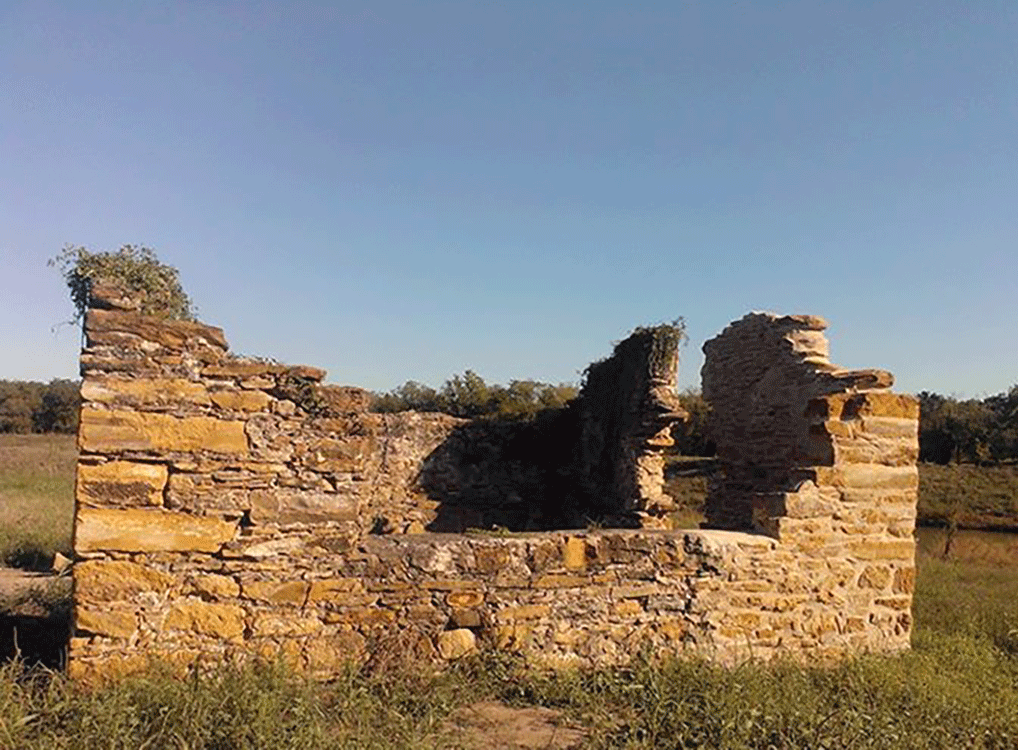
berg's-mill
Berg’s Mill
san-juan-today-2
Mission San Juan Capistrano

Perhaps that is what makes “Wind” most fitting for the rural river setting chosen by the River Foundation for his installation. His monumental blades of wind will serve as a gateway transitioning and leading people up from the river to the area where the ruins of the historic Berg’s Mill community are perched on the left and Mission San Juan Capistrano lies ahead on the right.

“Wind,” according to Quinze’s website, is designed to: “evoke emotion, spark conversation and make people stop in their tracks. They will be attracted to explore this surreal experience of the shadow and sunlight shining through the fixed pillars….”

To contribute to public art projects along the Mission Reach and the development of Confluence Park, visit the website of the San Antonio River Foundation.

Looking forward to being stopped in my tracks in 2015.

April 20, 2015, Update: Noticed that Arne has more site-specific renderings for his “Wind” installation posted online now.

And this is from the April 2015 River Reach, published by the San Antonio River Authority:
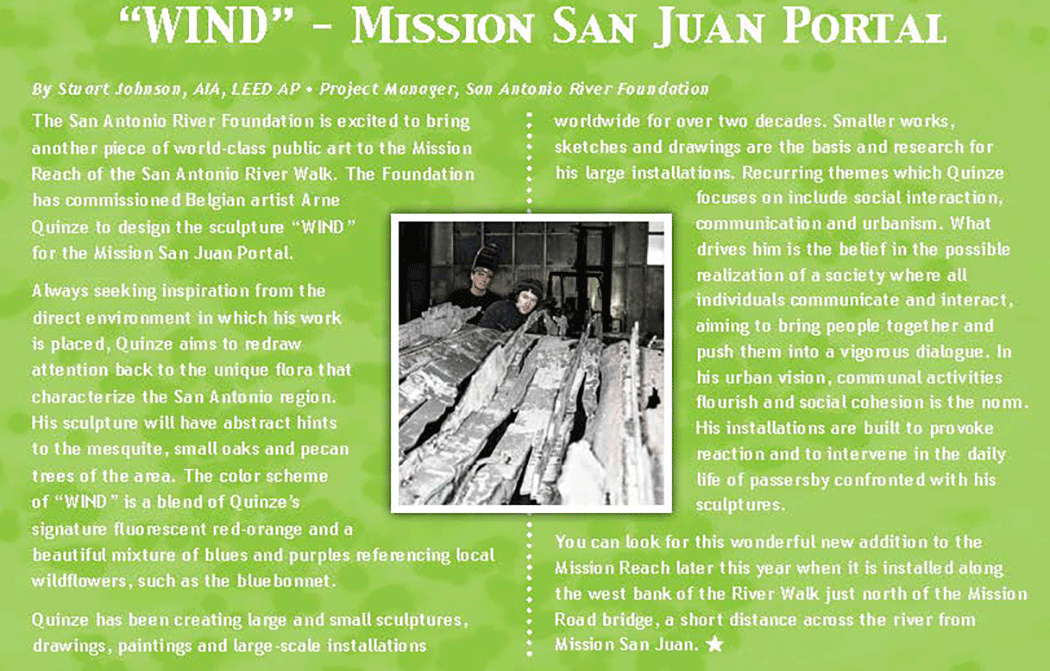
arne-at-san-juan

October 20, 2015, Update:

Artist Lecture: Arne Quinze will talk about “Wind” installation, his first permanent public art piece in the United States, at Blue Star at 6:30 p.m. on Thursday, October 22.

Sculpture Unveiling: Mission San Juan Portal will be unveiled at 10 a.m. on Wednesday, October 28.

The Curse of Madarasz Park: Another Ghost Wandering in Brackenridge Park?

Sometimes in the middle of the night, lions and wildcats can be heard crying out from the San Antonio Zoo by people living in neighborhoods more than a mile away from Brackenridge Park. Or so they say. I’m not convinced that some of those cries might not be a woman’s screams….

Shortly before coming to San Antonio to star in a silent film shooting in San Antonio in 1923, Martha Mansfield predicted what fashions stylish women would be wearing that fall:

The straightline frock, slim and narrow, is back for another season…. in lustrous satin of white or pastel shades.

The Hamilton News, July 2, 1923

After breakfasting in the company of friends at the St. Anthony Hotel on the morning of November 29, she unfortunately traded a narrow, fashionable frock for one of yards of fabric billowing over layers of crinolines. She donned the gown for her role as a daughter of the Confederacy falling in love with a Union soldier in The Warrens of Virginia, written by William Churchill de Mille, Cecil’s older brother. Brackenridge Park was selected for the day’s shooting because it:

contained a picturesque group of rag pickers’ shacks that would do very well for the servants’ quarters of the Southern plantation….

The Ogden Examiner, December 30, 1923

Her chauffeur parked the car near the set, and, during a break in filming, Martha retreated inside to relax. Shortly thereafter she emerged “screaming from her limousine, a flaming torch.” Leading man Wilfred Lytell threw his jacket over her head and face to protect her from the flames as the chauffeur frantically flailed to extinguish them. Although she was rushed to the hospital, she died from the severe burns on November 30.

How the fire started and enveloped Martha so quickly remained a mystery; police termed her death accidental. Some say the cause was a match tossed away carelessly by a fellow cast member; others speculated she herself dropped a match while lighting a cigarette. The Ogden Examiner hinted at foul play, perhaps the actress had not been alone:

What was it that turned the picturesque gown into a fiery funeral shroud?…. What started the flames that swept over her crinoline costume and wrapped her in a deadly embrace….

This slideshow requires JavaScript.

Born in New York as the new century dawned, Martha Erlich quickly progressed from the Ziegfeld Follies to star in silent films under her stage name of Martha Mansfield. The young starlet quickly was cast in numerous films, with a role opposite John Barrymore in Dr. Jekyll and Mr. Hyde in 1920 her most famous.

After her life was extinguished in San Antonio, her body was shipped to New York. Papers reported 1,000 people crowded into the funeral chapel, with another 5,000 held at bay by police outside. Among the films released after her death was The Silent Command, a story of “temptation and disgrace of a naval officer” by a ring of spies led by Bela Lugosi. The Washington Post reported the film was “heartily endorsed by Theodore Roosevelt, assistant secretary of the Navy and by General Pershing.”

So perhaps there is another ghost haunting Brackenridge Park, joining poor Helen Madarasz whose body went up in flames the year Martha Mansfield was born.

I promise I am not actively seeking spirits to populate the park. Helen is the only one I stumbled across on my own. Pursuers of the paranormal based in Austin recently led me to Martha after reading my earlier post about Helen. Just in time for Halloween. And Sarah found an additional four men who all perished in 1906 and 1907 in the portion of the park that bore Helen’s name – Ernest Richter, Otto Petrus Goetz, Sam Wigodsky and William Berger.

Let me know if you see or sense any of them. Or perhaps hear their screams.

Seeing San Fernando Cathedral in a new light….

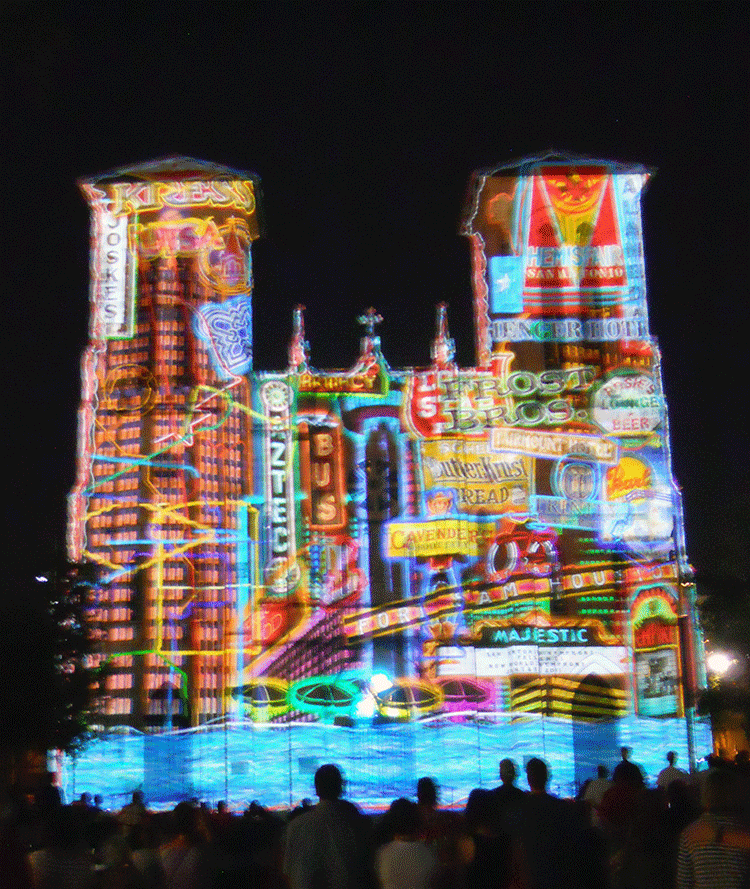
So easy to be lazy about something when you know you have ten years to see it. Plus, I must confess, I feared Xavier de Richemont’s San Antonio Saga might be a sanitized, preachy-teachy version of San Antonio’s history.

But the painterly projections of the Algerian-born Frenchman are accompanied by music as they sweep masterfully across the façade of San Fernando Cathedral. The massive kaleidoscopic collages quiet the crowd, mesmerized by the colorful images dominating Main Plaza.

This slideshow requires JavaScript.

The Main Plaza Conservancy has made a major contribution to the downtown landscape with this installation, and the Archdiocese of San Antonio is wonderful to offer the Cathedral as a canvas for the light show four nights a week. A video is not the same as being there, but hopefully will convince you to drag everyone you know downtown for the admission-free show.