Postcard from Sevilla, Spain: The most celebrated mother in Spain

My childhood memory might be as hazy as the incense clouds at midnight mass, but I think the head covering of a rather homely statue of the Virgin Mary at Star of the Sea church was a humble blue cloak.

In Spain, things are different. La Virgen generally wears richly embroidered gowns with an elaborate silver or gold crown perched upon her head. And she is mesmerizingly beautiful.

In Adalusia, she appears everywhere (see La Virgen tiles of the streets of Seville here). In Seville, one stunning representation of Mary per church is rarely enough. Although Holy Week theoretically revolves around the story of Jesus’ last days before his crucifixion and resurrection from the dead, the candlelit floats bearing Mary through the streets are the stars.

The most cherished of these is La Macarena, or La Virgen de la Esperanza (above). The 17th-century carved wooden figure resides on the altar of her Basilica in the Macarena neighborhood in Seville. When she emerges at midnight on Good Friday, the assembled faithful gasp and cry, with some scrambling to touch her cloak. She is paraded through the streets for 12 hours, with candles lit, according to Margaret Galitzin, to prevent her from seeing her son’s suffering on the float preceding her.

The wooden representation of Our Lady of Sorrows with her dramatic glass tears generally is attributed to Pedro Roldan (1624-1699). She received numerous makeovers through the years, particularly after a not-very-pious drunk hurled a bottle at her resulting in a “bruise.” Legend claims no cosmetic alterations could erase the damage. According to Galitzin:

When the man who committed this terrible offense against the Mother of God became sober, he saw the bruise and repented for his crime. For his penance, he resolved to walk before the statue each Holy Week with chains on his feet and carrying a cross to expiate his sin. After his death, his descendants continued this practice. To this day, it is said, a family member continues this act.

In addition to her elegant attire and shining crown, La Macarena wears several emerald floral brooches. The jewels were a gift from one of Seville’s most famous matadors, Jose Gomez Ortega (1895-1920), Joselito. A Canonical Coronation in 1913 added these precious stones to the garments of La Virgen.

You might have noticed the year of Joselito’s death and realized it seems premature. His faithful tribute failed to spare him from a fatal goring 99 years ago.

Yet La Virgen went into mourning. She wore widow-black robes for a month following his death – the only time she has shed her embroidered fashions. La Macarena remains the patron of bullfighters.

The photographs collaged here are regal representations of La Virgen from numerous churches in Seville.


Belated Mother’s Day wishes to all.

Postcard from Sevilla, Spain: Size foremost in the minds of Cathedral founders

In the year 1482, Pierre Dancart began carving the High Altar for the Cathedral of Seville, el Catedral de Santa María de la Sede. The enormous project probably consumed most of his life, as he did not finish until 44 years later. The sheer size of the altar overwhelms the vignettes from the Bible and lives of saints contained within it, such as the rather gory spearing of children above.

But size was what mattered most to those who determined to build the grand Cathedral in 1401.

Prior to that time, the site was occupied by a major mosque with a minaret designed by architect Ahamed ben Basso for Almodhad Caliph Abu Yaqub Yusuf (1135-1185). When King Ferdinand III of Castile (1199-1252) conquered Sevilla in 1248, both the city and the mosque were Christianized. Chapels were inserted to convert the interior into a more Catholic appearing space.

Seville became a center of wealth, and the initial redo of the mosque was not as grandiose as the city’s leaders vision for the city. They wanted an awe-inspiring Cathedral, so work commenced.

The resulting Cathedral was built astride the mosque and inside some of the walls of its compound. The imposing edifice covers close to six acres, with the center transept soaring to a height equal to a 12-story building – by most measurements, the largest Gothic cathedral in the world. The minaret was converted into a bell tower, the Giralda, and rises more than 30 stories in height.

Perhaps some of the plans were more grandiose than practical. The center dome collapsed in 1511, only five years after its completion. Its replacement, however, lasted until an earthquake in 1888. The newest one was completed in 1903.

The Cathedral contains the tombs of several kings as well as that of Christopher Columbus (1451-1506). The riches within are suitably impressive, and art includes works by Bartolome Esteban Murillo (1617-1682) and Francisco de Goya (1746-1828).

One can be overwhelmed by the sheer size of the Cathedral, or zoom in on the details, such as tiny shards of saints held in reliquaries or predatory, the Moorish lock on a door or wolves topping pilasters at one of the entrances.

Postcard from Cadiz, Spain: Final Semana Santa processions pass through her streets

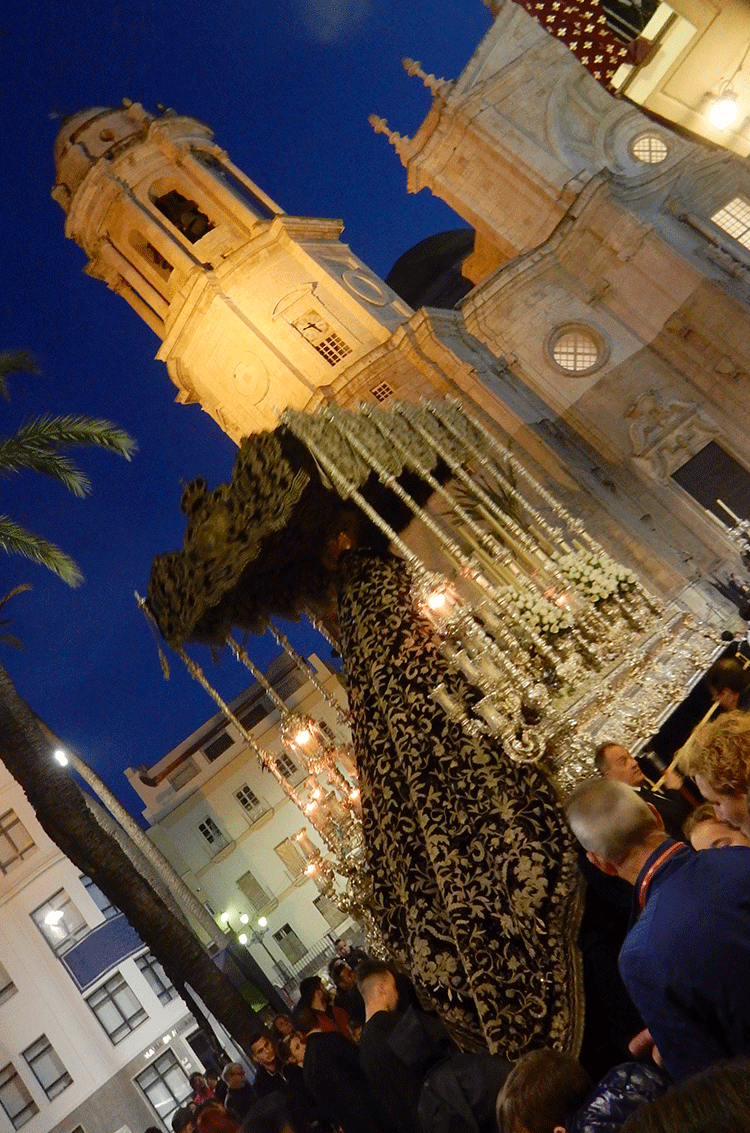
From early afternoon to the wee hours of the morning, the winding streets of Cadiz have been entangled with crisscrossing Semana Santa processions.

Banners and the color of robes worn by members of the different cofradias distinguish the sponsoring group for each procession. Most have only two actual floats, but the marching continues for hours as they transport their particular Virgin Mary and portion of the tale of Jesus’ trials and tribulations from plaza to plaza.

The mood of the spectators is mainly reverential, although the end of each procession is followed by the vendors’ carts offering candies, including caramel lollipops in the shape of the pointed capirotes.

The most excitement is generated by watching the teams of costaleros struggle to squeeze the floats in and out of the church doors with barely an inch to spare in any direction. And the music. The brass bands are filled with more talented musicians than it seems possible for a city of the size of Cadiz to possess.

And finally, the processions conclude with the resurrected figure of Jesus standing unburdened atop his Easter Sunday paso.

Not a bunny in sight.