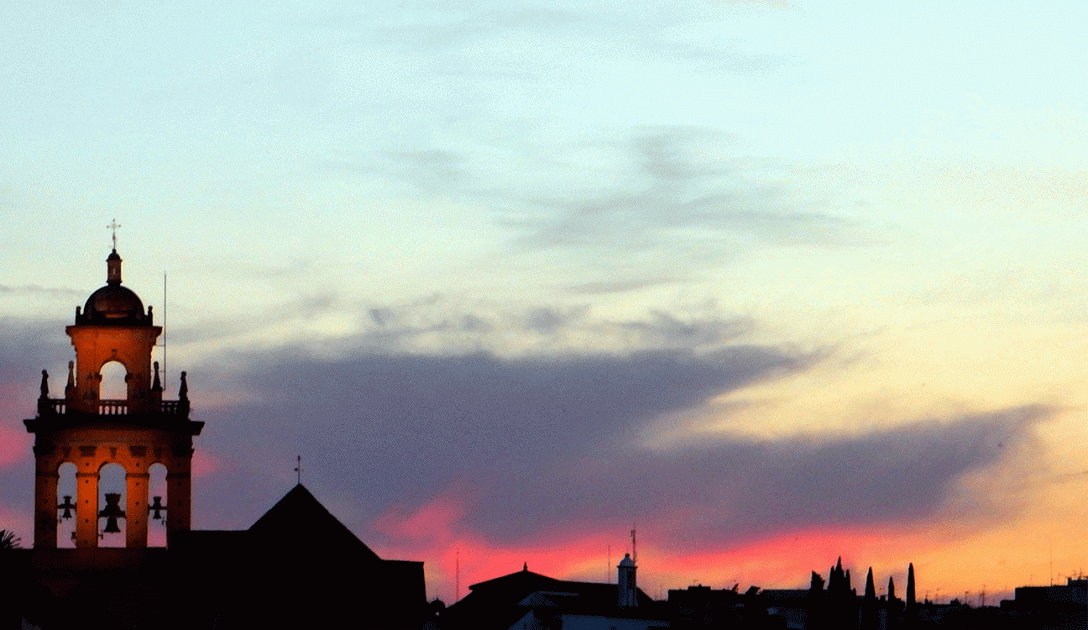
Postcard from Cordoba, Spain: A city filled with churches

When Ferdinand III (1199-1252), King of Castile, conquered Cordoba in 1236, he launched a flurry of construction projects to formalize the city’s conversion to Catholicism. The mosques destroyed in the process provided convenient foundations and served as quarries for building numerous of these. Through the centuries, the original medieval structures received Renaissance alterations topped by a Baroque overlay.

Shells left by pilgrims who have traveled the Camino de Santiago dangle from the statue of Santiago, or Saint James the Greater, in the temple built atop a mosque and dedicated to the saint. Following the death of Jesus, James proselytized throughout the Iberian peninsula before returning to preach in Samaria and Judea.

In the year 44, King Herod Agrippa I (11 BC-44 AD) ordered him beheaded, making James the first of the 12 apostles to be martyred. According to Acts 12:20-23, Herod himself perished later that same year because: “he had not given the glory to God, an angel of the Lord struck him down, and he was eaten by worms and died.” Legends associated with Santiago as the patron saint of Spain claim he, with neck intact, miraculously appeared armed atop a horse to lead outnumbered Christians to victory in a battle with the Moors – 800 years following his death.

And, continuing on a saintly topic, a large silver vessel enshrined in the Basilica of San Pedro contains a jumbled assortment of skulls and bones purported to belong to the Martyrs of Cordoba. According to accounts recorded by San Eulogio, these 48 Christians were beheaded by their Muslim rulers between 851-859 for their violations of Islamic law, mainly blasphemy and apostasy, or renunciation of the Islamic faith.

Eulogio’s writings, The Memorials of the Saints, ended abruptly upon the priest’s own execution in 859.


Postcard from Cordoba, Spain: The ‘popular religiousity’ of Santa Maria

“Popular Religiousity” is the heading applied to the figures of Jesus and Mary venerated in Cordoba in the brochure for Ruta de las Iglesias Fernandinas. The route includes a series of temples founded by Ferdinand III (1199-1252), King of Castile, following his conquest of Cordoba in 1236.

While figures of Jesus seem to play a larger role than they did in the churches of Seville, Mary is always a show-stopper with her regal brocaded gowns and impressive glittering crowns. Most of the statues of Mary have devoted brotherhoods or cofradias to see that their Marias are always elegantly attired and prepared to be borne aloft in parades, primarily during Semana Santa.

The ticket to La Mezquita Catedral provides you with access during the opening hours of these churches.

Postcard from Sevilla, Spain: The celebrated potters of Triana

“Saints Justa and Rufina” (detail above) by Francisco de Goya hangs in the Cathedral of Seville.

The most revered potters of Seville made their living in the area known as Triana in the third century – Santa Justa and Santa Rufina. During a festival, the sisters purportedly refused to sell any of their wares for use in pagan celebrations. In anger, those who had been refused service broke all of the pair’s ceramics. And, in the spirit of an eye for an eye, the sisters retaliated by smashing a statue of Venus.

The city’s prefect imprisoned the sisters and demanded they renounce their Christian beliefs. They refused, so their deprivation of food and water and various stages of torture began. Barefoot marches, the rack, hooks. Their faith remained steadfast.

Justa finally starved to death, and still Rufina refused to surrender to the prefect’s demands. Rufina was cast into the public amphitheater with a lion, but the fierce lion supposedly demurred attacking and purred at her instead. The frustrated prefect finally resorted to beheading, a method that proved effective at ending Rufina’s life.

With clay from nearby Isla de Cartuja, the Triana neighborhood on the left bank of the river remained Seville’s center for ceramics and azulejos for centuries. In 2014, the former Ceramica Santa Ana factory reopened as the Centro Ceramica Triana. The museum traces the regional history of tiles from the earliest known examples through the 20th-century.