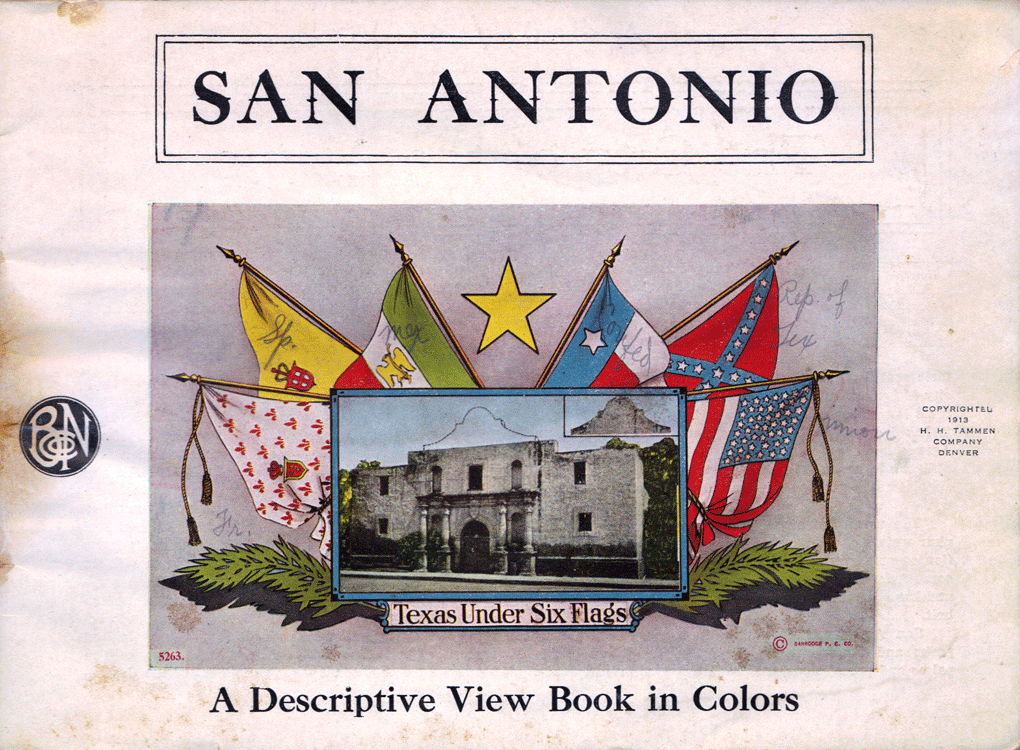
A 1911 postcard shows the beauty of the land in Brackenridge Park formerly owned by Helen Madarasz.
Time for the semiannual big-brother spy report on what posts you have been reading most during the past 12 months. As usual, you are all over the map, seemingly encouraging me to continue randomly sending postcards from San Antonio and back home no matter where we wander.
The mysterious murder of Helen Madarasz in Brackenridge Park rose to the top, which makes me wonder why ghost-hunters have not latched onto the story of Martha Mansfield. There are still some who pine to hear the San Antonio Song, a post from five years ago, but a few new posts squeezed into the top dozen. Hope some of you have found your way to dine in our favorite restaurants in Oaxaca, but my personal favorite entry about food in Oaxaca is on grasshoppers.
The number in parentheses represents the rankings from six months ago:
A long list is found on one of the walls of La Compania de Jesus Church in Oaxaca. A list of those waiting. Those whose lives in Mexico were so full of sacrifice Rome surely will notice and promote them on the road to sainthood.
I’m pulling for the child martyrs of Tlaxcala, the land of corn tortillas. Poor Christobalito, Antonio and Juan were, after all, children. Antonio and Juan were clubbed to death, but Christobalito’s own father, a confirmed pagan, condemned him to be beaten with clubs and then set ablaze for his faith. The trio was beatified by Pope John Paul II in 1990, but they hardly seem on the fast-track. They have been waiting in line a really, really, really long time. Ever since the late 1520s.
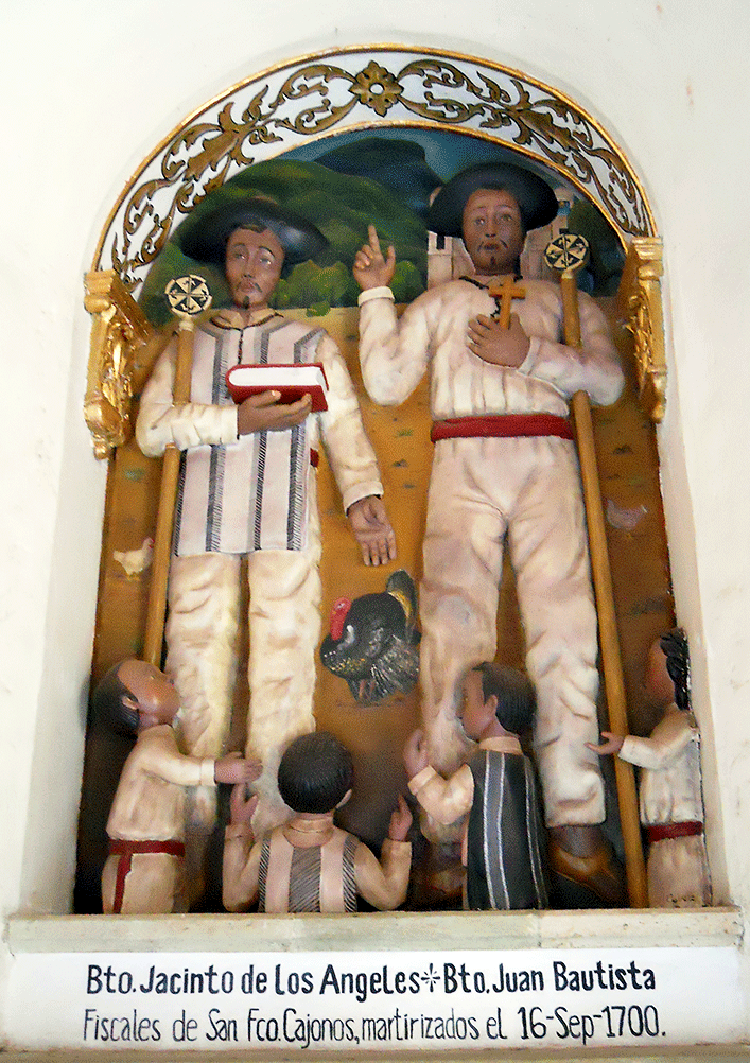
But in Oaxaca, a pair of Zapotecs stand out, although newcomers to the waiting list by comparison to the ninos above.
Back in 1700, Dominican priests in Oaxaca would commission converts to serve as “attorneys general,” assigned to police the purity and practices of those living in rural areas. Jacinto de los Angeles and Juan Bautista of San Francisco Cajonos, “the town in the clouds,” were so honored. Overhearing those worshipping the harvest god, Huitzilopochtli, talking about a clandestine evening gathering in his honor, the attorneys reported back to the Dominican friars. Intervention was planned, and Jacinto and Juan led a group to break up the idolatrous meet, seizing the men’s musical instruments.
Unfortunately for Jacinto and Juan, their Zapotec brethren did not take kindly to what they viewed as tattle-tale turncoat interference. A mob seized the two from the sheltering confines of the convent. The pair refused to recant their faith, even under torture.
They survived being thrown off Tanga Hill in the village of San Pedro, but clubs still were viewed as a popular way to deal with Christians anyway. The mob clubbed them and cut them with knives before cutting open their chests and feeding their hearts to the dogs. (I don’t make these things up. Read the Vatican’s version here.)
Whatever parts were left were gathered later by the faithful, who put them in the church of Villa Alta until 1889. The remains were moved to a chapel in the Cathedral of Oaxaca, a chapel almost always locked for their protection.
A bad thing happened to what should be set aside as their day. Jacinto and Juan attained martyrdom on September 16, but, unfortunately, 110 years later Father Hidalgo absconded with their day on the calendar. His cry for independence from Spain changed what would be their feast day to Mexican Independence Day, a celebration far overshadowing their sacrifices.
But an exhausted-looking but determined Pope John Paul II rescued them from obscurity, beatifying them in 2002 as examples “of how, without regarding one’s ancestral customs as myths, one can reach God without renouncing one’s own culture but letting oneself be enlightened by the light of Christ, which renews the religious spirit of the best popular traditions.”
While their hearts probably wouldn’t be fed to the dogs, one wonders what kind of reception church spies would receive in someplace like San Juan Chamula today. “Hey, they are sacrificing chickens in your church.” “Hey, do you know that elder over there has four wives?” They would be so expelled from town.
But, the good part of this story is how Jacinto and Juan are revered in their hometown. Their stories didn’t rise up on the Vatican radar without help. A trio of maize and chickpea farmers championed their cause at the grassroots level. According to a story by Stephen Henderson in the Los Angeles Times, they researched the story at City Hall and then chronicled the testimonies of more than 30 locals who claimed prayers to Jacinto and Juan were answered with miracles. This represents 1/10 of the entire town.
The task took decades of dedication, but it paid off. A group of Cajonos proudly accompanied the glass-encased heartless remains of Jacinto and Juan to Mexico City for the papal ceremonies taking them one step closer to sainthood. Plus, the pair was given a new feast day of their own – September 18.
The Pope-blessed glass-encased relics can still be glimpsed sitting on the altar in that side chapel in the Cathedral of Oaxaca, a destination for Zapotecan pilgrims.
As theman from the countryside drove his pack mules down the dusty street in Oaxaca in the year 1620, one dropped to its knees. There, in front of the church of Saint Sebastian.
But, wait, this was not one of his burros. It was a volunteer laden with a heavy chest. The burro refused to budge, rolling over dead, knocking open the chest to reveal its contents. The hands and beautifully carved face of the Virgin Mary appeared. Surely a miracle.
A church would have to be built here. And it was. A grand church now known as the Basilica de La Virgen de la Soledad.
And the Virgin was cloaked in splendor, her garment designed to conceal her lack of corporal substance.
Many who have prayed to the Virgen de la Soledad through the centuries since credit her with miraculous cures. In the belief that she, the patron saint of Oaxaca, protects them, mariners would trek from the coast on foot to bring her tributes of pearls and gold.
When the Constitution of 1857 authorized confiscation of the church’s assets, her bejeweled garments and tributes were spirited away by some of her faithful. The tattered remnants of her gown, gems intact, were rediscovered by a merchant remodeling his shop in 1888. He ordered the finest velvet from France to present to the nuns who stitched the jewels back into the luxurious garment that is her hallmark.
The Feast Day of La Virgen de las Soledad on December 18 is one of Oaxaca’s most important celebrations. We never were able to determine at what hour she arrived by float paraded through the streets, perhaps midnight? A few spent fireworks littered the stones the next day. We found her enthroned in a corner of the Basilica’s plaza on her day, the faithful filing by to lay floral tributes before her.
In addition to the behemoth Basilica built in her honor, a smaller plaza in front of the church always beckons – the ice cream plaza, properly known as Plaza Socrates. Stalls of vendors of imaginative flavors of ice cream – such as rosa or aguacate – competitively beckon families to sit at their tables for some of the best people-watching in the city. Marimba minstrels generally set up in the middle of the neverias.
A plaza full of ice cream makes Socrates seem a wise man indeed.