Postcard from Mexico City: Rivera freed stories from ancient stones

After vanquishing the Aztecs in Mexico City, Hernan Cortes (1485-1547) requisitioned the stones from the destroyed palace of Moctezuma II (1466-1520) to build his home on the same site across the plaza from the Cathedral. While much of this building was devastated in 1692, the stones were incorporated yet again as the building blocks for what is known as the National Palace, the current home of Mexico’s Treasury and Archives departments.

Working on an immense mural on a massive staircase within the governmental building between 1929 and 1935, Diego Rivera (1886-1957) released some of the stories witnessed by those stones. Tackling centuries of the history of Mexico in one composition, he viewed his painting as an opportunity to redefine the national identity. An accompanying set of murals, added between 1940 and 1951 and covering part of the walls on the second floor, traced pre-Hispanic history and the early roots of products of Mexico.

Instead of presenting history through the traditional European descendant lens, an anti-Indian and anti-Mestizo lens, Rivera glorified what it meant to be Mexican. He did not shrink away from presenting the brutal horror of the conquest or the corruption he saw within the clergy or the reign of Porfirio Diaz (1830-1915). Native Americans and those of mixed race were given dignity as the true faces of Mexico.

Diego Rivera belonged to a generation of Mexican muralists who picked up paintbrushes as others would swords. His paintbrush was wielded as a powerful didactic tool for shaping public opinion and affecting political change.

‘Tree of Life’ bears bountiful crop of tales from the past

If history were taught in the form of stories, it would never be forgotten.

Rudyard Kipling

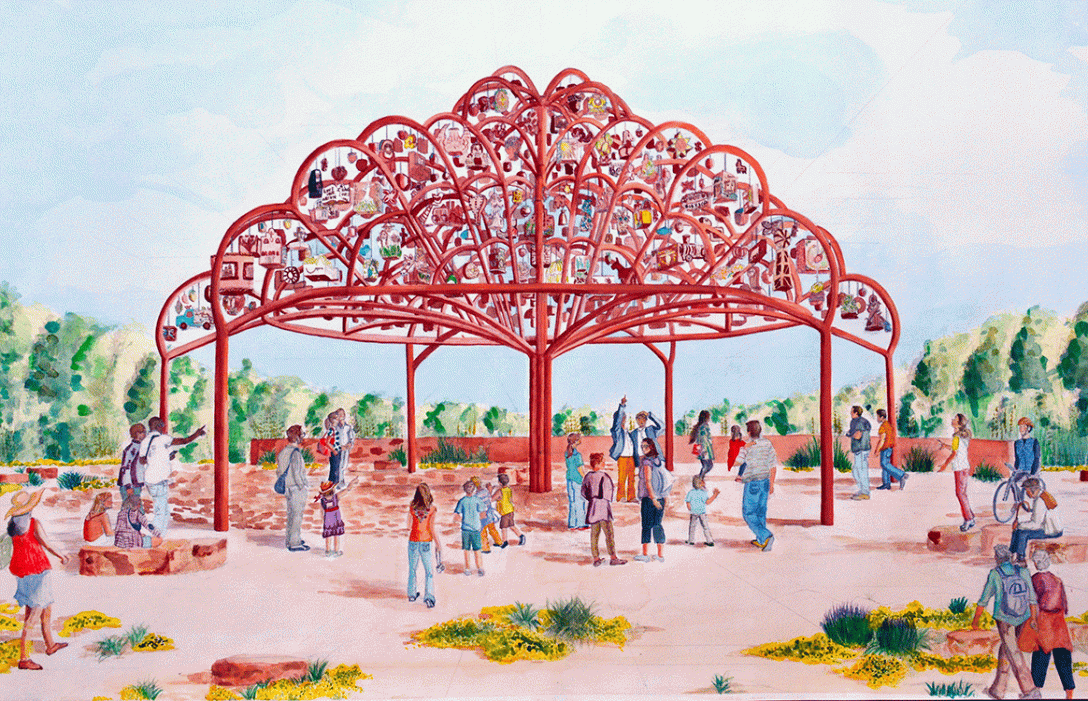
Assigned by the San Antonio River Foundation with the creation of a major work of public art to celebrate the community surrounding Mission San Francisco de la Espada and its strong connections to San Antonio’s ranching heritage, Margarita Cabrera envisioned a tree of life. A tree of life overflowing with fruit. “Arbol de la Vida: Voces de Tierra.”

The origin of colorful trees of life is rooted in Colonial Mexico. Missionaries worked with craftsmen in the Puebla region of Mexico to create clay sculptures to relay biblical stories, often branching upward and outward from Adam and Eve at the base.

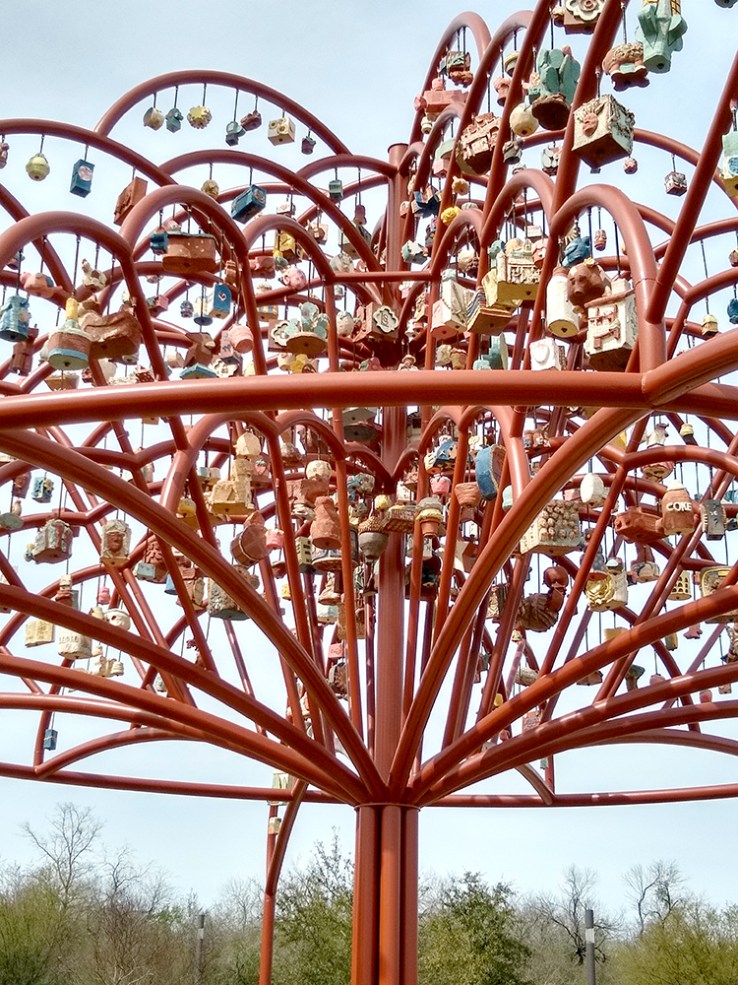
Building on that tradition of rendering stories in clay, Cabrera has collaborated with more than 600 members of the community since May to capture their narrative memories. Workshops were held to help even novices record these chapters of San Antonio’s shared history in slab and coil based clay sculptures. The finishing touches on the final fruits of this labor of love involving so many are being completed in a studio at Mercury Project.

While many of the 700 pieces already have been fired, these photos are of works in progress. After firing, Cabrera says, each piece will be filled with epoxy so that, even if a piece is damaged, the sculpture will remain intact. The average weight of each of the suspended “fruits” will be in the neighborhood of 200 pounds. Serving as a portal linking the Mission Reach of the San Antonio River to Mission Espada, this tree will be immense.

An ostrich-plumed hat perched atop the head of “la patrona” made Rosa Maria Hinojosa de Balli (1752-1803) easy to spot on early Texas cattle drives, according to Merri Gutierrez, one of her descendants. Gutierrez chose to depict the signature hat to represent the story of the daughter of two Spanish aristocrats who was born in Tamaulipas, Mexico. Known as the first cattle queen of Texas, Hinojosa de Balli amassed more than one-million acres of land stretching across five Texas counties. She built chapels at all of her ranches for the ranchhands and served as godmother to more than 300 of their children.

Thelma Ortiz Muraida is crafting a truck to signify the lifestyle of her father, a migrant worker born in Floresville. An artist who has illustrated numerous children’s books, Muraida is enjoying working with the clay. Her father loved to create folk art from found objects, and her great-aunt worked with her husband alongside Dionicio Rodriguez, known for his landmark faux bois cement sculptures. The truck pays tribute to those who work with their hands and their appreciation of and respect for the land. She is filling her truck with family members and the things they would pack up to create a sense of home as they roamed to harvest crops in other parts of the country –  birds, chickens, the pet dog and the guitar her grandmother played.

The meaningful ornaments for Cabrera’s tree are taking shape within the walls of Mercury Project, a network of artists’ studios founded in 2012 by artists and designers Antonia Richardson and Warren Borror in a renovated factory on Roosevelt Avenue. When Borror’s mother first saw the structure, she said, “I know this building.” From 1945 to 1955, the building was the San Antonio home of Clicquot Club Beverages, distinguished by its Eskimo Boy logo. The owner was popular for giving neighborhood kids free ginger ales and root beers, and church socials often were held upstairs. Borror chose that part of Mercury Project’s past to highlight for his contribution to the tree, a Clicquot bottle cap.

But the scallops of the edge of the bottle cap reminded the fifth-generation San Antonian of another part of both the city’s and his family’s past. The flip side of the cap will represent the cranks for a bicycle chain. His family has a photo of his great-grandfather in San Antonio’s first bicycle parade in 1893, and one of his great grandfather’s sons operated Ullrich’s bicycle shop where La Frite is today. While relating some of the city’s early bicycle history, Borror also is celebrating San Antonio’s increasing transition into a bike-friendly city.

So, staring up at 700 individual clay sculptures, how will anyone glean the stories behind them? There will be an app for that, says Cabrera. After firing, each piece will be photographed on all sides and will be accompanied by narrative from the community storytellers.

While shading people below, this tree will be an incredible place to play “I Spy.” The bountiful tree of life will stimulate viewers’ memories, encouraging multi-generational sharing, reviving San Antonio’s rich oral tradition often drowned out by contemporary media.

Harvesting the tales hanging above will take multiple visits to the story-telling tree. I sure hope this magical tree comes with a couple of rocking chairs below for grandparents to hold their grandchildren in their laps while telling them about life when they were young.

February 23, 2019, Update: Tales told through clay are bursting into bloom as the “Arbol” nears completion.

Postcard from Mexico City: Opulent Art Nouveau facade contrasts with revolutionary murals housed within

Dear Mr. Rivera:

While I was in the No. 1 building at Rockefeller Center yesterday viewing the progress of your thrilling mural, I noticed that in the most recent portion of the painting you had included a portrait of Lenin. The piece is beautifully painted, but it seems to me that his portrait, appearing in this mural, might seriously offend a great many people. If it were in a private house it would be one thing, but this mural is in a public building and the situation is therefore quite different. As much as I dislike to do so, I am afraid we must ask you to substitute the face of some unknown man where Lenin’s face now appears.

You know how enthusiastic I am about the work which you have been doing and that to date we have in no way restricted you in either subject or treatment. I am sure you will understand our feeling in this situation and we will greatly appreciate your making the suggested substitution.

Letter from Nelson A. Rockefeller, May 4, 1933

Halted as he was at work last night on his scaffold in the Great Hall of the seventy-story RCA Building in Rockefeller Center, Diego Rivera, the celebrated Mexican mural painter whose communistic leaning have frequently enveloped him in controversy, was informed that the fresco on which he was engaged, and which he had regarded as his masterpiece, was no longer acceptable to the Rockefeller family.

Turning sadly with a few of his assistants and devoted friends to his “shack” on the mezzanine of the building, Senor Rivera found that his telephone had been cut off. He also found awaiting him a letter from Todd, Robertson & Todd, enclosing a check for $14,000, completing payment in full of the $21,000 he had been promised for three murals.

The letter expressed regret that Senor Rivera had been unable to come to some compromise on the paintings and said that the check was to be regarded as terminating his employment, although none of the three panels for which he had been contracted had been finished.

A crowd of about 100 art students and other admirers of the painter previously had been ushered from the hall by representatives of Todd, Robertson & Todd, the managing agents on behalf of John D. Rockefeller Jr., and mounted and foot police were on duty outside the building to prevent any demonstration when Senor Rivera was called away from his work.

No demonstration materialized immediately, but about 10 o’clock, two hours later, between 75 and 100 men and women sympathizers of the artist paraded in front of the building, shouting “Save Rivera’s art,” and “We want Rivera.” They carried banners on which similar sentiments were emblazoned.

The police and fifteen uniformed attaches of the building made no attempt to interfere as the demonstrators marched around the building three times. But on their last round they gathered in Sixth Avenue between Forty-ninth and Fiftieth Streets, blocking the sidewalks, and were ordered to disperse by the police.

Booing and jostling the policemen, the demonstrators refused. A crowd of waiting taxicab drivers took the side of the police, and a free-for-all fight developed. The policemen, brandishing their nightsticks, rushed into the crowd, which resisted until two mounted patrolmen charged into their midst. Then they fled….

With an air of resignation rather than bitterness, Senor Rivera described in his broken English his design for the mural which, covering a space sixty-three feet long and seventeen feet high, was to have depicted “human intelligence in control of the forces of nature.” A sketch of it had been shown to the Rockefeller family and approved by them, Senor Rivera said….

But when the actual painting began objection was raised, he said, to a figure of Lenin joining the hands of a soldier, a worker, and a Negro, which was to have topped the painting. In the background were crowds of unemployed.

Senor Rivera said that he had been told that Mr. Rockefeller and his advisors did not find the mural as “highly imaginative” as they have expected it to be, and that its effect was unpleasant. They also objected to the brilliant colors in the background, he said.

“Rockefellers Ban Lenin in RCA Mural and Dismiss Rivera,” The New York Times, May 10, 1933

Rockefeller Center canceled its $21,000 investment in a fresco by Diego Rivera by destroying the offending mural over the week-end.

Yesterday, when the news became known, protest meetings were called and John Sloan, president of the Society of Independent Artists, urged an artists’ boycott of Rockefeller Center and announced that he would never exhibit there….

“If this vandalism had been committed last May immediately after Rivera was dismissed from Rockefeller Center, it might have been condemned as ‘art slaughter’. My verdict now is that it is premeditated ‘art murder’.”

“Rivera RCA Mural Is Cut from Wall,” The New York Times, February 13, 1934

In hindsight, it seems an obvious train wreck waiting to happen. The strident politics of Diego Rivera, often figuring prominently in his work, were the polar opposite of those of his client, a family symbolizing the massive wealth that could be accumulated under the banner of capitalism.

What was censored in the staid and stable El Norte, however, was embraced by its neighbor to the south, a country whose history was crowded with wave upon wave of successive revolution. A country where rising to the presidency often turned into a death sentence.

Mexico welcomed the rejected design. Diego Rivera recreated the work in the new Palacio de Bellas Artes in Mexico City. His enormous murals and the possibly even more controversial ones completed inside by Jose Clemente Orozco and David Alfaro Siqueiros stand in sharp contrast to the elegantly proportioned Art Nouveau palace.

The construction of the Bellas Artes itself reflected tumultuous times. President Porfirio Diaz first commissioned Italian architect Adamo Boari in 1904 to design an opulent new home for the National Theatre of Mexico for the centennial celebration of the Mexican War of Independence in 1910. The soft subsoil led to issues with sinking soon after construction began, but the project was completely stalled out by the time of the 1913 overthrow and assassination of Francisco Madero.

Much of the original Neoclassical and Art Nouveau exterior design favored by Boari was retained when construction resumed in 1932. But architectural styles had evolved during the lapse, and Mexican architect Federico Mariscal transformed the interior into a celebration of Art Deco detailing. When the doors finally opened in 1934, the Bellas Artes also embraced the inclusion of works by some of Mexico’s greatest muralists.

The political, satirical and even violent revolutionary images apparently need not be feared by government leaders. Every president of Mexico since 1934 has survived to complete his six-year term in office.