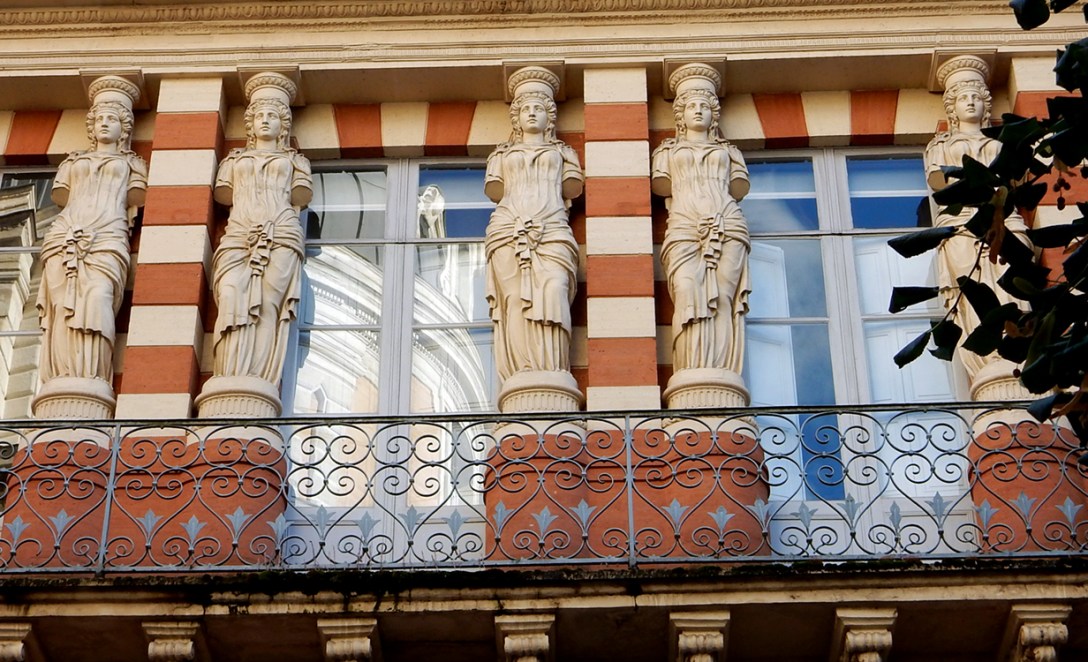
Postcard from Toulouse, France: How to fall in love, one quirky detail at a time

Above: 19th-century molded terracotta caryatids

Walk and walk. And, even at the risk of stumbling, always look up. The rewards are rich, and you will be smitten.

An architectural embellishment I’ve never noticed elsewhere is the frequent usage of lacy, “picado” metalwork at the top of windows in Toulouse. Hoping someone will provide a proper term for this or know of other places it is found. Sometimes the wrought-iron designs on balconies echo those patterns, and often elaborate wrought-iron railings meticulously match the carved or molded work adorning the buildings. And the contrasting patterns of brick and stone are striking and distinctively Toulouse.

These architectural details range about six centuries or so in age, but this randomness represents how they are encountered around the city.

Continue reading “Postcard from Toulouse, France: How to fall in love, one quirky detail at a time”

Postcard from Toulouse, France: A basilica with great bones

Above: Reliquary in the Basilica of Saint Sernin

Most people reading this headline would assume I’m talking about religious architecture, but those definitely are not the only bones on my mind. This does not mean that the architecture of the Basilica of Saint Sernin is not amazing; it is. So, we’ll just get those bones out of the way first.

Continue reading “Postcard from Toulouse, France: A basilica with great bones”

Postcard from Toulouse, France: A far from humble home for city’s leaders

Above: Under renovation this past fall, the distinctive pink brick Neoclassical facade of the Capitole stretches across the entire eastern side of an impressive plaza.

The city government of Toulouse has headquartered itself on the same expansive plaza since the 12th century.

In the early 16th century, the people of Toulouse lived in fear of invasion by Spanish forces under the flag of King Charles V (1500-1556). The threat was ongoing because Charles V was at constant war somewhere on the continent as he tried to defend his multiple titles in a far-flung Hapsburg Empire. Charles simultaneously was King in Germany, King of Italy and Emperor of the Holy Roman Empire. This powerful threat inspired city leaders to build what is now the oldest remaining governmental portion of its Capitole compound, a brick tower designed to protect the city’s archives and gunpowder. The tower often is referred to as Le Donjon, or The Keep. Le Donjon’s centuries newer belfry was added by the architect known for remodeling Notre Dame in Paris, Eugene Viollet-le-Duc (1814-1879).

Continue reading “Postcard from Toulouse, France: A far from humble home for city’s leaders”