

Like a lump of coal in your Christmas stockings, I’m writing this for the next generation: Cecil, Bill, Lawrence, Tarrall and Kate.
I don’t mean to be a bah-humbug type, but it’s a lot worse for your mothers and me. We grew up told we were Indian princesses, the 13th-great-grandchildren of Pocahontas (Pocahontas “Rebecca” Powhatan Matoaka Rolfe, 1595-1618). I don’t think we promised you that you are the 14th with the same degree of certainty.
But we were told this by your Great-Great Aunt Mary (Mary Virginia Williams, 1894-1967), a rather intimidating Victorian-type woman whom we did our best not to cross and who, thank goodness, has no idea that we produced offspring who might pronounce her title as “Ant” Mary.
As long as she was alive, no one challenged her story to her face. And would she lie? Well, maybe, if it were something she viewed as extremely important, such as qualifying for the Daughters of the American Revolution.
Diluted through generations, Pocahontas never could provide enough Native American blood to qualify for scholarships, but she added something exotic to our ho-hum English-Irish combative combination.
But it’s time to strip that false heritage away once and for all.
Your Great-Great Aunt Mary fudged, or her “professional” genealogist did. The shortcut to Pocahontas they took was through Elizabeth Bernard in the 1700s. While we have an Elizabeth Bernard, the one they claimed was married to John Lambeth, Jr. (1726-1813, your 6th-great-grandfather) actually was married to Philip Gooch.
The line of our Elizabeth Bernard (1750-1796) definitely takes us back to daughters and sons qualifications, which I don’t think any of us have considered tapping into, but not to Pocahontas. If you are related to Pocahontas, it’s not direct. At most, Pocahontas might be something more like the 4th-great-grandmother of your 1st-cousin 6-times removed.
You are losing Pocahontas, but, hey, there are a ton of people (many fudging like Aunt Mary) who claim to be her descendants. Instead, it’s time to put away your moccasins and embrace your Spanish blood.
Yes, it’s true, or possibly true, you have Fernandez blood lurking in your veins. And that was a pretty rare infusion in Virginia in the 1800s.
A remote cousin who I have never met and I both have come to this conclusion. Her leap might be based more on fact than mine, and, if it’s wrong, I’ll blame her.
But we think your 4th-Great-Grandfather, Nicholas Marshall Tarrall (1809-1852), married Ann Biddle Fernandis (1815-1884). Ann and her brother Joseph P. Fernandez (1817-1876), a shipmaster before the Civil War demoted to a watchman afterwards, lived in Norfolk, Virginia, but were born in Maryland. Ann Fernandis was christened in Saint Paul Protestant Episcopal Church in Baltimore. Alas, poor Joseph drowned in the Norfolk Harbor.
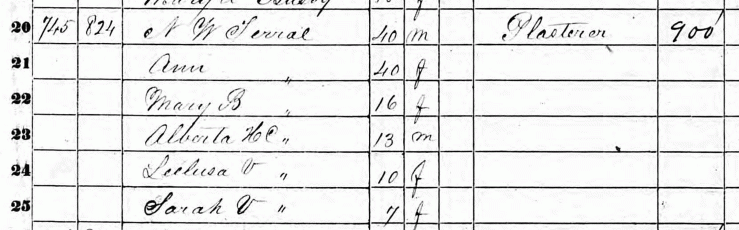
Now these Spanish roots might be part of Aunt Mary’s disapproval of Grana’s background, your great-grandmother (Thelma Virginia Tarrall Williams, 1899-1999), but the joke might be on Aunt Mary. We’re not positive when our Fernandis ancestors first set foot on American soil, but there were not many around and only a handful living in Maryland.
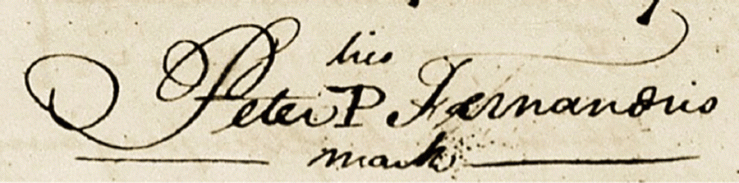
Pedro, or Peter, Fernandise (1652-1736) was born in Valenciana, Spain, and died in Marbury in Charles County, Maryland; although his body has gone missing. Two of his sons served in the American Revolution. I’m hoping they represent our Fernandez roots. If so, Pedro might be your 7th-great-grandfather.
Sorry about Pocahontas, but paella is part of your past. So put on some flamenco music for the holidays, stamp your feet and douse your pasta with extra olive oil. Olé!


 Postcards from Barton Springs