Visit those quiet little missions before the reenactors remember the Battle of Espada

One of the nicest features of the Mission Reach of the San Antonio River Improvements Project is that it invites you to visit the missions strung along the banks of the San Antonio River.

And not just the first two you normally take visitors from out of town to see before you get missioned-out and head for margaritas.

But the oft-overlooked San Juan Capistrano and San Francisco de la Espada, which, true confession, the Mister and I had not seen for at least two decades (but, true confession, not as long as it’s been since my last confession). Their histories easily can be found online, so I will not attempt to rewrite. This post is simply meant to entice you through pictures to rediscover what we tend to forget on the south side of town.

This slideshow requires JavaScript.

Mission San Juan Capistrano was founded in 1716, with much of the mission compound not completed until 1756. San Juan himself must of have been incredibly pious because he was governor of Perugia, the chocolate capital of Italy, before becoming a Franciscan. However, since chocolate came from the New World, maybe lording over Perugia around the year 1400 was not as flavorful as it would be today.

When the Mister and I made a mid-morning stop at the mission, the information center was staffed by a volunteer from the parish. What was wonderful was that he peopled the mission for us with his own ancestors, photographs of ancestors he did not realize had lived within the protective mission walls until seven years ago. Plus, he told us how a window at each of the missions is positioned to let illuminating rays of light shine on the statues of each one’s patron saint on the appropriate feast day. Clever calculations by the priests; miracles to the Native Americans they were converting.

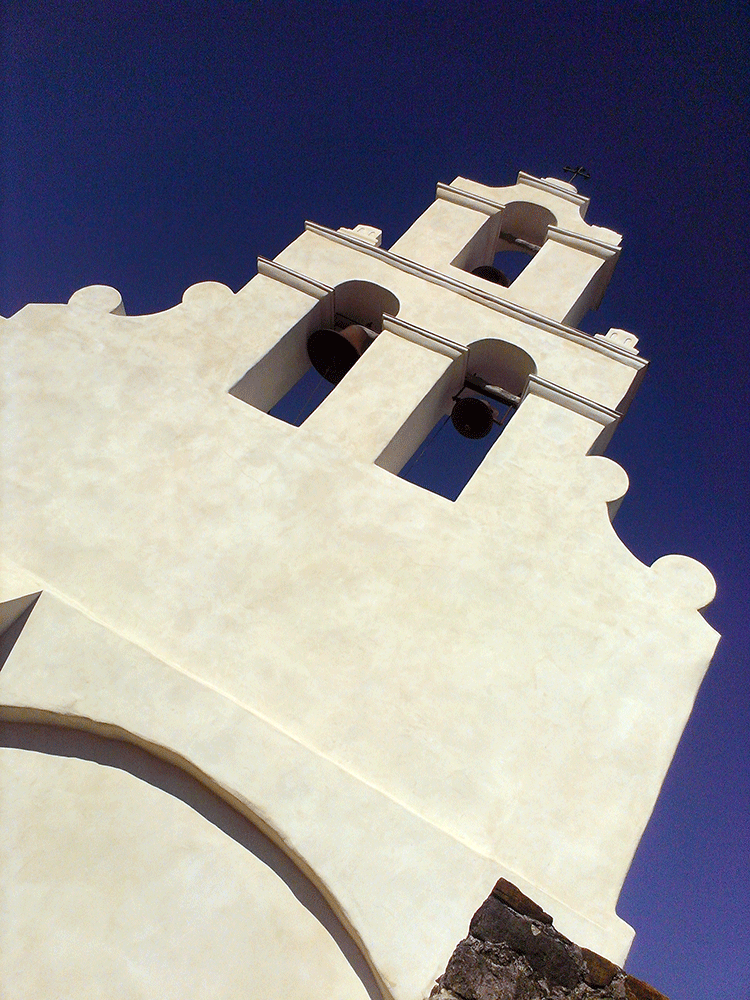
The National Park Service seems proving a good steward of the grounds, and Father David has been applying the funds he has raised successfully through the nonprofit Old Spanish Missions to re-stucco the church for the first time in about 250 years. The church now gleams against the blue Texas sky. Unfortunately, the priest does not keep the same hours as the park, so we did not view the interior. Probably the most reliable time to view the interior is during a scheduled Mass, but I’ll probably stick with more random attempts.

Visiting Mission San Francisco de la Espada should become a more fashionable pilgrimage now with the popular Pope Francis in charge at the Vatican. More attention undoubtedly will be focused on Saint Francis, about whom I have written before in this blog. It would help if San Antonians, including myself, would incorporate the Francisco instead of shortening the name to Mission Espada.

Of course, if the National Park Service really wanted to market Espada to Texans, maybe the thrust of the story should change away from the agrarian and vocational skills the friars taught the inhabitants.

I mean, look at the Alamo. If you make it about guns, they will come, as Land Commissioner Patterson recently showed us.

If more people were aware of the battle fought there in October 1835, Espada would soon be mobbed.

The following is from a report submitted to General Austin by James Bowie and James Fannin following the battle, according to Wallace McKeehan on the Sons of Dewitt Colony Texas website:

Mission of Espadas, Saturday morning 7. oclk AM 24th octr 1835 Genl S F Austin Half an hour since we were attacked by the enmy, who were repulsed, after a few fires being exchanged Only a few men were seen-say about fifty-tho, from the dust etc. it is believed 200 or more, were in the company-Dr Archer says that Col. Ugartichea was the commandant, as he plainly saw him, and recognised him-The place is in a good condition, or can be made so in an hour, for defence, and until we know, of the advance of some aid, or what was intended by this feint, we will continue to occupy this station, where we have provisions enough for the army provided means are supplied to purchase….

If the Alamo attracts millions of visitors to a site where virtually all the Texians were slaughtered, wouldn’t people love to visit the spot where Bowie and Fannin were victorious?

Espada is the spot.

Visit it now. Before the word gets out. While it is still a peaceful place at the end of the Mission Reach.

A place to celebrate the Feast Day of St. Francis on October 4, perhaps even witnessing the rays of light illuminating his statue.

And well before reenactors decide they need to start shooting off noisy guns at 6:30 a.m. every October 24.

Update Added on August 12, 2014: As August 15th brings a solar illumination to Mission Conception in time for the Feast of the Assumption of Mary, an article in Today’s Catholic by Carol Baass Sowa sheds light on the phenomenon that would amaze Native Americans:

It was the Franciscan missionaries’ knowledge of astronomy, he related, that was responsible for the incorporation of solar illuminations in a number of their churches. They served to symbolically communicate the friars’ Catholic faith to the Native Americans, much as medieval churches used stained glass windows to tell the story of Christ and Gothic arches pointed upwards towards highly decorated ceilings to symbolize the heaven men should strive to attain.

Arriving in what was a wilderness, the Franciscan founders of Concepcion had little to work with, Father (David) Garcia explained, so they built into the church the symbols and signs that would tell the indigenous people about God and Christ. “They had a ray of sunshine come in and illuminate the sanctuary,” he said. It was a way to tell the native people “God is moving among us…..”

The friars were highly educated men, (George) Dawson explained, and the Catholic Church used churches as solar observatories since the 15th century as a means to figure out such things as when Easter fell. Also leading credence to the case for the Franciscans is research on the California missions, which has shown one or two Franciscan priests were in charge of construction for several of the missions there which feature the majority of the solar illuminations….

Mission Espada also has an illumination, he related. On the morning of Oct. 4, the Feast of St. Francis of Assisi, (the Franciscans’ founder), light from the rectangular window on the eastern wall bathes the statue of St. Francis on the altar in a golden glow. Again, there is a duplicate display on March 9, which happens to be the feast day of St. Frances, a woman mystic who died in the 1400s.

Justin Boyd: Squeezing a year’s worth of river meanderings neatly into a box

Sergio Gonzales and Randy Allee of KLRN on location filming Justin Boyd
Sergio Gonzales and Randy Allee of KLRN on location filming Justin Boyd

The river is an amazing resource.

Justin Boyd

How do you take the essence of something as sweeping as the Mission Reach of the San Antonio River and compress it into a to-go size box?

Artist Justin Boyd does this in a multimedia format incorporating sound and video recordings and natural and manmade found objects in “Days and Days,” an exhibit on display through February 10 at the Southwest School of Art.

Although not as immense as trying to condense a broad landscape into a small box in a gallery, I struggled with adjusting my writing style to a television format in collaborating with the crew at KLRN-TV for this piece for ARTS. Whittling and weaving Justin’s dialogue into a story presented difficult and complicated choices for me, and, in turn, for David Bibbs at KLRN.

Here’s the result on ARTS | January 18, 2013 on PBS.

Although our paths never had crossed, Justin and I walk the same stretch of river often. But he has added new layers to my thoughts – the river representing time and its passage – as I meander southward along the river’s banks.

While celebrating the restoration of the Mission Reach as part of the San Antonio Improvements Project, Justin’s art is conscious of the litter man continually discards:

The impact we have as humans on the landscape…. This impact is so heavy…. Manmade objects are sitting right next to natural objects….

When you are down here everyday, you can’t help but reflect on how we are affecting our landscape.

January 28, 2013, Update:

The photo above was shot at the point where the waters of San Pedro Creek (left) join the San Antonio River. The San Antonio River Foundation recently announced, according to the San Antonio Express-News, the commission of a pair of designers from the firm of Ball-Nogues Studio to design amenities for this point, to be known as Confluence Park:

With vague hopes of developing “some type of gathering place for the community,” the foundation spent about $300,000 on the park site several years ago and deeded it to SARA, said foundation executive director Estela Avery, wife of James Avery.

Plans gathered steam late last year, after Ball-Nogues Studio was invited to offer designs. The award-winning studio has created installations around the world that meld art and function, including works in California, New York, France, Italy and Hong Kong.

In recent months, designers Benjamin Ball and Gaston Nogues have collaborated with local water experts, botanists and others to create tentative concepts for the site at 310  W. Mitchell St.

“We’re working with an idea for a pavilion that will be enshrouded in vegetation, that’s also three windmills,” Ball said.

“We also have some features we’re calling ribbons, which are a man-made geology for the site. We’re trying to create some sense of discovery when you’re moving through the site so that you’re creating different vistas, different moments,” he said.

Added Nogues, “There’s going to be quite an extensive rainwater catchment system, which is going to mimic a cistern.”

Nogues appreciates the river restoration, noting that the Los Angeles River “suffered a similar fate” as the San Antonio River when its natural channel was lined with concrete decades ago. Most concrete has been removed here in the past few years during the river’s ecosystem restoration.

“It’s really an inspiration for what the Los Angeles River could become as  well,” Nogues said.

Foundation interim project manager Stuart Allen said design details are pending, but the park’s purpose is firm.

“We want this park to be a really unusual destination,” Allen said.

“It’s going to be a park geared toward teaching about ecosystems, sustainable living, water transport mechanisms and watersheds. The park will be designed around forms that collect water and direct them to an underground cistern. The water will be recirculated back into the park.”

confluence-parkl

Fundraising received a major boost from a gift of $1 million for an educational endowment fund from James and Estela Avery.

January 31, 2013, Update: Nancy Cook-Monroe writes about Confluence Park and the announcement of the Avery gift to the River Foundation:

This one, with a water catchment system, solar panels and windmills, will be all about teaching sustainability, stewardship and environmental science. Its centerpiece will be an artistically designed educational pavilion. Other elements will be laced with double meanings, such as a “foraging fence.”

“It doesn’t keep neighbors out but invites them to enjoy decorative and  edible plants,” said planning architect Gaston Nogues of Ball-Nogues Studio in Los Angeles.


Saplings to Shade the Next Generation

Reports from Spanish missionaries exploring what was then northern Mexico almost 300 years ago described a river with lush, tree-lined banks. Native Americans, who called the land Yanaguana, valued these trees for much more than shade from the brutal summer sun. Trees provided wood for fuel and tools and bark for medicinal purposes. Brasils, Mexican plums and persimmons all provided fruit, and pecans and walnuts provided food that could be stored for months. 

The much maligned, homely honey mesquite tree was among the most useful. The hard wood could be hewn into tools or musical instruments; the gum and bark served as an antiseptic. While the tough seeds were discarded, the blossoms and pods were eaten. But don’t expect mesquite pods to be the next gastropub trend in the locavore movement. According to Texas Beyond History:

The Cahuilla utilized mesquite in three different forms – blossoms, green pods, and dried pods. Blossoms were collected and either boiled or roasted on heated stones, squeezed into balls, and consumed. Green pods were pounded into a juice using a mortar and pestle. Most of the harvest probably was pounded into meal using a mortar and pestle. The meal was moistened with water, then allowed to harden into flatcakes a few inches thick. It was stored in this form, but often bruchid beetle eggs would hatch and the cakes would become infested with larvae (Bean and Saubel 1972). The Pima, at least, are on record as saying that the larvae simply added some zest to the meal. Informants said that the pods could be consumed without any preparation by breaking them into small pieces and chewing them (Russell 1908).

While the area off Avenue A adjacent to the River Road neighborhood provides a glimpse of what the river might have looked like in its natural state, the recently opened stretches of the Mission Reach of the San Antonio River Improvements Project are virtually treeless. 

Flood-control projects of years ago were single-minded; trees impeded flood waters so were removed leaving a barren flood channel. Native grasses and wildflowers planted the past several years as part of the San Antonio River Improvements Project have improved that landscape dramatically, but 100-degree summer days cry out for shade.

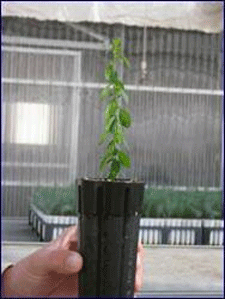
My grandmother always said, “Little acorns grow into tall trees;” although she was reassuring a young girl she would one day blossom bosoms. And in greenhouses and fields outside of Lubbock, the Texas Forest Service is nursing acorns and those pesky Anaqua seeds that embed themselves in the ridged valleys of my walking shoes into a huge crop of saplings to shade the next generation hiking along the banks of the San Antonio River. 

In November, crews from the San Antonio River Authority will begin planting 3,000 saplings ranging in height from a few inches to a few feet in the first phase of the Mission Reach. Depending on the species – including cedars, willows, cypresses, cottonwoods, elms, Mexican sycamores, possumhaws and redbuds – the trees will take from 10 to fifty years to reach full maturity.

To provide a preview of some of the native trees soon to grace the banks, the San Antonio River Foundation worked with the Parks and Recreation Department of the City of San Antonio to plant 15 trees at Roosevelt Park by Mission Road. The trees were planted in honor of the hard work of the volunteers on the San Antonio River Oversight Committee who have shepherded the project along through the years. This anaqua sporting a Treegator skirt, slowly releasing water to nourish the roots through the drought, is among them.

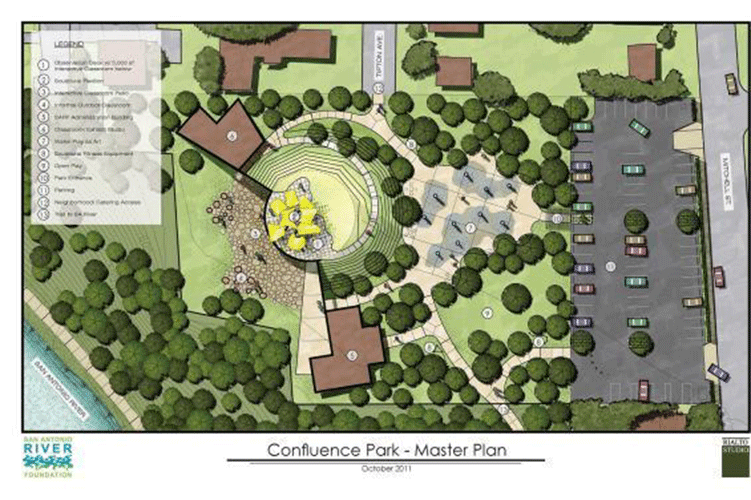
The River Foundation will be sharing saplings for you to take home and plant from 4:30 to 6 p.m. on Thursday, October 20, at Confluence Park, 310 West Mitchell. In addition a free tree, you will be able to view the Master Plan for this neighborhood park reestablishing the historical connection from the river to Mission Concepcion.

And, the best news: By the close of 2015, the River Authority will have planted another 20,000 trees along the Mission Reach. The next generation might not even need to wear sunscreen on morning walks.

January 24, 2012, Update: Want to add this link to another blogger’s recent post about plantings along the Mission Reach.