Postcard from Rome, Italy: Church tour for the fleet of foot

No time to pause for even the slightest genuflection in this lightening-fast tour of more than a dozen churches in Rome.

You might think this blog has dragged you through every single church in Rome, but, no. One could spend a year visiting a church a day without exhausting that supply. Rome is divided into 339 parishes, and there are close to 70 basilicas within the city. Probably all are worth ducking into for a visit.

But, mercifully, our tour stops here.

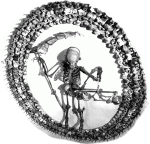
On this whiplash final lap, am going to point out two major relics of the type upon which most American Catholics never lay their eyes. The reliquary above is said to contain “the first foot to be entered in the tomb of Christ,” that of Mary Magdalene enshrined in the Basilica di San Giovanni dei Fiorentini. And the other is a portion of the head of Saint John the Baptist housed in a chapel in the Basilica di San Silvestro in Capite.

I wonder whether anyone ever has developed a scavenger hunt for spying saintly parts tucked away in nooks and crannies in churches in Rome.
A shortcut to encountering a massive number of bones, if one is so inclined, is to seek out the Capuchin Museum and Crypt tucked under Santa Maria della Concezione. The church was commissioned in 1626 by Pope Urban VIII (to whom you were introduced during my “wild things” museum meltdown) in recognition of a relative who was a Capuchin friar, Cardinal Antonio Barberini. Cardinal Barberini had the remains of thousands of his Capuchin brethren transferred to the crypt, which provided monks with a creative side unusual materials for their assemblages.

The museum offers a rather dry history of the Capuchin order, somewhat interesting if not for the macabre magnetic pull of the crypt you know lies on the far side. I doubt much has changed there since Mark Twain’s visit long ago, so I will let him describe the interior:

There were six divisions in the apartment, and each division was ornamented with a style of decoration peculiar to itself – and these decorations were in every instance formed of human bones! There were shapely arches, built wholly of thigh bones; there were startling pyramids, built wholly of grinning skulls; there were quaint architectural structures of various kinds, built of shin bones and the bones of the arm; on the wall were elaborate frescoes, whose curving vines were made of knotted human vertebrae; whose delicate tendrils were made of sinews and tendons; whose flowers were formed of knee-caps and toe-nails. Every lasting portion of the human frame was represented in these intricate designs (they were by Michael Angelo, I think,) and there was a careful finish about the work, and an attention to details that betrayed the artist’s love of his labors as well as his schooled ability. I asked the good-natured monk who accompanied us, who did this? And he said, “We did it” – meaning himself and his brethren upstairs. I could see that the old friar took a high pride in his curious show. We made him talkative by exhibiting an interest we never betrayed to guides.

“Who were these people?”

“We – upstairs – Monks of the Capuchin order – my brethren.”

“How many departed monks were required to upholster these six parlors?”

“These are the bones of four thousand.”

“It took a long time to get enough?”

“Many, many centuries.”

“Their different parts are well separated – skulls in one room, legs in another, ribs in another – there would be stirring times here for a while if the last trump should blow. Some of the brethren might get hold of the wrong leg, in the confusion, and the wrong skull, and find themselves limping, and looking through eyes that were wider apart or closer together than they were used to. You can not tell any of these parties apart, I suppose?”

“Oh, yes, I know many of them.”

He put his finger on a skull. “This was Brother Anselmo – dead three hundred years – a good man.”

The Innocents Abroad, Mark Twain, 1869

And, as this is a whiplash tour of churches, our friend Chris’ seconds-long forbidden video recording of the interior seems appropriate.


I asked the monk if all the brethren upstairs expected to be put in this place when they died. He answered quietly:

“We must all lie here at last.”

The Innocents Abroad, Mark Twain, 1869

Catholicism remains a religion of many mysteries, even for someone who was raised as one, particularly during the years when mass still was said in Latin. Like, when near the end of the service, the priest would talk about Nabisco crackers: “Dominus vobiscum.” “The Lord be with you,” lost in translation between the priest’s lips and my ears.

Postcard from Rome, Italy: A literal definition of a marriage made in heaven

But bright Cecilia raised the wonder higher:
When to her organ vocal breath was given,
An angel heard, and straight appeared
Mistaking Earth for heaven.

“A Song for Saint Cecilia’s Day,” John Dryden, 1687

Music the fiercest grief can charm,
And fate’s severest rage disarm:
Music can soften pain to ease,
And make despair and madness please:
Our joys below it can improve,
And antedate the bliss above.
This the divine Cecilia found….

“Ode on Saint Cecilia’s Day,” Alexander Pope, 1708

Some time in the first or second century, the daughter of a wealthy family in Rome was betrothed to a young pagan. A Christian, Cecilia was dragging her feet about entering into the arranged marriage, fasting and pleading with God and the Virgin Mary to help her preserve her virginity. Definitely not the vow a prospective groom envisions.

As the musicians played at the feast celebrating the wedding, Cecilia stared upward, focused on serenading the heavens with the song in her heart. Valerian, the groom, was miraculously understanding when she explained her wedding night plans to him did not include consummation of their marriage.

Cecilia claimed she had an angel protecting her. A little suspicious, he asked for proof. She directed him to the third milestone on the Appian Way and to be baptized by Pope Urban I (died in 230). Valerian complied and, upon his return, saw her guardian angel with her, crowning her head with roses and lilies. In addition to his religious conversion, he accepted her vow of chastity.

Valerian’s enthusiasm was so great, his brother followed suit. Christianity was far from the official religion in Rome at the time, so Valerian and his brother busied themselves gathering the bodies of executed Christians and providing them with burials. This chore kept them quite occupied until their dedication attracted too much attention, and they themselves became martyrs.

Cecilia then threw herself more fervently into spreading the word, converting more than 400 pagans to the still somewhat new religion. Until…

… you know where this is leading, she attracted attention of those in power. But Cecilia’s angel did not let her succumb quickly to the efforts to dispose of her. First condemned to death by “spa,” she was locked in the baths with the heat and steam stoked up unbearably high. She emerged unfazed, so a more direct approach was taken.

Chop off her head. The executioner swung his axe three times. Despite profuse bleeding, her head remained in a semi-attached state. This afforded Cecilia time to make arrangements to distribute any remaining wealth to the poor and to donate her home in Trastevere for a church. Pope Urban I complied.

In the 800s, Pope Paschal I rebuilt the church. Desiring to locate Saint Cecilia’s remains and transfer them to her church, the pope searched the catacombs. After a vision, he finally located them and those of her husband and brother-in-law. Saint Cecilia’s original robes, blood-soaked, were at her feet; she was clothed in gold. All three bodies were moved to the church.

While the mosaic in the apse from that period survives, much remodeling followed. Fast forward to the 1500s, Cardinal Niccolo Sfrondrato (1535-1591), later becoming Pope Gregory XIV, was trying to confirm the location of the remains of Santa Cecilia.

Workers uncovered a marble coffin and opened it in front of the cardinal and, even more conveniently, sculptor Stefano Maderno (1576-1636). And there she was. Santa Cecilia incorrupta. The first Catholic saint recorded as emerging in this totally preserved state, further demonstrated by the fact that she had rolled over to a more comfortable position on her side.

Word spread like wildfire in Rome, and the cardinal was fortunate to escape being crushed by the crowds eager to view their patron saint of music, still cloaked in golden cloth. Maderno recorded this miracle by sculpting a realistic depiction of her body for the altar. But her actual body was reinterred elsewhere in the church.

The Mister is wise. A sign on the left side of the church offered entrance to the basement for a couple of euros, and he said, “Never turn down an invitation to visit the crypt.” And he proved so right.

Down underneath the church are ancient crypts and the remains of an old tannery, but then you stumble into a magical space. Arcades and walls covered with glittering mosaics heralding Saint Cecilia’s final resting place.

The Mister’s fingers seem to be gliding across his travel guitar’s strings more effortlessly ever since.


Postcard from Rome, Italy: Palace reflects vestiges of papal perks

It has never been easy to obtain first-class relics worthy of designing a gilded chapel around, but it certainly helped to have a pope in the family.

Among the prizes contained in reliquaries in Palazzo Doria Pamphilj are “the perfectly preserved remains,” according to the website, of Saint Theodora. We are not sure which Theodora, but this one, before final martyrdom I assume, purportedly was spared from a fiery end by flames that parted around her. Stretched out below the chapel altar are the remains of a saintly centurion who, prior to his conversion and martyrdom, served as an imperial guard standing by during the crucifixion of Christ.

The basic structural bones of Palazzo Doria Pamphilj date from 1435, but the Pamphilj family undertook major remodeling during the second half of the 17th century. Later redo’s Rococo-ed things up a bit.

The Doria portion of the family originally was from Genoa, while the Pamphilj branch had roots in Gubbio. Both powerful families, but the glory years of consolidating prime property and accumulating wealth and art in Rome followed the papal inauguration of Giovanni Battista Pamphilj in 1644 as Innocent X (1574-1655). Papal perks awarded to friends and family were chief causes of stormy Vatican politics for centuries.

Pope Innocent X lived in office for more than a decade, a decade during which he presided over the 1650 Jubilee Celebration. Traditionally during Jubilee years of the church, currently held every 25 years:

families were expected to find their absent family members, the Hebrew slaves were to be set free, debts were to be settled and illegally owned land had to be returned to its owners.

“The Jubilee Year,” www.vatican.com

In honor of the Jubilee, Pope Innocent X added opulence to St. Peter’s and, for the public, made Piazza Navona the incredible landmark it remains today. He moved an immense Egyptian red granite obelisk of Domitan there and commissioned artists of the caliber of Gian Lorenzo Bernini (1598-1680) to add ornate Baroque fountains.

But wait, was that project for the public good or for the pleasure of the Pamphilj family whose palazzo happened to be located there? The family who would flood the plaza to float boats for elaborate summertime parties? No matter now, it is a stunning, if ridiculously overcrowded, public space.

Among the major paintings included in the palazzo’s collection is a portrait of Innocent X by Diego Velazquez (1599-1660). Some critics regard this portrait as one of the finest in the world; artist Francis Bacon (1909-1992) obsessively turned to reproductions of the painting as the basis for his two-decade series of “screaming popes.”