

Strange to keep referencing my father, Lawrence Conway Brennan (1918-1988), in posts about Italy, but he had several things in common with his namesake saint, Saint Lawrence (225-258). And Saint Lawrence happens to be honored prominently in Genoa where the seat of the archbishop is the Cattedrale di San Lorenzo.
First of all, they were both treasurers, my father of the Columbian Peanut Company and Lawrence entrusted with the treasury and riches of the church by Pope Sixtus II (?-258). Then there is the grill. Valencian-born Saint Lawrence is pretty much always depicted with a gridiron at his side or underfoot and is known as the patron saint of cooks.
My father loved grilling, so much so that I actually grew sick of eating his prized marbled sirloin steaks and still am not much of a steak-eater today. His penchant for medium-rare did carry over to me. My father’s impeccable timing for grilling was governed by when he swilled the last sip of bourbon and water from his highball glass.
The iconography of Saint Lawrence’s gridiron is not as pleasant an association. While sometimes in subsequent centuries assuming responsibility for the Vatican treasury enabled accumulation of great personal wealth, the perks in 258 were not pleasant. Emperor Valerian (200-264) was not fond of Pope Sixtus II and his band. He demanded the Christian clergy perform sacrifices to the Roman gods. Failing to follow his order, Christian leaders were ordered executed.
You might have noticed Sixtus II and Saint Lawrence died during the same year, but Lawrence lived a few days longer. Missed during the initial sweep of those to be beheaded, the treasurer requested a delay of three days to assemble church treasures to “render them unto Caesar.” He rounded up the goods, but, instead of turning them over to Roman authorities, he distributed them to the poor and infirm.
Needless to say, the reallocation of church assets was not received well by the emperor’s minions. A simple beheading was deemed too merciful a fate for Lawrence. A massive gridiron was heated over a fiery bed of hot coals to ensure a slow, sizzling death process for him.
After roasting for a considerable amount of time, legend claims Saint Lawrence piped up with a request: “I’m well done on this side. Turn me over.” A memorable quip meriting his saintly status as a patron of both cooks and comedians.
The impressive 1828 silver reliquary, above, containing some of Saint Lawrence’s unidentified smoked body remnants in its chest, is housed amid a collection of impressive silver and gold treasures housed in a museum under the cathedral in Genoa. Included there is a ceremonial casket for transporting the ashes of Saint John the Baptist, presumably not including his head as we viewed it enshrined in Rome in the Basilica di San Silvestro in Capite, on appropriate church holidays. And displayed also is yet another chalice with claims of being used for Jesus’ final sip of wine at the Last Supper. No wonder the search through the centuries for the “real” Holy Grail has been so convoluted and controversial.


In memory of Saint Lawrence’s sacrifices, the Genoese built an impressive Duomo atop/around the site of several earlier churches. The cathedral was consecrated in 1118 by Pope Galasius II (1060-1119) during his brief year-long papal reign.
Obviously from the photos above, the handsome cathedral underwent numerous major changes through the centuries resulting in layers of different architectural styles.
Perhaps my father’s mastery of the art of grilling was directed by his patron saint perched upon his shoulder? That, accompanied by a little devil perched on his glass urging him not to let those ice cubes melt.


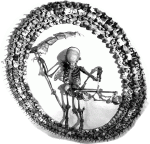 A shortcut to encountering a massive number of bones, if one is so inclined, is to seek out the Capuchin Museum and Crypt tucked under Santa Maria della Concezione. The church was commissioned in 1626 by Pope Urban VIII (to whom you were introduced during my
 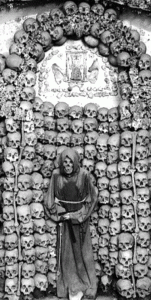 There were six divisions in the apartment, and each division was ornamented with a style of decoration peculiar to itself – and these decorations were in every instance formed of human bones! There were shapely arches, built wholly of thigh bones; there were startling pyramids, built wholly of grinning skulls; there were quaint architectural structures of various kinds, built of shin bones and the bones of the arm; on the wall were elaborate frescoes, whose curving vines were made of knotted human vertebrae; whose delicate tendrils were made of sinews and tendons; whose flowers were formed of knee-caps and toe-nails. Every lasting portion of the human frame was represented in these intricate designs (they were by Michael Angelo, I think,) and there was a careful finish about the work, and an attention to details that betrayed the artist’s love of his labors as well as his schooled ability. I asked the good-natured monk who accompanied us, who did this? And he said, “We did it” – meaning himself and his brethren upstairs. I could see that the old friar took a high pride in his curious show. We made him talkative by exhibiting an interest we never betrayed to guides.


 Postcards from Barton Springs