Postcard from Pontevedra, Spain: Refueling stop for peregrinos

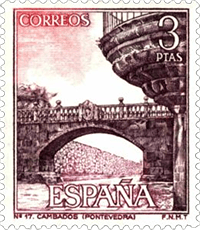
A vintage Spanish postage stamp featuring a bridge over a river, with intricate architectural details and the text 'Correos' and 'España' alongside a denomination of '3 ptas'.

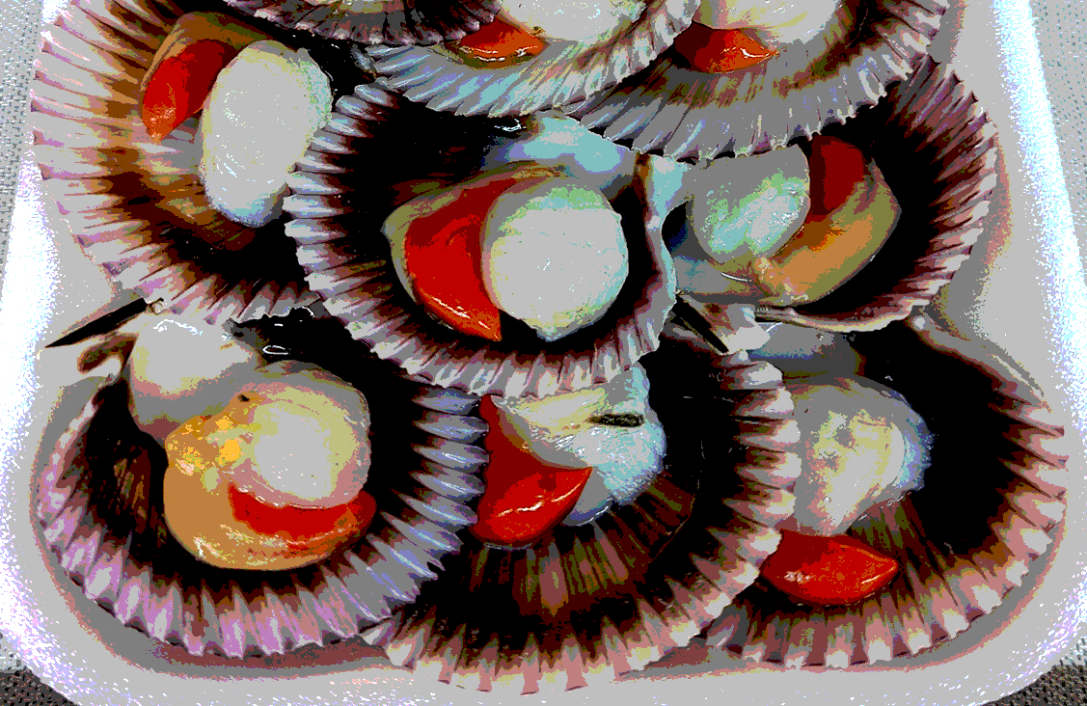
Above: Zamburinas for sale in Mercado de Abastos

During temperate seasons, approximately 280,000 pilgrims strike out on one of the Portuguese routes to Santiago de Campostela, passing through Pontevedra on their way. Pilgrims from around the world walk Camino de Santiago, collecting shell stamps as proof of stops and actual scallop shells as souvenirs. Long ago, it is said these shells served as scoops for food offered at the door of inns along the way.

Myths surround this symbol of Saint James, from his saintly remains being borne ashore at Campostela atop shells to miraculous legends of loved ones who drowned emerging alive from the sea covered in scallop shells. The ridges of the shell symbolize diverse pilgrimage routes, all converging upon Santiago de Compostela.

Whatever the religious symbolism, the zamburinas of the region are famed for their distinctive texture and flavor. Like eggshells for cascarones at Fiesta San Antonio, someone has to empty those shells for the pilgrims. So, we try to do our part by pursuing those delectable Galician zamburinas wherever we can, which translates to every couple of years. (Read about their red “commas” in an earlier postcard sent from Zaragoza in 2022.)

For all of those walkers in Pontevedra arriving tired and hungry yet spiritually recharged, we’ll take a detour before scallops because my alphabetical listing of restaurants dictates it.

Continue reading “Postcard from Pontevedra, Spain: Refueling stop for peregrinos”

Postcard from Oviedo, Spain: Sacred relics attract peregrinos and thieves

Above: Central detail of the main Gothic altarpiece, dating from the early 1500s, in Santa Iglesia Catedral Basilica Metropolitana de Oviedo

He who goes to Santiago and not to the Savior visits the servant and forgets the Lord.”

Back in the year 40, the apostle James was preaching in Zaragoza when the Virgin Mary miraculously floated down on a cloud to assist him with his efforts to convert pagans living under Roman rule to Christianity. Soon after establishing a chapel in her honor, James traveled all the way back to Jerusalem. His preaching incurred the ire of the King of Judea, Herod Agrippa (11 BC-44 AD), who had him beheaded in the year 44. Avenged as, according to Acts Chapter 12, Verse 23, King Herod Agrippa met his maker within the same year:

…an angel of the Lord struck him, because he did not give glory to God. And he was eaten by worms and died.”

The head of Santiago, as James is known in Spain, is said to be entombed below the altar of the Armenian Apostolic Cathedral of Saint James, the church built on the site where he was martyred in Jerusalem. But what became of the rest of his body? As Santiago is the country’s patron saint, let’s go with the miraculous version. A band of angels arrived on a cloud to retrieve it, placed it in a simple boat and guided it to shore in northern Spain.

Continue reading “Postcard from Oviedo, Spain: Sacred relics attract peregrinos and thieves”

Postcard from Burgos, Spain: Pilgrims should indulge in Santiago’s symbolic seafood

Above: Broiled zamburinas, Gallaecian scallops, at La Cantina Burgos

Bronze scallop shells embedded in the streets of Burgos lead pilgrims along the Camino de Santiago route to the Cathedral. The trail of shells conveniently passes right by La Cantina de Burgos, where one can find perfectly prepared grilled zamburinas, Gallaecian scallops. Earlier in this same trip, a blog post explains both the shell’s connection to Saint James and the bicolored anatomy of the bivalves.

Continue reading “Postcard from Burgos, Spain: Pilgrims should indulge in Santiago’s symbolic seafood”