The nuns of Star of the Sea instilled the fear in me long ago. Never touch the host as Father Habit placed it upon your tongue. Suck on it gently, very gently, as you head back to your pew to pray. And, no matter how strong a vacuum it creates adhering it to the roof of your mouth, do not prod it loose with your finger and, never, never, never ever chew it before swallowing.
They insinuated that something major would occur if you violated these rules. I mean major. Like suddenly your whole pew full of people would be swallowed up by the earth or a lighting bolt would flash through the ceiling striking you dead upon the spot. They had me convinced.
Things are different today. God is more tolerant and forgiving; he no longer minds if you touch the consecrated host.
But a miracle in Ferrara left me wondering whether the nuns were wise in issuing their strong prohibitions.
Father Peter of Verona was celebrating mass in Ferrara on Easter Sunday in 1171, when he raised and broke the consecrated host, now the body of Christ. Blood sprayed and splattered upon the vault above the altar. A miracle.
Pilgrims from around Italy flocked to see the bright red proof left upon the ceiling. The church, the Basilica of Santa Maria in Vado, was expanded greatly to accommodate them in 1495, and a special vault was constructed within the sanctuary to safeguard the site.
Alas, I climbed the stairs to examine the bricks but failed to spot the spots. Perhaps that failure is the fate of lapsed Catholics – missed miracles.
On the other hand, maybe those red spots simply are faded. The evidence of the miracle appeared on that vault more than 800 years ago.
Never thought “get thee to a nunnery” had an appetizing sound to it. But Puebla is different.
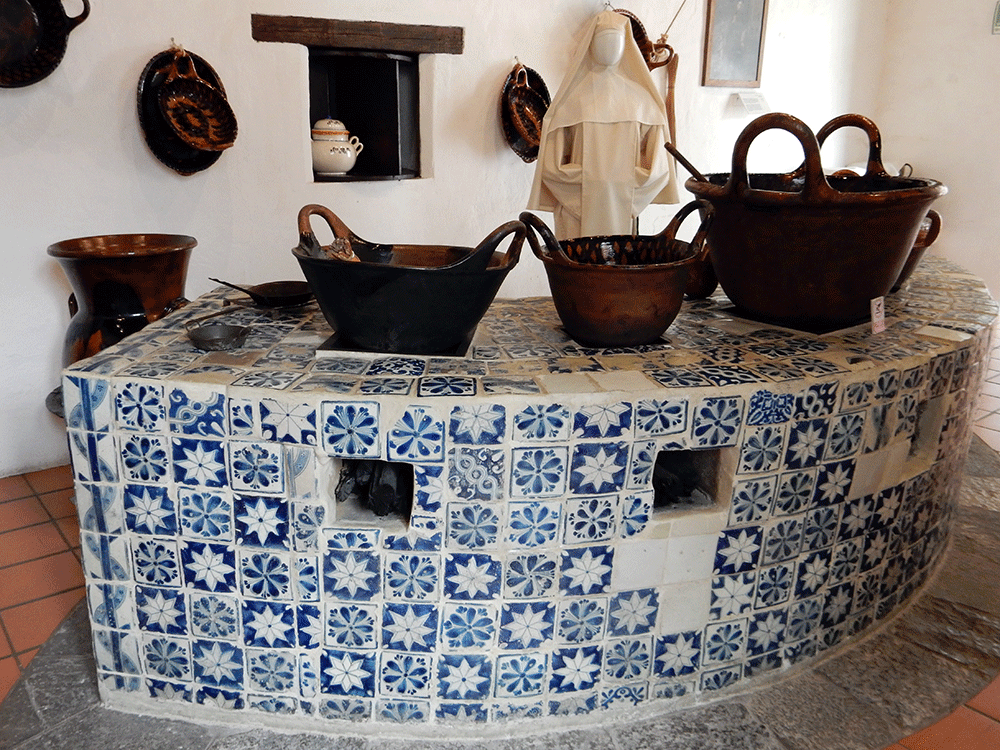
The Talavera-tiled kitchen of the former Santa Rosa Convent is reputed to be the birthplace of the richly flavored mole poblano, and the nuns of the former Convent of Santa Monica are credited with inventing the famous chiles en nogada in 1821 to celebrate Mexico’s newly gained independence from Spain. Reason enough to visit the former convents.
The early history of the building housing the Ex-Convento de Santa Monica is highly unusual. At the beginning of the 1600s, it served as a home for widows and wives whose husbands had abandoned them. Then its role switched as a place to isolate some of the city’s prostitutes; and then the usage seesawed back to a high school protective of young virgin girls in its charge. In the 1680s, it became a convent.
Santa Monica served as a convent for more than two centuries before the nuns had to go underground following the 1917 Constitution of Mexico. The façade of the convent was remodeled to appear as a house, but inside, behind a secret door, a group of nuns remained cloistered.
Supposedly, an antique dealer grew angry when the sisters refused to sell him paintings he desired. Inebriated in a bar, he began complaining about the nuns. A detective overheard him, and the closet convent was raided by police in 1934. The nuns were banished from the premises, and the government converted it to a museum for religious art.
Reviving the city’s reputation for nun-chefs, a new star recently arose in Mexico. Sister Florinda Ruiz Carapia became a fan favorite competing for a cash prize on Mexico’s version of Master Chef. Known as “Hermana Flor,” the humble nun who toils as a cook for seminarians in Puebla, reached the top five. Her popularity only increased because she was striving not for personal gain but to alleviate some of the debts accrued by her order of nuns, according to a story by Mark Stevenson in the San Antonio Express-News.
Perhaps if I tiled my kitchen, I’d miraculously be transformed into a good cook?




 Postcards from Barton Springs