Postcard from Guadalajara, Mexico: The anguish of man battling oppression

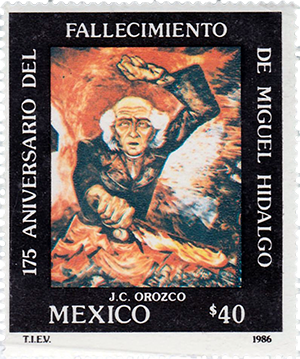
A postage stamp commemorating the 175th anniversary of the death of Miguel Hidalgo, featuring an artistic depiction by J.C. Orozco. The design showcases Hidalgo in a dramatic pose, with vivid colors and expressive details.

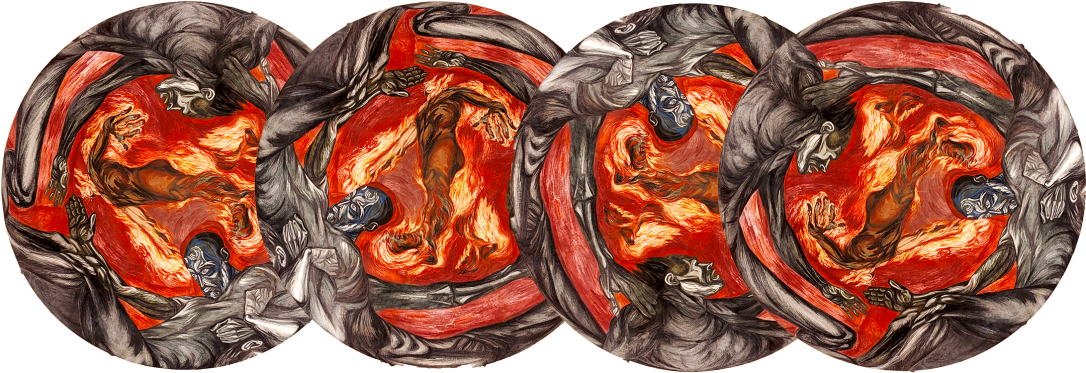
Above: Rotating views of Jose Clemente Orozco’s “Man of Fire” fresco in the dome of Instituto Cultural Cabanas, 1937-1939

An artist is a freedom fighter, fighting for the liberation of the human spirit.”

Jose Clemente Orozco (1883-1949)

At the age of 20, Orozco was in the process of prepping fireworks, when: Boom! He delayed treatment, and gangrene gained hold of his wound. So, his left hand had to be removed, a tragedy that spared him from being drafted into the trenches of the Mexican Revolution.

But the artist did not stand idly as history unfolded; he honed art as his weapon. His art evolved into something stark, dark and boldly modern. His offensive was against all and any institutions that kept the common man in a state of poverty – art meant to shame the rich and privileged and inspire the poor.

Continue reading “Postcard from Guadalajara, Mexico: The anguish of man battling oppression”

Postcard from Oaxaca, Mexico: Always welcome more candles on your cake

This woman’s anxious expression on a wall in Oaxaca is a bit frightening to have surfaced close to my birthday. I’ve decided to consider her as successfully defiant.

Some years are harder than others. The image below of the late Vicente Fernandez did not weather well this past year.

But walls in Oaxaca are everchanging canvases for artists, new discoveries encountered with every walk. As prints peel and fade, other layers soon are plastered over them – palimpsests of life.

Continue reading “Postcard from Oaxaca, Mexico: Always welcome more candles on your cake”

Postcard from Bilbao, Spain: Heart of Basque Country, Vitoria-Gasteiz

Above: Detail of mosaic portion of “Eskuz Esku” in Basque, or “Hand to Hand.” Lead artist John Pitman Weber and assistant Alicia Vallejo Sanz, a 2010 project of Itinerario Muralistico of Vitoria-Gasteiz.

While Bilbao with the Guggenheim and San Sebastian’s Running of the Bulls have made those cities well known in the United States, Vitoria-Gasteiz is the actual seat of government of Basque Country. With a population of about 250,000, the Basque capital lies only 40 miles outside Bilbao. The hyphenation reflects the duality of Spain’s sometimes dueling cultures: Vitoria is Spanish while Gasteiz is the Basque half of its name.

Continue reading “Postcard from Bilbao, Spain: Heart of Basque Country, Vitoria-Gasteiz”